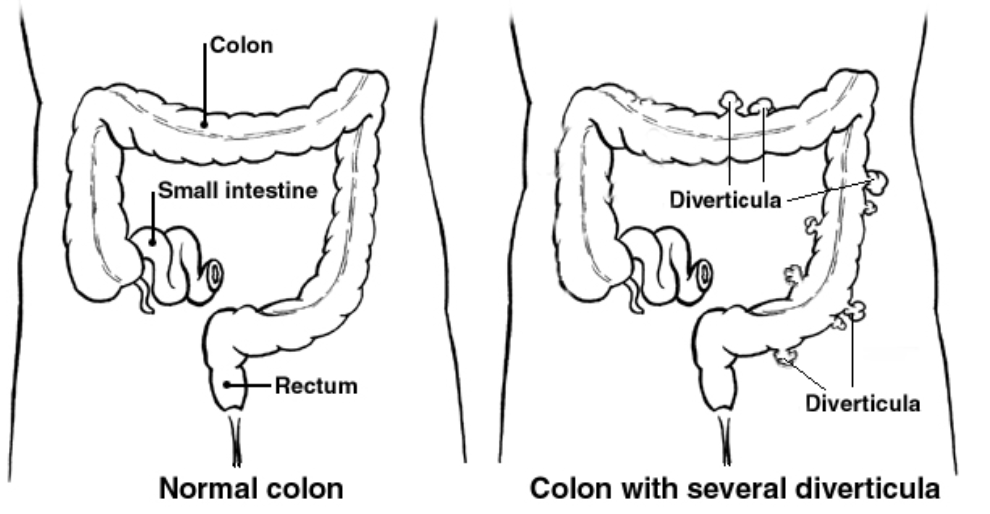
Diverticula
This information is for people with autosomal dominant polycystic kidney disease (ADPKD), their families and friends. It explains problems caused by bulges in the bowel lining, called diverticula. Most people probably don’t have diverticula, but they’re more likely to occur in people with ADPKD than the general population.
Key facts
- Diverticula are bulges or pouches in the lining of the colon (large bowel).
- People with ADPKD might be twice as likely to get diverticula than the general population, but we are not certain.
- Most people with diverticula don’t get any symptoms.
- However, 1 in 5 people with diverticula can get pain, bloating, constipation or diarrhoea. Less commonly, diverticula can get infected or bleed.
- A healthy balanced diet containing lots of fibre can lower your risk of getting symptoms and complications from diverticula.
- Medicines used to treat symptoms include paracetamol for pain, laxatives for constipation, and antibiotics for an infection.
What are diverticula?
As people age, some develop bulges or pouches in the lining of their colon (the large bowel). These dead ends in the bowel are called diverticula (see picture).
Most people with diverticula don’t get any symptoms. However, sometimes people can get symptoms and, less commonly, diverticula can get infected or bleed.
Other terms you might hear are:
- diverticulosis: diverticula that aren’t causing symptoms
- diverticular disease: diverticula causing symptoms
- diverticulitis: infected and inflamed diverticula
How common are diverticula in people with ADPKD?
Most people with ADPKD probably don’t have diverticula. However, people with ADPKD could be twice as likely to get diverticula than the general population. We are not sure of the exact risk because there has not been much research on this.
In a large American study, about 4 in every 100 people with ADPKD had been diagnosed with diverticula previously. This compared with about 2 in every 100 people in the general population.
The true number of people with diverticula may be much higher than this study found. This is because diverticula don’t usually cause symptoms. So, many people probably have them without ever knowing.
Some experts think as many as half the population could have diverticula by the time they’re 50 years old.
Your chance of having diverticula increases with age and when you have reached kidney failure.
If you have questions or concerns about your risk of diverticula, chat to your GP or kidney specialist.
Symptoms
Usually, diverticula don’t cause symptoms. However, in about 1 in 5 people, diverticula can cause symptoms such as:
- abdominal pain (usually on the left side)
- feeling bloated
- constipation
- diarrhoea
- blood in your poo
If a diverticulum gets infected (called diverticulitis) it can cause:
- severe abdominal pain
- a high temperature (38°C or higher)
- blood and mucus (slime) in your poo
If you get symptoms of infected diverticula, see your doctor urgently or contact the NHS for advice on 111.
Diagnosis
You’ll only be tested for diverticular disease if you have symptoms. Screening is not routine in the general population or for people with ADPKD. If you have tests for other bowel problems, these may spot diverticula.
If you have symptoms such as bloating, constipation or diarrhoea, your doctor (GP) might refer you for tests to find the cause.
Tests for diverticula include:
- a blood test
- a test on a poo sample
- a colonoscopy or flexible sigmoidoscopy, for which a doctor will put a thin tube containing a camera through your anus into your bowel
- a computed tomography (CT) scan, which uses X-rays to make images of the inside of your body
Complications
Problems linked to diverticula can include:
- an infection (called diverticulitis)
- an abscess (collection of pus) in the abdomen
- bleeding from the bowel
- a hole in your bowel wall
In a study, 1 in 5 people with ADPKD who had received a kidney transplant got an infected diverticulum (diverticulitis) within 12 years.
If you have high blood pressure or constipation, this may increase your risk of getting problems linked to diverticula.
If you get any of the symptoms we listed earlier, see your GP.
Treatment
There is no cure for diverticula. Changes to diet and medicines can help to prevent and manage symptoms.
Management of diverticula without symptoms
If you have diverticula but no symptoms (known as diverticulosis), you won’t need any treatment.
A healthy balanced diet containing lots of fibre can lower your risk of getting symptoms and complications. Foods high in fibre include whole grains, fruit and vegetables. You can find out more about a high-fibre diet at NHS Inform.
Treatment of diverticular disease
Diet
If you have diverticula that are causing symptoms (known as diverticular disease), your doctor may recommend a diet high in fibre. We explain this above.
Pain
If your diverticula are causing pain, your doctor will recommend painkillers, such as paracetamol.
Don’t take non-steroidal anti-inflammatory drugs such as ibuprofen (Nurofen®) unless your doctor says this is okay. These drugs can harm the kidneys of people with ADPKD. They may also increase your risk of getting bleeding diverticula or a hole in your bowel wall.
Constipation
If you have constipation, your doctor or pharmacist can recommend laxatives for you. The type of laxative that can help is a ‘bulk-forming laxative’. Examples are ispaghula husk, methylcellulose and sterculia.
Bleeding
Occasionally, diverticula can bleed due to a blood vessel bursting. This is usually painless but can cause a lot of blood loss.
If you have small amounts of blood when you poo, see your GP.
If you have a lot of blood coming out your bowel, get medical care urgently. Go to accident and emergency (A & E) or call 111 for advice.
If you have a big bleed, doctors in the hospital can assess how much blood you’re losing and give you a blood transfusion if needed. The bleeding usually stops on its own, but some people need surgery.
Treatment of diverticulitis
If you have signs of an infected diverticulum (called diverticulitis) and are unwell, your doctor will prescribe you antibiotics. They’ll explain the signs of the infection worsening to look out for and when to contact them.
You might need to stay in hospital if you have a bad infection, can’t take oral antibiotics, or are in poorer health.
Usually, diverticulitis gets better with antibiotics. However, if the infection spreads or causes an abscess, you might need surgery.

Why are people with ADPKD more likely to get diverticula?
We don’t know why diverticula are more common in people with ADPKD, especially those with kidney failure.
One suggestion is that the gene alterations that cause ADPKD may also weaken the muscle in the bowel wall. Another idea is that the ‘glue’ that holds cells together (the extracellular matrix) is abnormal in the bowel of people with ADPKD.
Can people with diverticula have peritoneal dialysis?
If you’re due to start dialysis, you and your kidney specialist will talk through the best options. The main two types of dialysis are:
- haemodialysis, for which a machine filters your blood
- peritoneal dialysis, where you put fluid in your abdomen
You can learn about dialysis on our website.
Having diverticula doesn’t usually stop you being able to have peritoneal dialysis. However, if you keep getting infected diverticula, haemodialysis might be a better option for you. This is because there is a risk that an infection in a diverticulum could spread into the area of the abdomen being used for peritoneal dialysis. This is just one factor your specialist will help you to consider, among many others.
More from the PKD Charity
Information and support from others
- NHS Inform has information on the diverticular disease and diverticulitis including the prevention of problems (a high fibre diet).
- The NHS website has information on diverticular disease and diverticulitis, CT scans, and colonoscopy.
- Guts UK has information on diverticular disease and other bowel conditions (email: [email protected]; 020 7486 0341).
The Bladder and Bowel Community provides support to people with bladder and bowel conditions (email: [email protected]).
Further information
All of our publications are based on references but these are removed for ease of reading on our webpages. A version of this webpage with references included is available upon request by emailing [email protected]
Authors and contributors
Written by Hannah Bridges, PhD, independent medical writer, HB Health Comms Limited. Reviewed by Dr Lukas Foggensteiner, Consultant Nephrologist, NHS University Hospitals Birmingham.
With thanks to all those affected by PKD who contributed to this publication.
Ref No: ADPKD.DIV.V3.0
Latest version: © PKD Charity May 2025
Due to be medically reviewed: May 2028
Disclaimer: This information is primarily for people in the UK. We have made every effort to ensure that the information we provide is correct and up to date. However, it is not a substitute for professional medical advice or a medical examination. We do not promote or recommend any treatment. We do not accept liability for any errors or omissions. Medical information, the law and government regulations change rapidly, so always consult your GP, pharmacist or other medical professional if you have any concerns or before starting any new treatment.
If you don't have access to a printer and would like a printed version of this information sheet, or any other PKD Charity information, call the PKD Charity Helpline on 0300 111 1234 (weekdays, 9am–5pm) or email [email protected]
The PKD Charity Helpline offers confidential support and information to anyone affected by PKD, including family, friends, carers, newly diagnosed or those who have lived with the condition for many years.