Polycystic liver disease
This information is for people with autosomal dominant polycystic kidney disease (ADPKD) and their families and friends. Many people with ADPKD have cysts in their liver, which is called polycystic liver disease (PLD). Find out here about the symptoms, diagnosis and treatment of PLD.
Key facts
- Most people with ADPKD have liver cysts by their mid-thirties. This is known as polycystic liver disease (PLD).
- If a doctor diagnoses you with ADPKD, they should offer you a liver scan to check for liver cysts.
- Your liver is likely to work well despite the cysts. You probably won’t get symptoms or need treatment.
- However, a few people with PLD get very large livers. This can make you feel full, bloated and give you a large tummy. It can also cause acid reflux (heartburn), pain and make you out of breath.
- A few people with PLD get problems that need treatment. For example, a cyst may bleed or get infected. Liver cysts might also squash a vein in their liver.
What does the liver do?
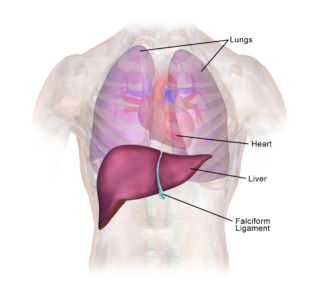
Your liver sits under your ribs on the right side of your body.
Its jobs include:
- to process digested food from the gut
- to control levels of sugar, fat and amino acids in your blood (your body uses amino acids to make proteins)
- to remove drugs and toxins from your blood
- to fight infections
- to make bile (which helps you digest fat)
- to store iron, vitamins and other chemicals
What is PLD?
ADPKD is mainly thought of as a kidney condition. However, if you have ADPKD you’re likely to get cysts in your liver too. This is called polycystic liver disease (PLD).
Most people with ADPKD (8 out of 10) have PLD by their mid-thirties. Women tend to be diagnosed with PLD at a younger age than men. Women’s liver cysts tend to be larger than men’s.
People without ADPKD can get PLD but this is rare.
PLD is unlikely to stop your liver doing its main jobs. This is because the cysts develop in bile tubes not liver tissue.
Most people with ADPKD and PLD don’t have liver symptoms. However, a few people with PLD get very large livers. This can cause symptoms.
Causes of liver cysts
Genes that cause kidney cysts (for example, PKD1 or PKD2) probably cause liver cysts too.
Oestrogen (a female hormone) seems to increase the growth of liver cysts.
Growth of liver cysts is linked to:
- being pregnant more than once
- using contraception with oestrogen in it
- using hormone replacement therapy (for the menopause)
However, most women with ADPKD get liver cysts regardless of these things.
Symptoms of PLD
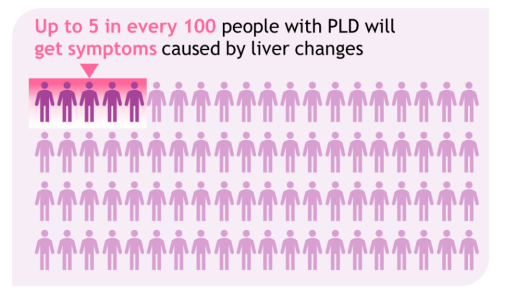
Most people with PLD (over 95 out of 100) don’t have any PLD symptoms.
However, a few people (up to 5 in 100) have PLD symptoms. These could affect their life.
You may get symptoms if your liver gets very large and pushes on other organs or blood vessels. Symptoms can also be caused by fluid in your abdomen (tummy).
Symptoms can include:
- feeling bloated
- having a large abdomen
- feeling full early on in a meal
- a burning feeling in your chest known as acid reflux or heartburn
- pain in your back or abdomen
- getting out of breath
Less often, a large liver can cause shoulder pain.
If you have any of these symptoms, tell your GP or kidney team. They can refer you to a liver specialist (hepatologist) for tests and treatment.
If you have a very large abdomen:
- you may find it hard to bend over
- sleeping on your side or front might be uncomfortable
- it may affect your confidence and how you feel about yourself (your self-esteem)
- your sex life may be affected
Tell your doctor if having a large abdomen is affecting you. They can talk you through treatment options.
A few people with PLD get a bleeding or infected liver cyst. Sometimes liver cysts can squash a vein or tube in the liver, causing problems.
We explain these problems and their treatment later.
Diagnosing PLD
If a doctor diagnoses you with ADPKD, they should offer you a liver scan. This is to check for liver cysts.
A radiologist can use an ultrasound scan, computed tomography (CT) or magnetic resonance imaging (MRI) to check your liver. An ultrasound scan uses soundwaves to see inside your body. A CT scan uses X-rays. An MRI uses magnets and radio waves.
A doctor will diagnose you with PLD if you have 10 or more liver cysts.
You might also have a blood test to check your liver health.
Liver check-ups
Your treatment team will plan your check-ups based on your symptoms and needs.
You may have a blood test about once a year. If you have liver symptoms, you might have a liver scan every 1-3 years.
Treatment of symptoms
People with PLD usually only need treatment if they get symptoms.
Specialists who might be involved in your care include:
- a liver specialist (hepatologist)
- a liver surgeon
- a specialist in using imaging to treat diseases (an interventional radiologist)
- a specially trained nurse
Cyst infections
Sometimes, a liver cyst can get infected with bacteria (germs). This can cause pain and fever (a temperature over 38°C). It’s important to get treatment before the infection worsens.
A liver specialist can diagnose a cyst infection based on signs and symptoms and the results of a blood test and liver scan. They might take a sample of fluid from the cyst to test.
They’ll give you antibiotics but these will take time to work. You might need to take them for 4 to 6 weeks.
You might need the cyst drained if the infection won’t go away or comes back. We explain cyst drainage later.
Bleeding cysts
If a liver cyst starts bleeding, you might get sudden pain. A liver specialist can diagnose a bleeding cyst using a liver scan.
It’s often best to let the cyst heal itself. Your doctor can prescribe pain killers to reduce any pain.
Pain
If your PLD is painful, your doctor can prescribe you pain killers. Find out more about managing pain on our website.
If your pain is unbearable and pain killers aren’t working, you may need surgery to reduce your liver’s size. We explain this later.
Treating a squashed liver vein (portal hypertension)
Rarely, liver cysts can squash a big vein in the liver. This can cause a problem called portal hypertension.
If this happens, you might need surgery. A surgeon can put a tube (a stent) into the vein to hold it open. Or they can remove part of your liver, which we explain later.
Jaundice
Rarely, liver cysts can squash tubes carrying bile. A chemical in bile can get into your blood, making your skin and eyes turn yellow. This is jaundice.
Draining the problem cysts can allow the bile to flow again.
Procedures and surgeries
Most people with PLD don’t need surgery or smaller procedures.
These can include:
- cyst drainage and treatment
- removal of a cyst
- removing part of your liver
- getting a liver transplant
Your liver specialist or surgeon will recommend the simplest procedure possible. They’ll talk you through the benefits and risks, and what to expect.
Cyst drainage and treatment
If a liver cyst is large and infected, you might need it drained and treated. The treatment is called sclerotherapy and kills the cells lining the cyst.
You can learn more about cyst drainage and sclerotherapy on our website.
In a study, most people with PLD who had this treatment said their symptoms improved. Over half said their symptoms disappeared.
This treatment has some risks, which specialists will explain.
Surgery to remove cysts
If you have multiple cysts causing problems, a surgeon may be able to remove them. This surgery is called cyst deroofing. The surgeon will open each cyst, remove the fluid and remove the lining cells.
You can learn more about cyst deroofing on our website.
This treatment usually works well to reduce people’s symptoms long term. It has some risks, which your surgeon will explain.
Removing part of your liver
If you have many liver cysts close together, a surgeon may be able to remove this part of your liver. This is called partial liver resection.
A surgeon will only recommend this surgery if you have bad symptoms and other treatments have failed or aren’t possible.
They’ll explain the surgery and its risks. You’ll need to stay in hospital for about 10–15 days to recover.
Most people who have had a partial liver resection for PLD say their symptoms improved. However, about half had some problems after surgery.
Having a liver transplant
Very few people with PLD need a liver transplant. This surgery is usually only used for people with bad symptoms when other treatments are not possible or have failed.
In this surgery, your liver is removed and replaced by a donated liver. If you need a kidney transplant too, you might have both surgeries together.
A liver transplant cures liver cysts and their symptoms. However, it’s common to have problems after the surgery. You’ll need to take medicines called immunosuppressants for life. These stop your body fighting the donated liver.
Preventing liver cysts
There are no ways to stop liver cysts forming in people with ADPKD. There are also no approved medicines to slow the growth of liver cysts.
Medicines to slow cyst growth
Research has shown a medicine called a somatostatin analogue might slow the growth of liver cysts. However, this medicine didn’t work in all clinical trials.
Somatostatin analogues are not approved for use in the UK for people with ADPKD. This means NHS doctors can’t prescribe them unless they make a special case.
You might be able to try a somatostatin analogue through a clinical trial.
Avoiding oestrogen
If you’re a woman and want to use contraception, your doctor will suggest types without oestrogen. This is because oestrogen might speed the growth of liver cysts.
Likewise, if you have menopausal symptoms your doctor will probably not recommend HRT because it contains oestrogen. Ask your doctor to explain the benefits and risks of you using HRT. They can explain other ways to help menopausal symptoms.
Diet and lifestyle
There’s no special diet or lifestyle to slow the growth of liver cysts.
It’s good to follow general advice for people with ADPKD. See our webpage on diet and lifestyle for tips.
More from the PKD charity
Information and support from others
The British Liver Trust has more information on liver blood tests and liver transplant.
Further information
All of our publications are based on references but these are removed for ease of reading on our webpages. A version of this webpage with references included is available upon request by emailing [email protected]
Authors and contributors
Written by Hannah Bridges, PhD, Independent Medical Writer, HB Health Comms Limited. Expert review by Dr Ahmed Elsharkawy, Consultant Hepatologist, University Hospitals Birmingham NHS Foundation Trust.
Ref No: ADPKD.PLD.V3.0
© PKD Charity 2025
First published: June 2025
Due to be medically reviewed: June 2028
Disclaimer: This information is primarily for people in the UK. We have made every effort to ensure that the information we provide is correct and up to date. However, it is not a substitute for professional medical advice or a medical examination. We do not promote or recommend any treatment. We do not accept liability for any errors or omissions. Medical information, the law and government regulations change rapidly, so always consult your GP, pharmacist or other medical professional if you have any concerns or before starting any new treatment.
If you don't have access to a printer and would like a printed version of this information sheet, or any other PKD Charity information, call the PKD Charity Helpline on 0300 111 1234 (weekdays, 9am–5pm) or email [email protected].
The PKD Charity Helpline offers confidential support and information to anyone affected by PKD, including family, friends, carers, newly diagnosed or those who have lived with the condition for many years.