
Kidney transplants and ADPKD
This information is for people with autosomal dominant polycystic kidney disease (ADPKD) who are approaching kidney failure. It’s also for family members and friends. It explains when you might need a kidney transplant, the benefits and risks, finding a donor, and the operation. It also covers the long-term medicines and check-ups you’ll need.
If you’re considering a transplant, please also talk to your kidney specialist and transplant team for advice and information.
Contents
- Key points
- Reaching kidney failure
- The benefits of a kidney transplant
- The risks of having a kidney transplant
- Is a kidney transplant an option for me?
- Can I have a transplant before my kidneys fail?
- Finding a donor
- The transplant operation
- Check-ups after your transplant
- How long does a donated kidney last?
- What happens if my body starts to reject the kidney?
- What are the alternatives to having a kidney transplant?
- Stories of people with ADPKD who have had a transplant
Key points
- On average, people with ADPKD reach kidney failure at about age 55–60 years. However, the timing differs a lot from person to person. Some people with ADPKD never get kidney failure.
- If you get kidney failure, you’ll need kidney replacement therapy (a kidney transplant or dialysis).
- A kidney transplant is the best treatment for kidney failure but isn’t suitable for everyone. Over half of all people with kidney failure have one; the rest have long-term dialysis.
- A kidney transplant should increase your life expectancy, improve your quality of life, and reduce your ADPKD symptoms.
- Possible problems after the transplant operation include infections, problems with the urinary system, or your body fighting the donated kidney (called rejection).
- To stop your body rejecting your new kidney, you’ll need to take immunosuppressant medicines for life.
- Although they’re essential, these medicines have risks such as increasing your risk of infection, cancer and cardiovascular disease.
- In the UK, about a third of people having a kidney transplant receive the kidney from a living donor, while two-thirds receive it from a deceased donor.
- The average time people wait for a deceased donor kidney is about 2–3 years.
- Most people with ADPKD don’t need to have their own kidneys removed before or during their transplant.
- The transplant operation takes about 2–4 hours.
- Most patients recover well after a kidney transplant and leave hospital after 4–10 days.
- You’ll have regular check-ups at the transplant clinic.
- On average, transplanted kidneys from living donors last 20–25 years, while those from deceased donors last 15–20 years.
Reaching kidney failure
ADPKD slowly damages your kidneys over the years. Eventually, they might stop working, which is called kidney failure.
You’ll be diagnosed with kidney failure if your estimated glomerular filtration rate (eGFR) is less than 15 ml/min/1.73m². This means the amount of blood your kidneys can filter in 1 minute is about a sixth that of a healthy kidney. Kidney failure is also known as chronic kidney disease (CKD) stage 5.
On average, people with ADPKD reach kidney failure at about age 55–60 years, but the timing differs a lot from person to person. Some people with ADPKD never get kidney failure. People with a PKD2 gene alteration tend to get kidney failure much later in life than those with a PKD1 alteration.
If you get kidney failure, you’ll either need a kidney transplant or dialysis to survive. These are types of kidney replacement therapy. Over half of the people in the UK with kidney failure have a transplant. The others have long-term dialysis.
Who can have a kidney transplant?
A kidney transplant is the best treatment for kidney failure. It should replace much of your lost kidney function.
Benefits include:
- increased life expectancy
- better quality of life
- fewer ADPKD symptoms
- improved sex life and fertility
We explore each of these below.
Dialysis also has benefits but it doesn’t improve quality of life or life expectancy as much as a kidney transplant can.
Life expectancy after transplant
A kidney transplant will improve your life expectancy. How long you’re expected to live will depend on a few factors including your age and general health.
If you’d like to know more, ask your treatment team.
Quality of life after transplant
After having a kidney transplant, most people find their quality of life improves.
- People usually return to ‘normal life’ within months.
- Their energy levels increase and they can work, drive, go on holiday and exercise.
- Most people don’t have to follow a special diet after having a transplant (but it’s best to eat a healthy diet).
However, some people find their quality of life is still impacted by ADPKD after their transplant.
ADPKD symptoms after transplant
A kidney transplant will improve your kidney function but it won’t cure your ADPKD.
Symptoms of poor kidney function (such as tiredness, feeling sick, and swollen ankles, feet and hands) should ease as your new kidney starts working.
Some people have one (or both) diseased kidneys removed before, during or after their kidney transplant. This is called nephrectomy. It will stop any symptoms or problems caused by that kidney. We explain this later.
Even when diseased kidneys are left in place, they often shrink over time. On average, they shrink by about a third in the year after transplant. This might reduce any pain and other symptoms they were causing by pushing on other organs.
Having a kidney transplant doesn’t stop ADPKD affecting your liver. Liver cysts often continue to grow. However, liver cysts don’t usually stop the liver working and few people have serious problems. You can learn more about how ADPKD affects the liver on our page on polycystic liver disease.
A few people with ADPKD need a liver transplant, which is sometimes done at the same time as kidney transplant.
Sex life and fertility after transplant
Prior to having a kidney transplant, many people with kidney failure have some problems with their sex life:
- The most common issue for men is not being able to get or keep an erection.
- The most common issues for women are a drier vagina, pain during sex, and difficulty reaching orgasm.
Most people find their sex life improves after having a kidney transplant.
Having a kidney transplant also often improves fertility, although this depends on your age and the reason for any infertility.
Men are usually fertile soon after transplantation.
If you’re a woman and want to try for a baby, it’s best to wait at least a year after your transplant. Use contraception in the meantime. Before trying to get pregnant, talk to your transplant team because they may need to change some of your immunosuppressant medicines.
See our web page on ADPKD and pregnancy for more information.
The risks of having a kidney transplant
Risks of surgery
The transplant operation has some risks, such as infection or problems with your urinary tract. We explain these later.
Risks in the longer term
Some people have problems in the weeks, months or years after kidney transplant.
These can include:
- your body fighting the donated kidney (called rejection), which can cause the kidney to fail
- an increased risk of cancer, high blood pressure, diabetes, increased levels of lipids (fats) in the blood, cardiovascular disease, weak bones (osteoporosis), or bone fractures
Your transplant team and doctor will monitor you for the rest of your life so they can spot and treat any problems promptly.
Is a kidney transplant an option for me?
Over half of all people with kidney failure are suitable for a kidney transplant and have one.
To check whether you’re suitable, your transplant team will carefully assess your health.
They will arrange a variety of tests with different specialists, including:
- a general health check
- blood tests to check your blood and tissue type
- blood tests to check if your immune system is likely to fight a donated kidney
- tests for certain infections (for example HIV and hepatitis B and C)
- heart tests
- lung tests
- a scan of blood vessels on your groin
It can take 3–6 months to have all these tests. Learn more about these tests on the NHS Blood and Transplant website.
Reasons why you might not be able to have a kidney transplant include:
- you have cancer that has spread
- you have certain infections
- you have a short life expectancy
- you have serious cardiovascular disease
- you’re unable to take the long-term medicines needed after transplant
- you inject illicit drugs
If a kidney transplant is not suitable for you, your kidney specialist will offer you dialysis.
Can I have a transplant before needing dialysis?
Your doctor should refer you to a transplant team at least 12 months before you’re predicted to need one (or dialysis). This is to give you all time to plan and, if possible, organize a transplant before you’d need to start dialysis.
About 2 in every 10 people with kidney failure have a kidney transplant without needing to start dialysis. This is called a ‘pre-emptive transplant’. The other 8 in 10 people start dialysis while they wait for a transplant.
Whether or not you can have a pre-emptive transplant will depend, in part, on the availability of a suitable donor.
Finding a donor
Kidneys can be donated from people who are living and people who have just died.
You and your donor’s tissue type must be a close enough match, which is called ‘compatibility’. Your transplant team will check this by testing a sample of blood from you and potential donors for your blood group (A, B, AB or O) and molecules called human leukocyte antigens (HLAs).
Living donor
Living donation is possible because a single kidney is enough to keep a person alive and healthy. If a friend or relative is willing to donate you a kidney and they’re a good match, this can usually be organized in about 3–6 months.
The NHS Blood and Transplant website has information for people thinking about being a living donor.
Benefits of having a living donor versus a deceased donor include:
- shorter waiting time
- being able to plan the date of the operation
- the donated kidney lasting longer
- longer life expectancy for you
If a friend or family member wants to donate a kidney but isn’t a good enough match, it might be possible to arrange for a kidney swap with another family (or families) in the same situation. Your transplant team can arrange this through the UK Living Donor Kidney Sharing Scheme. You can learn about this scheme on the NHS Blood and Transplant website.
If one of your birth relatives wants to donate their kidney to you, they’ll need tests first to check they don’t have ADPKD.
Deceased donor
If you don’t have a living donor, your transplant team will put you on the waiting list for a kidney from someone who has died (because their heart or brain has stopped working). Just under two-thirds (59%) of kidneys donated in the UK are from a deceased donor.
The average time people wait for a deceased donor kidney is about 2–3 years but it can be shorter or longer than this. The wait tends to be shorter for people of blood group AB or A than blood group B or O.
Preparing to have a transplant
Putting plans in place
Whether you have a living or deceased donor, you’ll need to get some plans in place before the operation. You should expect to be in hospital for 4–10 days after your operation, and you’ll need a good few weeks (about 8) to recover afterwards at home.
Your transplant team will explain what to expect and how to prepare.
Preparing for a transplant from a living donor is usually simpler because you’ll know the planned operation date. If you’re waiting for a kidney from a deceased donor, you’ll need to be ready to go to the hospital whenever you get the call, day or night.
Things to plan include:
- travel to and from hospital for the operation and check-ups
- who’ll look after children, pets and your other responsibilities
- who’ll care for you at home while you recover
- letting your employer know how long you’re likely to be off work
In addition, if you’re on the waiting list for a kidney from a deceased person, let the transplant centre know if you’re going away or are unwell. They can then pause you on the waiting list.
Staying healthy
While waiting for your transplant, stay as healthy as possible.
Steps to take include:
- stay active
- eat healthy meals and follow your kidney specialist’s advice on food and drink
- stay a healthy weight (lose weight, if advised)
- don’t smoke
- limit the alcohol you drink
Waiting for a transplant can be stressful and worrying. Speak to your GP or transplant team if anxiety or depression are affecting you.
You might find it helpful to talk to other people in the same situation or who have had a transplant. Find out about support groups and Facebook groups on our website or call our helpline on 0300 111 1234 (9:30am to 5:00pm, Monday to Friday, except bank holidays).
The transplant operation
Checks before your surgery
Before your operation, you’ll have tests to check you’re fit enough for the surgery. This is called a ‘pre-op’.
The transplant service will check the suitability of the donated kidney, and your surgeon will explain the results.
If a blood relative has had a brain aneurysm or you have signs of one, your surgeon will recommend you have a brain scan before your transplant operation. This is to check you don’t have a brain aneurysm. If one is found, you might need to have it treated before your transplant.
Removal of diseased kidneys
Most people with ADPKD don’t need to have their own kidneys removed before or during their transplant. However, some people have one or both diseased kidneys removed (nephrectomy).
Reasons your surgeon and other specialists might suggest removing one or both of your diseased kidneys are:
- to make room for your donated kidney
- because they’re causing ongoing problems such as severe pain, bleeding, infections, fullness affecting your appetite, a hernia, breathing difficulty or kidney stones
- doctors think you might have kidney cancer
If your diseased kidneys are left in place, a surgeon can remove them at a later date if needed.
The transplant operation
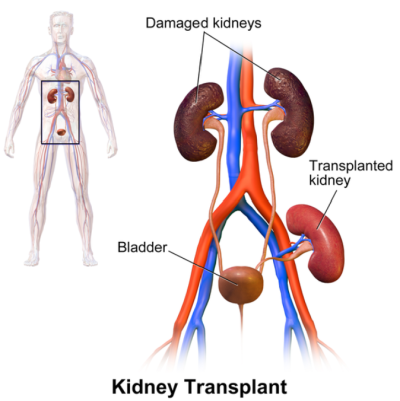
The transplant operation takes about 2–4 hours. Your surgeon will place your new kidney in your groin and will connect the kidney’s blood vessels to those running to and from one of your legs. They’ll connect the tube that carries urine (the ureter) from the donated kidney to your bladder. We show this in the picture below.
Recovery and complications
Most people recover well after a kidney transplant. You’ll probably leave hospital about 4–10 days after your operation.
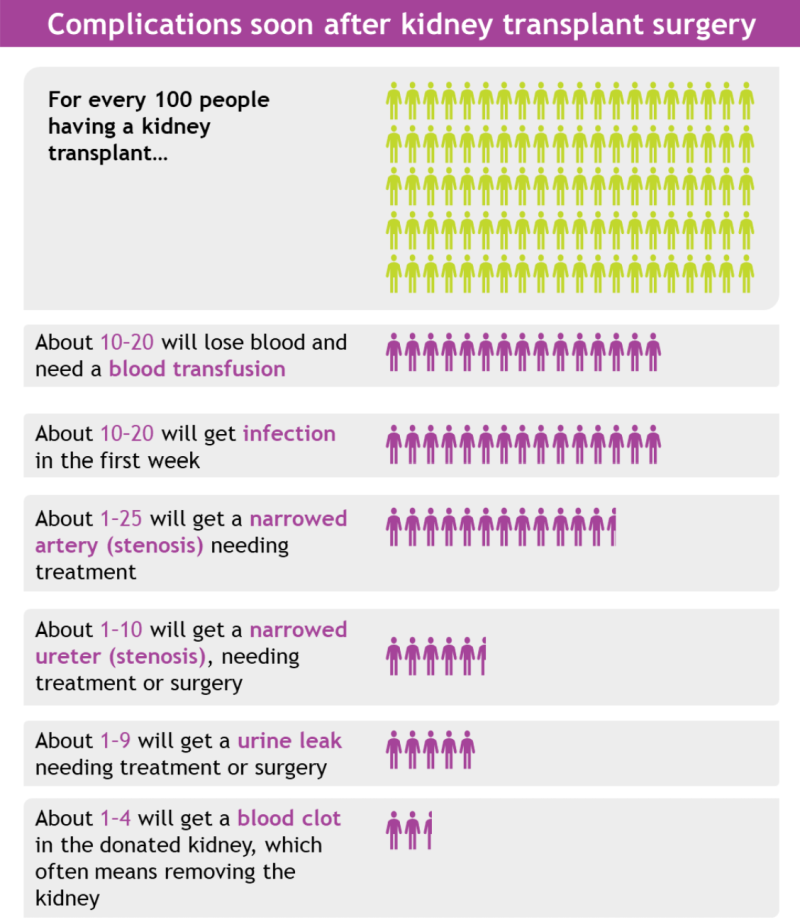
Complications from the surgery can include:
- bleeding requiring a blood transfusion (10–20% of people)
- an infection requiring antibiotics in the first week (10–20%)
- a narrowing (stenosis) in an artery needing treatment (1–25%)
- a narrowing (stenosis) in the ureter needing treatment or surgery (1–10%)
- a urine leak needing treatment or surgery (1–9%)
- a blood clot in the donated kidney, which often means the kidney needs to be removed (1–4%)
These figures are based on people who had a kidney transplant for various reasons (not only ADPKD).
If you get a kidney from a deceased donor, there’s a chance it won’t work well for a few days or weeks. At least 20 in every 100 people getting a kidney from a deceased donor have this problem. For about 2–4 in every 100 people, the donated kidney never works and needs to be removed.
This is not a full list of all the problems that can occur after kidney transplant surgery. Ask your transplant team to talk you through all the risks fully. If you’re worried about the risks, let them know.
Complications might mean you need to stay in hospital for longer than expected. You might also need to return to hospital for further treatment or surgery.
Your transplant team will support you well. They’ll monitor your health closely and organize any treatments you need.
Medicines after transplant
Starting immunosuppressants
Naturally, your body’s immune system would attack the donated kidney. This is called rejection. To stop this happening, you’ll need to take medicines called immunosuppressants.
Common immunosuppressants include basiliximab, tacrolimus, ciclosporin, azathioprine, mycophenolate mofetil, prednisolone and sirolimus. People with higher risks of rejection may need extra immunosuppressants such as alemtuzumab or anti-thymocyte globulin.
You’ll usually need to take 3 or more different immunosuppressants. Your transplant team will adjust the dosing as needed:
- If the dose is too low, your body is more likely to reject the donated kidney.
- If the dose is too high, you’re more likely to get infections, diabetes, cardiovascular problems and cancers of the skin or lymph nodes.
Take your medicines as instructed to reduce your risk of complications.
Other medicines
You’ll be given medicines to reduce your risk of getting bacterial, viral and fungal infections in the first few months after your transplant. You’re also likely to be given a blood thinner to reduce the risk of blood clots.
If you get side effects from your immunosuppressants (for example, an upset stomach), your doctor can prescribe medicines to help.
You might also need to take other medicines long term, depending on your health. For example, if you have diabetes, high blood pressure or high cholesterol, this may need treatment. Your doctor might also recommend medicines to keep your bones healthy.
If you took any other medicines before your transplant, your doctor will let you know whether these are still needed and any changes you need to make.
If you’re a woman going through the menopause, your doctor can explain the risks and benefits of taking hormone replacement therapy (HRT) after transplant.
Medicines and foods to avoid
Check with your doctor or pharmacist before using any medicines, supplements or herbal remedies you can buy without prescription. Some might affect other medicines you’re taking, which can stop them working properly or cause side effects.
Don’t take non-steroidal anti-inflammatory drugs (for example, Nurofen® or other brands of ibuprofen) as they could damage your kidneys.
Depending on which immunosuppressants you’re taking, you might need to avoid certain foods such as grapefruit, pomegranate, Seville oranges (used in many marmalades), chamomile tea and earl grey tea. Check with your treatment team.
Check-ups after your transplant
After your transplant, you’ll have check-ups at the transplant clinic. Initially these will be at least twice a week. Once your donated kidney is working well, you can have check-ups less often, for example, 3–4 times a year.
At appointments, your transplant team will check:
- the health of your donated kidney
- your blood pressure and general health
- whether you’re having any difficulties with your immunosuppressants
- how well you’re coping
If you have questions or concerns between check-ups, contact the transplant centre. Your GP will also be on hand to help you manage your health.
How long does a donated kidney last?
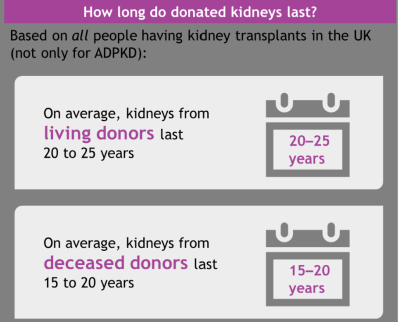
On average, transplanted kidneys from living donors last 20-25 years, while those from deceased donors last 15-20 years. These numbers are from all people in the UK who have had a kidney transplant (not only people with ADPKD).
The length of time your donated kidney will last depends on many factors. It may last longer if:
- you had a living donor rather than a deceased donor
- you and your donor are relatively young
- you and your donor were a very good match
- you take your immunosuppressants as instructed
- your body doesn’t fight (reject) the kidney
- you follow a healthy diet and lifestyle to reduce your chance of getting other health problems, such as diabetes, obesity and high blood pressure.
What happens if my body starts to reject the kidney?
Sometimes, the body can start to fight (reject) the donated kidney. This happens in about 10–20 in every 100 people within a year of their transplant. It can also happen later on.
If check-ups show your kidney function has dropped, this might mean your body is starting to reject your donated kidney. You’ll have further tests, including a blood test, and a doctor will take a small sample of the kidney tissue (a biopsy) for testing.
By testing the biopsy and your blood sample, the lab can confirm whether you have rejection and what part of your immune system is responsible (cells or antibodies). Your transplant team can then tailor your treatment.
If the rejection is caused by immune cells, you’ll need a high dose of steroids given intravenously (via a drip) for 3 or more days. You’ll then switch to steroid tablets. You might need other medicines too if the steroids don’t stop the rejection.
If the rejection is caused by antibodies (defence proteins), you’ll need treatment to remove these from your blood. Most often, this is done using a machine similar to a dialysis machine. This is called plasma exchange (plasmapheresis). Other treatments for this type of rejection include intravenous immunoglobulin (IVIG), which stops your body making more antibodies.
If the rejection continues, your donated kidney might fail. If this happens, you’ll need to go on dialysis. You might be able to have another transplant in the future.
What are the alternatives to having a kidney transplant?
Not all people are suitable for a kidney transplant and some choose not to have one.
The alternatives are:
- dialysis using a machine to filter your blood (haemodialysis)
- dialysis using fluid placed in your abdomen (peritoneal dialysis)
- supportive care, medicines and lifestyle changes to ease your symptoms (these won’t improve your kidney function).
Stories of people with ADPKD who have had a transplant
Nicki had a kidney transplant after having both diseased kidneys removed
“Dialysis hardly worked for me at all. The doctors had said that my need for a transplant was urgent. Around 3 months after my operation [to remove my PKD kidneys], the consultant felt I could [go on] the transplant list.
“Just one week later, I was at home and I received a call to go immediately to the hospital. I had no reservations about having the transplant even though I realised I was vulnerable to infection and still had pain from recent surgery. My creatinine* [dropped substantially] overnight and I woke up feeling like a brand-new woman. I was well cared for and a future felt possible once again.”
*Creatinine is used to measure kidney function. High levels indicate poor function.
Martin had a pre-emptive transplant from a living donor
“When I dropped below eGFR 20, it was suggested that I start thinking about live transplant. My great niece volunteered and was a really good match. From the time she agreed to donate to transplant was about 2¾ years. I had the transplant at eGFR 9, in October 2016.
“The transplant team told me that mine was a ‘textbook’ pre-emptive live donation. My niece sailed through it – she wanted food as soon as she came back from theatre! The transplant was on the Thursday and she went home on the Monday. Once out, I was very well looked after by my wife.”
Stephen found the wait hard, but coped by keeping fit
“There were some dark periods as one is waiting with a real chance of time running out before a kidney becomes available. Nonetheless I was determined to keep fit and look after myself so that I would be able to take the opportunity should the call ever come.
Rob had some false starts before a suitable kidney was found
“Life is quite normal; until you get the call! My first call was at 1 am. I went to Manchester Royal and had to wait around for about 30 minutes, then was given a bed. I was just in the middle of getting my gown on and a nurse came and said that the kidney wasn’t good enough and I could go home. I arrived home at 3.30 am. A very surreal experience! I had a further 3 calls before I was successful.”
Andy found the wait for a donor kidney and liver a strain
“Being on dialysis was sometimes an emotional strain — and probably on loved ones too. Waiting for a donor with no set date rather than having a live donor planned is just that — a 'waiting game' and can be tortuous. But however hard dialysis could get, I remembered it was keeping me alive.”
Ian explains his recovery after a kidney transplant
“The operation went smoothly and I woke in recovery as if nothing had happened, apart from all the tubes. However, the following day I did feel nauseous, and was sick, then Day 2 started to go into full recovery, and Day 3 the kidney started working and all tubes were removed. On Day 5 I was able to come home.
“Initially it went well. I have had a hiccup with a viral infection, but my lifestyle is getting back to normal. I'm feeling healthier, and about to start up physical fitness again. Even with the hurdles I’ve encountered, my GFR has been up to 65%, and I am looking forward to the future.”
Andy had complications after his joint kidney and liver transplant
“My operation was long and didn't go exactly to plan. I tried to stay pragmatic and positive about the recovery process, which was not always easy or straightforward with infections, episodes of rejection and a 'sleeping' donor kidney.
“Everyone's experience is different — I was in hospital for about 10 weeks. I had a few overnight visits over the next 6 months, but things settled down gradually. I celebrate the little victories (like having my first wee in 2 years!). For me, my 12-month anniversary was most significant both physically and emotionally — that was when I felt I had turned a corner in my recovery.”
Stephen has got more active since his transplant recovery
“I have no dialysis and no dietary restrictions and my fitness is such that I play golf, have been back pedalling on the bike and I competed at this year’s Transplant Games. Life will never entirely return to what it was prior to PKD, but every day feels like a massive bonus. I am immeasurably grateful to the medics and of course to my donor and his family.”
Nicki’s quality of life improved but there have been challenges too
“I have been on quite a journey over the last 13 years [since transplant]. Certainly, this donation prolonged my life span and increased my quality of life immensely — I have been able to travel, gain a master's degree, continue to work for some time, and create a home for myself.
“I have also had to deal with the traumatic impact [that PKD] has had on my emotional and physical health, and have had some unfortunate experiences of employers and colleagues not understanding what this has been like. Even so I wouldn't have had it any other way. To share life with another person is a great privilege in both directions.”
Rob found freedom from dialysis the biggest change
“Immediately after the transplant, my skin lost its yellow tinge and I gained a normal complexion. I felt normal again, just like I used to. The biggest change was no longer being tied to dialysis 3 times a week, and once again being able to do all the things that I used to without having to take regular breaks. One thing I will never forget — how lucky I have been.”
More from the PKD Charity
Information and support from others
- Kidney Research UK has information on kidney transplantation.
- NHS Blood and Transplant has information on kidney transplantation.
- The Organ Donation website has information on donating an organ.
- The National Kidney Foundation (an American charity) has teamed up with Health Unlocked to provide an online forum for people who have had a kidney transplant.
- The British Transplant Games is open to people who have received an organ transplant and immunosuppressant therapy. Ask your transplant clinic if you’re interested in joining or supporting the team.
Further information
All of our publications are based on references but these are removed for ease of reading on our webpages. A version of this webpage with references included is available upon request by emailing [email protected]
Authors and contributors

Written by Mr Badri Man Shrestha, BSc MBBS MS MPhil MD FRCS(Eng & Gen) Hon.FRCS(Edin) FEBS FACS FICS, Consultant Transplant Surgeon, Sheffield Teaching Hospitals NHS Trust, and Hannah Bridges, PhD, independent medical writer, HB Health Comms Limited.
Ref No: ADPKD.KT.V2.0
© PKD Charity 2025
First published: May 2025
Due to be medically reviewed: May 2028
Disclaimer: This information is primarily for people in the UK. We have made every effort to ensure that the information we provide is correct and up to date. However, it is not a substitute for professional medical advice or a medical examination. We do not promote or recommend any treatment. We do not accept liability for any errors or omissions. Medical information, the law and government regulations change rapidly, so always consult your GP, pharmacist or other medical professional if you have any concerns or before starting any new treatment.
If you don't have access to a printer and would like a printed version of this information sheet, or any other PKD Charity information, call the PKD Charity Helpline on 0300 111 1234 (weekdays, 9am–5pm) or email [email protected]
The PKD Charity Helpline offers confidential support and information to anyone affected by PKD, including family, friends, carers, newly diagnosed or those who have lived with the condition for many years.