
Helpline

0300 111 1234

Which genes cause ADPKD and what is genetic testing?

This information is for people with autosomal dominant polycystic kidney disease (ADPKD), their families, carers and friends. It explains the gene changes that cause ADPKD and how they’re inherited. We also explain how genetic testing works. If you’re wondering whether you can get tested and whether to go ahead with it, you’ll find useful information here.

Key facts

  • ADPKD is an inherited condition. This means it can be passed from a parent to their child through their genes.
  • Most people with ADPKD have a parent with the condition.
  • Occasionally, a new gene change happens by chance before a baby is born. This means that some people have ADPKD even though neither parent does.
  • Usually, it’s a change in the PKD1 or PKD2 gene that causes ADPKD.
  • Rarer gene changes can also cause ADPKD.
  • Genetic testing can look for changes in these genes linked to ADPKD.
  • Sometimes, a person’s entire DNA code is read, rather than individual genes. This is called ‘whole genome sequencing’ or ‘genomic testing’.
  • People can have a genetic test (or genomic test) for ADPKD if they have, or are likely to have, the condition.
  • The results can take from 6 weeks to 3 months. It is quicker if an ADPKD gene has been found in your family already.
  • Genetic testing often confirms whether or not you have a gene change that causes ADPKD. However, about 1 in every 4 people (25%) get an unclear result.
  • Knowing which gene change you have can help doctors predict when you might get problems from ADPKD.
  • There are pros and cons to having genetic testing. A clinical geneticist, genetic counsellor or kidney doctor can help you think these through.
  • If you inherited a gene change causing ADPKD, there’s a 1 in 2 chance (50% chance) of passing it on to each child you have.
  • If you have ADPKD, you and your partner might be able to have a special type of in vitro fertilization (IVF) to try for a baby without ADPKD. This involves genetic testing of embryos. It’s called preimplantation genetic testing.
  • Less commonly, couples opt to have their developing baby (fetus) tested during pregnancy.

What is a gene?

Genes are the instructions the cells in our bodies need to grow, divide and do their jobs. Genes are made of DNA — a long chain of molecules linked together to form a code. These codes act like recipes, telling our cells how to make different proteins. Proteins do most of the work in our bodies.

Picture: DNA strands, which make up genes. By Geralt, CC0, via Wikimedia Commons.
Which gene changes cause ADPKD?

ADPKD is usually inherited. This means it’s passed on from a parent with ADPKD to their child through their genes.

There are many different gene changes (mutations) that can cause ADPKD.

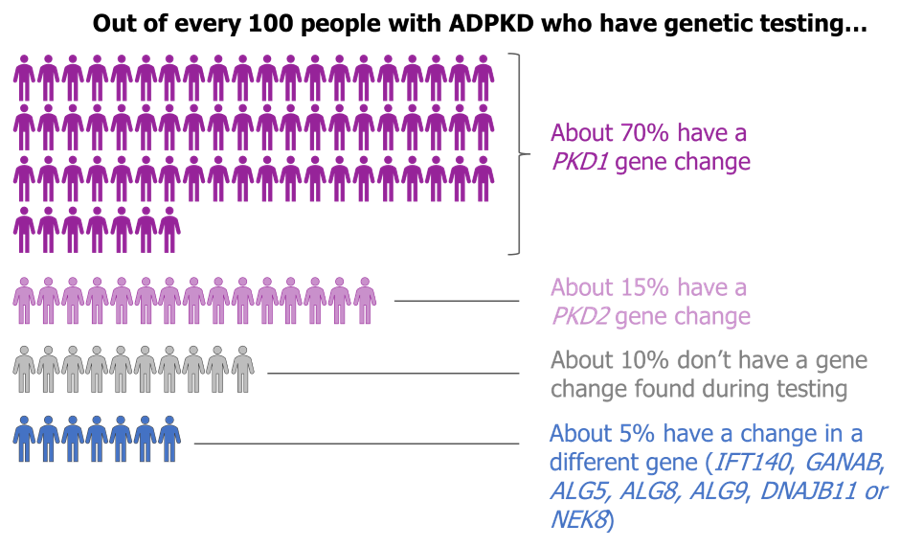
Usually, ADPKD is caused by a change in either the PKD1 or PKD2 gene. Less often, changes in other genes cause ADPKD (see picture below).

Diagram: The gene changes causing ADPKD

Although these gene changes are usually inherited, a new change sometimes happens by chance before a baby is born. This is called a ‘spontaneous mutation’ or ‘de novo mutation’. People with a de novo mutation have ADPKD even though neither of their parents do.


What is genetic testing?

A genetic test can look for gene changes that cause health conditions. You usually need to provide a blood or spit (saliva) sample to have a genetic test.

In a genetics lab, a technician will use a machine called a sequencer to read the DNA code of your genes. They’ll check the code for changes linked to ADPKD and other kidney conditions that cause cysts.

If they find an ADPKD gene change and you have physical signs (for example, kidney cysts), this means you have ADPKD. If you have an ADPKD gene change but don’t have physical signs yet, you’re predicted to get them in the future.

Sometimes, the technician reads a person’s entire DNA code rather than individual genes. This is called ‘genomic testing’ (because a whole DNA code is called a genome).

To keep things simple, we only say ‘genetic testing’ from now on. The information on this page applies to genomic testing too.

Can I have a genetic test for ADPKD?

ADPKD is uncommon. Testing for everyone would rarely be useful.

People can have genetic testing for ADPKD for free on the NHS if they have, or are likely to have, the condition.

Here are situations when people can have genetic testing for ADPKD on the NHS:

1. A person has kidney cysts and their kidney doctor is unsure of the cause

Adults can usually be diagnosed with ADPKD based on signs and symptoms, especially if they have a relative with ADPKD.

However, if a person has only a few kidney cysts and no other signs of ADPKD, it can be unclear whether they have ADPKD or a different kidney condition. The cause can also be unclear if the person doesn’t have any relatives with ADPKD.

For these people, doctors use genetic testing to work out if they have ADPKD. This is called a ‘diagnostic genetic test’. The lab will usually check the code of genes linked to ADPKD only.

2. A child or adolescent has symptoms of ADPKD

ADPKD doesn’t often cause symptoms in children. If a person under 18 years old has symptoms of ADPKD, their doctor may offer genetic testing to check if they have ADPKD or a different kidney condition.

3. A person is diagnosed with ADPKD and knowing the causing gene would help plan their care

The age at which people tend to get problems from ADPKD differs depending on which ADPKD gene change they have. For example, people with a change in the PKD1 or NEK8 gene tend to get kidney failure sooner than people with a PKD2 gene change.

Kidney doctors can use genetic test results to predict how and when a person’s ADPKD might cause problems. This can help to plan the person’s care.

4. A person has a close relative with ADPKD and wants to know if they have ADPKD too

If a person has ADPKD and the gene change causing it has been found, their close relatives can be tested to see if they have the same gene change. The lab will check each relative’s DNA to look for the same gene change. This is called a ‘predictive genetic test’.

Relatives with the same gene change have (or are predicted to have) ADPKD. There is a chance they can pass ADPKD on to their children.

Their kidney doctor might check their kidneys too using an ultrasound scan or other test.

5. A person wants to donate a kidney to a relative with ADPKD

If someone with ADPKD has kidney failure, they could have the option of a kidney transplant. If a close relative wants to donate a kidney to them, doctors first need to check that this relative doesn’t have ADPKD too. This can be done with a genetic test. People with ADPKD can’t donate a kidney.

If you would like a genetic test for ADPKD, ask your GP or kidney doctor. They can explain whether you can have a genetic test on the NHS. If you can, they can arrange this for you.

They might ask you to have genetic counselling first. This is to help you understand the pros and cons of testing before going ahead.

How long does it take to get the results?

If you’re having a genetic test for ADPKD and no one in your family has been tested before, the results should come within 12 weeks (about 3 months).

If the gene change running in your family is already known, your test result might come within 6 weeks. This is because the lab staff already know which gene change they’re looking for.

Waiting times can vary. Your genetics clinic can confirm how long you may wait.

What could the results of my genetic test be?

The 3 main results of a genetic test for ADPKD are:

  • You have a gene change known to cause ADPKD
    • This means you either have ADPKD now (if you have signs and symptoms already) or are predicted to develop it in the future.
    • Your children might inherit ADPKD.
    • Your relatives can have genetic testing too, if they choose.
  • You don’t have a gene change known to cause ADPKD
    • If the gene change causing ADPKD in your family is known and you don’t have it, this means you don’t have ADPKD. Your children can’t inherit ADPKD.
    • If you have strong signs of ADPKD and no one else in your family has ADPKD, you probably do have the condition. The genetic cause is unknown. Your children might inherit ADPKD.
    • If you have unclear signs (for example, one cyst), you probably don’t have ADPKD. Your kidney doctor will recommend more tests in the future to check.
  • You have a gene change but genetic specialists aren’t sure if it causes ADPKD.
    • This can happen if specialists haven’t seen this DNA code change before.
    • About 1 in every 4 people (25%) get an unclear result.
    • Your kidney doctor or genetic specialist will explain what the results mean for you and your family.

What happens if I’m diagnosed with ADPKD?

If your kidney doctor diagnoses you with ADPKD, they’ll offer you more tests to check your kidneys and general health. Find out more on our page on diagnosis.

To help you stay as healthy as possible:

  • You’ll have regular check-ups through life.
  • Your GP, kidney team and other specialists will organize any treatment you need.
  • Your kidney doctor might recommend a treatment called tolvaptan to help slow down the growth of kidney cysts. This depends on how ADPKD is affecting you.
  • Your kidney doctor will recommend a healthy diet and lifestyle to help protect your kidneys.

Will my DNA code be stored?

The lab is likely to read your complete DNA code when you have a genetic test for ADPKD. This is called ‘whole genome sequencing’. Although the machine reads your whole DNA code, the lab will only look at the genes linked to ADPKD and other kidney conditions.

Your doctor may ask if your full DNA code can be stored in the National Genomic Research Library. This is done anonymously (meaning your name is not stored in the database). Researchers can ask to use the anonymous data in studies about the diagnosis and treatment of diseases.

You can have the test without your DNA going into this library if you prefer.

Can I have a genetic test for ADPKD at a private clinic?

If you can’t have genetic testing on the NHS, ask your doctor to explain why. It might be that you’re not at risk of having ADPKD or the results would not alter your care plan.

Some companies offer private genetic testing (meaning it’s not done by the NHS). You need to pay for this yourself or via health insurance. Before using a private company, ask about the expertise of the lab and the doctor analysing the results.

Genetic tests are highly technical and the results can be hard to understand. There are over 2,000 different changes in the DNA code that can cause ADPKD. So it’s important the service is familiar with them.

Make sure the clinic explains beforehand what test results you might get, so you’re prepared. Ask who will be on hand to explain the results to you.

Can genetic tests tell how fast my ADPKD will progress?

The gene change you have might give some clues on how your ADPKD might progress. Your kidney doctor won’t be able to predict exactly when your ADPKD will worsen. This is because other factors affect ADPKD too.

Relatives with the same gene change can get different symptoms or experience problems at different ages.

People with PKD2 gene changes (versus PKD1), tend to have ADPKD that progresses more slowly. They may not get bad symptoms from ADPKD until quite late in life. For example, people with a PKD2 gene change often get kidney failure in their 70s, while people with PKD1 often get kidney failure in their 50s.

Experts are still learning about rarer ADPKD genes. ALG5, ALG9, DNAJB11, GANAB and IFT140 changes seem to cause ADPKD that is milder. People with these gene changes might not have symptoms until late in life.

People with a NEK8 gene change might get kidney failure during childhood.

Choosing whether to have genetic testing

What are the pros and cons of genetic testing?

It can be difficult to decide whether to have genetic testing. It may help to have genetic counselling. Talking to friends and family can also help.

Below are some of the pros and cons. Your doctor can refer you to a specialist to chat these through.

Pros:

  • It can help to have an answer on whether or not you have ADPKD, whatever the result.
  • If you have an ADPKD gene change:
    • You can have further tests and regular check-ups to spot any problems early.
    • You can have any treatment you need and follow the right lifestyle to help protect your kidneys.
    • You may be able to take part in clinical trials of possible new treatments.
    • You’ll know the risk of your children having ADPKD.
    • If you’re planning a family, you can look into a special type of fertility treatment called preimplantation genetic testing. This means you can try for a baby without ADPKD (we explain this later).
    • Other family members can get a test too, if they choose.
  • If you don’t have the ADPKD gene that runs in your family:
    • You can feel reassured that you don’t have ADPKD and your children can’t get it.

Cons:

  • Waiting weeks or months for test results can be difficult.
  • There is a 1 in 4 (25%) chance the test won’t give a clear answer on whether you carry a gene change that causes ADPKD. This can be frustrating.
  • Getting a diagnosis of ADPKD cause many emotions (such as shock, anxiety about the future, and anger).
  • If you’re diagnosed with ADPKD, this could affect your own and your family’s insurance (for example life and health insurance). We explain this later.

What happens in a genetic counselling session?

Genetic counselling is not the same as counselling for mental health issues. You could see a genetic counsellor, a clinical geneticist or a kidney doctor with expertise in genetics. They’ll give you information to help you decide whether to have a genetic test.

You’ll talk through:

  • the pros and cons
  • the possible results
  • how the results could affect you and your family
  • your views and what’s most important to you

After genetic counselling, you’ll choose whether you want to go ahead with the test. You don’t have to decide right away.

Sometimes, people within families can have different views on genetic testing. This can cause tension. Your genetic counsellor can provide helpful tips on talking to relatives.

Will having a genetic test affect my insurance?

Having genetic testing can sometimes affect insurance related to your health (such as travel insurance, life insurance, health insurance, or critical illness cover). It might be harder to find insurance and it might be more expensive.

This depends on the circumstances of the test:

  • In the UK, you don’t need to tell your insurer about any genetic test you (or your family) have to predict whether you have ADPKD if you have no signs or symptoms now. Your insurer must not ask for or use the results of predictive tests.
  • If asked, you should tell your insurance company about any conditions you have been diagnosed with. If you have symptoms of ADPKD and have a scan or genetic test confirming you have the condition, this is classed as a diagnosis. If you don’t tell your insurance company about your diagnosis when asked, this could invalidate your insurance. This means if you need to make a claim on your insurance in the future, the company might refuse to pay out.

Being clear on whether you’re having a predictive or diagnostic test is important. Ask your kidney doctor, clinical geneticist or genetic counsellor if you’re unsure.

Your insurer can ask about your family history. If anyone in your family has been diagnosed with ADPKD, tell your insurer when asked or it could invalidate your insurance.

If other people in your family have ADPKD, your insurance could be affected whether or not you have a genetic test. In fact, if you have a genetic test and this shows you don’t carry an ADPKD gene, this might help you get a better insurance deal.

Find out more about genetic tests and insurance on the website for the Association of British Insurers.

We also cover more on our webpage Insurance.

More detail on the genetics of ADPKD

How did I get an ADPKD gene?

Most people with a gene change causing ADPKD inherited it from a parent with ADPKD. Less often, the gene change can happen by chance early in life (when a person is an embryo).

How are ADPKD genes inherited?

You have thousands of genes, and you have 2 copies of each gene.

One copy came from your mum and one came from your dad. You only need one changed copy of a gene linked to ADPKD to get the condition. So, for example, if you inherited a changed PKD1 gene from your mum, you’ll get the condition.

If you’ve inherited a gene change causing ADPKD, there is a 1 in 2 chance (50% chance) of passing it on to each child you have.

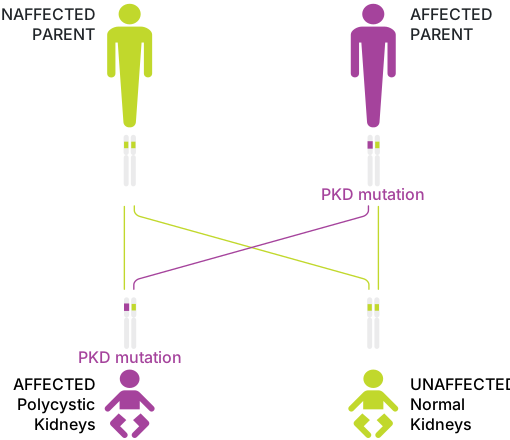
We show this in the diagram below using the PKD1 gene as an example.

Here’s an explanation to go with the diagram:

  • Every person has 2 copies of the PKD1 gene.
  • One copy came from their mum and the other copy came from their dad.
  • If a person has just one changed version of the PKD1 gene, they’ll develop ADPKD.
  • In the diagram, the parent shown on the right (in purple) has one changed copy of the PKD1 gene and one normal copy. They have ADPKD.
  • They could pass either the changed gene or the normal gene on to their child. It’s pure chance which copy their child will get.
  • The parent on the left (in green), has two normal copies of the PKD1 gene. Their child could inherit either one of these normal genes.
  • If this couple’s baby inherits a normal gene from each of them, the baby won’t have ADPKD. This is the baby on the left, in green.
  • However, if their baby inherits a normal gene from the healthy parent and the changed gene from the parent with ADPKD, the baby will have ADPKD. This is the baby on the right, in purple.
  • The chance of their baby inheriting the changed gene is 50%.

Diagram: How ADPKD is inherited. To keep things simple, we only show the PKD1 gene in this diagram. Changes in the PKD2 gene and rarer genes are inherited the same way.

A small number of people with a de novo mutation can’t pass it on to their children. Your kidney doctor or genetic specialist should explain if this applies to you.

What do the genes related to ADPKD do?

The PKD1 and PKD2 genes are codes for making proteins called polycystin 1 and polycystin 2. These proteins are found on cells lining the kidney tubes that make urine (wee).

People with a PKD1 or PKD2 gene change have differences in the polycystin 1 or polycystin 2 protein. These changes make it more likely that cysts will grow in the kidney tubes.

Some other gene changes that cause ADPKD (for example in GANAB or ALG9) might affect the way that polycystin 1 or 2 are made or moved in cells.

Experts don’t yet know exactly what jobs polycystin 1 and 2 do. But, if cells lining the kidney tubes don’t have enough working polycystin 1 and 2, the cells can multiply too often. When too many cells grow in one area it can make a bulge. This can become a cyst.

For more information see our webpage, How are cysts formed?

Researchers are studying polycystin 1 and 2 to find out more about what they do. Their findings might help to design new treatments for ADPKD in the future.

Information for parents and people planning a family

Should my child get tested for ADPKD?

Most children with ADPKD don’t have symptoms that cause problems. The only way to know whether a child has ADPKD (or might develop ADPKD later in life) is a kidney scan or genetic test.

Children at risk of having ADPKD can have genetic testing at any age. They can have a kidney scan if you prefer.

If you’re thinking about genetic testing, ask your GP to refer you to a genetic counsellor, clinical geneticist or kidney doctor. They can explain the pros and cons. It’s good to involve your child in the decision if they’re old enough to understand.

Doctors can check your child’s blood pressure every few years regardless of whether your child has had a genetic test. This is good to do because ADPKD can cause high blood pressure in children and adults. High blood pressure should be treated.

For more information, see our webpage Symptoms and testing in children.

Can I have my baby tested for ADPKD during pregnancy?

If you or your partner have ADPKD, there’s a 1 in 2 (50%) chance your child will inherit ADPKD. This risk applies to each child you have.

You can have your developing baby (fetus) tested for ADPKD during your pregnancy if you want to. This test can usually confirm whether your baby will develop ADPKD.

This test can be useful in these situations:

  1. Your pregnancy doctor (obstetrician) has spotted on a pregnancy scan that your fetus has possible signs of a kidney condition.
  2. You want to know whether your baby will develop ADPKD so you can decide whether to continue with the pregnancy.

We’re sorry if reading this information upsets you. Our helpline details are below, if you would like to chat to someone confidentially.

To do the test, your pregnancy doctor will take a sample of cells. Usually, they take a sample from the placenta. This is an organ that supplies oxygen and nutrients to your baby in the womb. The procedure is called chorionic villus sampling.

Find out more on our webpage ADPKD and pregnancy.

It’s best to discuss options before becoming pregnant. Ask your GP or kidney doctor to refer you to a genetics centre.

Can I have fertility treatment to select an embryo without ADPKD?

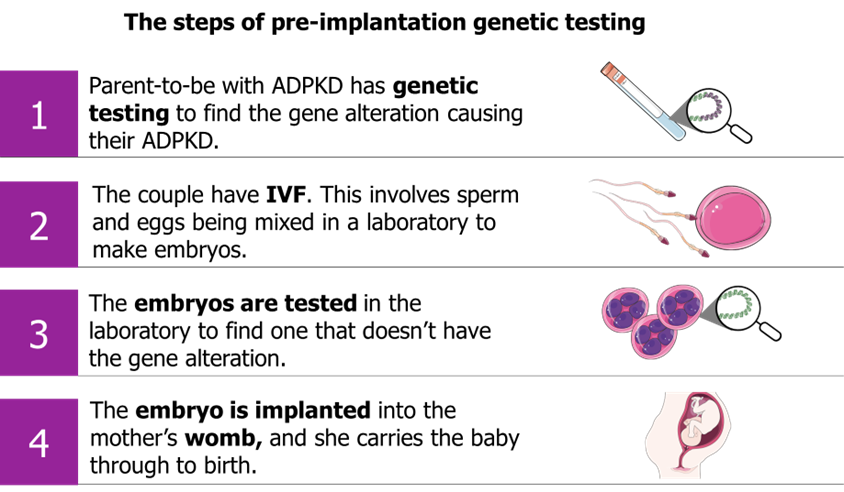
If you or your partner have ADPKD, a special type of in vitro fertilization (IVF) called pre-implantation genetic testing (PGT) might help you to have a child without ADPKD.

People can feel differently and strongly about PGT. Some people see it as a good thing. Others find it upsetting, for example because they feel it suggests a baby without ADPKD is ‘better’. A genetic counsellor can help you to explore your views on PGT.

For PGT, a specialist clinic will do genetic testing on your embryos. They’ll find an embryo without the ADPKD gene and put it in the mother’s womb. This means the baby won’t have ADPKD.

PGT doesn’t always lead to pregnancy. About a third of couples having PGT have a baby.

You can only have PGT if the gene change causing your or your partner’s ADPKD is known.

Figure 3: Steps of pre-implantation genetic testing

If you want to look into PGT, the first steps are:

  • Ask your GP whether PGT is available on the NHS in your area.
  • Ask your doctor to refer you to a genetic specialist to discuss PGT.
  • If the genetics service agrees you’re eligible for PGT, they’ll refer you to a specialist centre. There are not many in the UK so you may need to travel quite far.

ADPKD is one of the conditions approved for PGT. However, not everyone is allowed to have it on the NHS. Rules differ by area of the UK.

In England, for example, you can only have PGT on the NHS to have a baby without ADPKD if:

  • you or your partner have ADPKD
  • the mother-to-be is under 40 and not underweight or obese
  • neither of you smoke

If you (as a couple living together) already have a child without ADPKD, you won’t usually be allowed to have PGT.

Find out more about PGT on the Genetic Alliance website.

You may choose to have PGT privately if you can’t get NHS funding. Learn about choosing a clinic on the Human Fertilisation and Embryology Authority website.

Information and support from others

The photos on this webpage are freely available on Pexels.com. The medical history of the persons shown is unknown.

Authors and contributors

Written by Hannah Bridges, PhD, independent medical writer, HB Health Comms Limited, UK. Reviewed by Professor Richard Sandford, Academic Department of Medical Genetics, University of Cambridge, UK.

All of our publications are based on references but these are removed for ease of reading on our webpages. A version of this webpage with references included is available upon request by emailing [email protected]

With thanks to all those affected by ADPKD who contributed to this publication.

Ref No: ADPKD.GA.V3.0
Latest version: © January 2026.
Due for medical review: January 2029.

Disclaimer: This information is primarily for people in the UK. We have made every effort to ensure that the information we provide is correct and up to date. However, it is not a substitute for professional medical advice or a medical examination. We do not promote or recommend any treatment. We do not accept liability for any errors or omissions. Medical information, the law and government regulations change rapidly, so always consult your GP, pharmacist or other medical professional if you have any concerns or before starting any new treatment.

If you don’t have access to a printer and would like a printed version of this information sheet, or any other PKD Charity information, call the PKD Charity Helpline on 0300 111 1234 (weekdays, 9am–5pm) or email [email protected]

The PKD Charity Helpline offers confidential support and information to anyone affected by PKD, including family, friends, carers, newly diagnosed or those who have lived with the condition for many years.

Feedback

We welcome feedback on the information provided on this webpage. If you have any feedback regarding the information provided on this webpage, please complete the Feedback Form