

Helpline

0300 111 1234

How are cysts formed?

This information is for people with autosomal dominant polycystic kidney disease (ADPKD), their family and friends. It explains what cysts are, how they grow, and the damage they can cause to the kidneys.

What is a cyst?

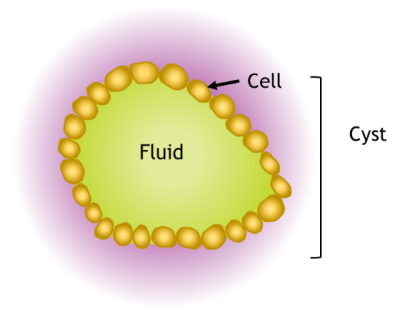
A cyst is a pouch (or ‘sac’) of cells that contains fluid. It can be as small as a pea to the size of a grapefruit. ‘Polycystic’ means ‘many cysts’, which is where polycystic kidney disease gets its name.

In people with ADPKD, many cysts grow in the kidneys and increase in size over time (usually over many years). This causes the kidneys to get larger and often stops them working properly. If you have ADPKD, you’re very likely to get cysts in other organs too, such as your liver.

A picture of a kidney cyst. A circle of cells is shown, with fluid held in the middle.

Where do kidney cysts form?

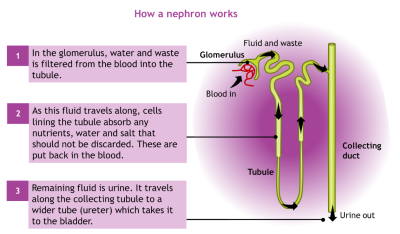
To filter our blood, each kidney contains up to a million filtering units known as nephrons. Each nephron is made of a filter and tiny tube (more technically known as a tubule) and blood vessels. The nephrons filter blood; the water and waste (urine) flow to the bladder.

In people with ADPKD, cysts grow from the kidney tubules.

A picture of a nephron. The nephron is a thin, long, winding tube. At the top of the nephron sits a ball of blood vessels called the glomerulus. Water and waste pass through these vessels into the tubule. Waste fluid (urine) flows via a collecting tube to the bladder.

How do kidney cysts form?

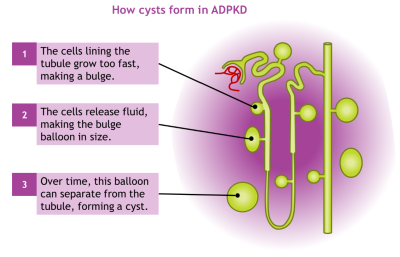
Kidney cysts begin to form when the cells lining the tubule grow too fast, making a bulge. Over time, this balloons in size and can separate from the tubule, forming a cyst. Fluid collects in the cysts causing them to swell. This is shown in the picture below.

 A picture showing cysts forming in a kidney nephron. Bulges are shown from the tubule. Some of these have ballooned in size and separated from the tubule, becoming cysts.

Some of the changes to tubule cells that lead to cysts growing are caused by an inherited altered gene (for example, PKD1 or PKD2). As the kidneys get damaged, more changes occur that can worsen cyst growth. For example, the amounts of certain molecules that control how tubule cells behave can change. The gluey substance holding tubule cells together can also weaken.

What damage do cysts cause to the kidney?

In people with ADPKD, more and more cysts form and enlarge over time. Scar tissue forms around the cysts (known as fibrosis) squashing nearby blood vessels and nephrons. Immune cells (which usually defend the body against infections) can also collect in the damaged tissue, making things worse.

These changes mean that both kidneys enlarge as a person ages. The speed at which the kidneys grow differs between people, but they tend to increase in size by about 5% each year. For example, a kidney 15 cm long could increase to almost 16 cm long in a year.

The kidneys usually continue to work well for many years despite these cysts. However, the damage to the kidneys eventually becomes too great and they stop working properly. The amount of blood they can filter per minute (the estimated glomerular filtration rate, or eGFR) drops. This is known as reduced kidney function or chronic kidney disease (CKD) stage 2, 3, 4 or 5.

On average, people with ADPKD get kidney failure at about age 60, but this differs a lot from person to person. Some people with ADPKD get kidney failure earlier, while others never get kidney failure. The timing depends on a few factors, including the gene alteration a person has (for example, PKD1 or PKD2).

Where else can cysts form?

Most people with ADPKD develop cysts in their liver by middle age. These cysts don’t usually cause any symptoms or stop the liver working. In some people, they increase the size of the liver but they usually don’t cause serious problems. You can learn more about liver cysts on our web page on polycystic liver disease.

Less commonly, cysts can form in other organs including:

  • the pancreas (an organ that makes enzymes and hormones that aid digestion)
  • the seminal vesicles (glands that release semen in men)
  • the ovaries (where a woman’s eggs are made)

What symptoms do cysts cause?

Cysts and kidney damage can cause a range of symptoms including: pain, infections, kidney stones, reduced kidney function, and high blood pressure. You can find lots of information on ADPKD symptoms and treatment on our website.

Can the growth of cysts be prevented?

There’s no cure for ADPKD and no treatments can prevent the growth of cysts. However, there are some steps you can take to help slow cyst growth. We explain these below.

Diet and lifestyle

Factors that might increase the speed that ADPKD worsens include:

  • being overweight or obese
  • eating more salt than recommended (over 5g a day for adults)
  • having high blood pressure
  • being dehydrated often

So, it’s a good idea to follow a healthy diet and lifestyle. You should also take any blood pressure medicines your doctor recommends if you have high blood pressure.

Experts recommend that adults with ADPKD drink at least 2–3 litres of water a day, provided their eGFR is at least 30 ml/min per 1.72 m². If your eGFR is lower than 30 ml/min per 1.72 m² (meaning you have CKD stage 4 or 5), please follow your kidney specialist’s advice about water. If you aren’t sure what your eGFR is, ask your doctor.

Experts aren’t sure that drinking plenty of water can slow the growth of cysts. However, they think it might help and it’s unlikely to cause you harm.

Tolvaptan

A treatment called tolvaptan (Jinarc®) can slow the speed at which the kidneys enlarge and are damaged.

Researchers think tolvaptan does this by:

  • stopping the growth of cells that line cysts
  • reducing the amount of fluid that collects in cysts

Tolvaptan is not available to all patients. To find out more about how it works and who may be suitable, see our webpage Medicines to treat ADPKD.

Information and support from others

Kidney Research UK has information on what the kidneys do.

TedEd has a video on how your kidneys work.

Further information

All of our publications are based on references but these are removed for ease of reading on our webpages. A version of this webpage with references included is available upon request by emailing [email protected]

Authors and contributors

Written by Hannah Bridges, PhD, independent medical writer at HB Health Comms Limited. Expert review by Dr Adam Rumjon, Consultant in Renal Medicine, Royal Free London NHS Foundation Trust.

With thanks to all those affected by ADPKD who contributed to this publication.

Ref No: ADPKD.HCF.2025.V2.0

Latest version: © April 2025 (v2.0).

Due for medical review: April 2028.

Disclaimer: This information is primarily for people in the UK. We have made every effort to ensure that the information we provide is correct and up to date. However, it is not a substitute for professional medical advice or a medical examination. We do not promote or recommend any treatment. We do not accept liability for any errors or omissions. Medical information, the law and government regulations change rapidly, so always consult your GP, pharmacist or other medical professional if you have any concerns or before starting any new treatment.

If you don't have access to a printer and would like a printed version of this information sheet, or any other PKD Charity information, call the PKD Charity Helpline on 0300 111 1234 (weekdays, 9am–5pm) or email [email protected]

The PKD Charity Helpline offers confidential support and information to anyone affected by PKD, including family, friends, carers, newly diagnosed or those who have lived with the condition for many years.

Feedback

We welcome feedback on the information provided on this webpage. If you have any feedback regarding the information provided on this webpage, please complete the Feedback Form