
Genetic counselling and testing
This information is for people who have been offered a test for autosomal recessive polycystic kidney disease (ARPKD) for themselves or their child. It’s also for their families and friends.
We explain the gene changes that cause ARPKD and how they’re inherited. We also explain how genetic testing is done and what genetic counselling is.
Getting new information on ARPKD can cause worry, especially if you’ve just been told your child might have ARPKD. Please call our helpline on 0300 111 1234 if you’d like to talk to someone about ARPKD.
Contents
- Key facts
- What is a gene?
- Which gene changes cause ARPKD?
- What's the chance of 2 ARPKD carriers having a child with ARPKD?
- Can a child have ARPKD if only one of their parents is a carrier?
- What is genetic testing?
- What is genetic counselling?
- Where will I have genetic counselling?
- When is genetic testing useful?
- Who can have genetic testing?
- Taking samples for genetic testing during pregnancy
- Amniocentesis
- Chorionic villus sampling (CVS)
- How long does it take to get genetic test results?
- What could the results of the test be?
- Can genetic tests help doctors predict how severe a person's ARPKD will be?
- Is a person's DNA code stored after genetic testing?
- Can I have a genetic test for ARPKD at a private clinic?
- What do the genes related to ARPKD do?
- More from the PKD Charity
- Getting more information and support
- Authors and contributors
Key facts
- ARPKD is a rare disease that’s inherited. This means that the genes causing it can be passed to a child from their parents.
- It’s usually caused by a change in a gene called PKHD1.
- A person needs to have a change causing ARPKD in both of their PKHD1 genes to have ARPKD.
- If a person only has 1 changed PKHD1 gene, this makes them a carrier. They don’t have ARPKD themselves. However, they could pass the changed gene on to their children.
- If 2 people who are both ARPKD carriers have a baby, there’s a 1 in 4 chance (25% chance) their baby will have ARPKD.
- Very rarely, a new gene change causing ARPKD can happen in a baby who doesn’t have 2 carrier parents.
- A genetic test can look for the gene changes that cause ARPKD.
- These tests are only available on the NHS to people at risk of having, or carrying, ARPKD.
- Before having genetic testing for yourself or your child, you can have genetic counselling.
- At genetic counselling, you’ll get information to help you decide whether to go ahead with the test.
- Genetic testing can usually confirm whether a person has ARPKD. Sometimes the results don’t give a clear answer.
- A genetic test can even be done during pregnancy if a baby might have ARPKD.
What is a gene?
Genes are the instructions the cells in our bodies need to grow, divide and do their jobs. Genes are made of DNA — a long chain of molecules linked together to form a code. These codes act like recipes, telling our cells how to make different proteins. Proteins do most the work in our bodies.
You have thousands of genes. You have 2 copies of each gene, 1 from each parent.

ARPKD is a rare disease that’s inherited. This means that the genes causing it can be passed to a child from their parents. You can’t catch ARPKD, and it’s not cancer.
ARPKD is usually caused by a change in a gene called PKHD1. Much less often, people with ARPKD have a change in the DZIP1L or CYS1 gene. To keep things simple, we’ll focus on the PKHD1 gene on this web page. Doctors sometimes call these gene changes ‘mutations’ or ‘variants’.
Remember that we all have 2 copies of each gene. A person needs to have a change causing ARPKD in both of their PKHD1 genes to have ARPKD.
If a person only has one changed PKHD1 gene, this makes them a carrier. They don’t have ARPKD themselves. However, they could pass the changed gene on to their children.
About one in every 70 people in the UK is an ARPKD carrier.
What’s the chance of 2 ARPKD carriers having a child with ARPKD?
If 2 people who are both ARPKD carriers have a baby, there’s a 1 in 4 chance (25% chance) their baby will have ARPKD. The risk is the same each time they have a child together.
There’s a 2 in 4 (50%) chance that their child will be a carrier.
There’s a 1 in 4 (25%) chance that their child won’t inherit any gene changes that cause ARPKD. This child can’t pass ARPKD on to their own children.
We show this in the diagram below.
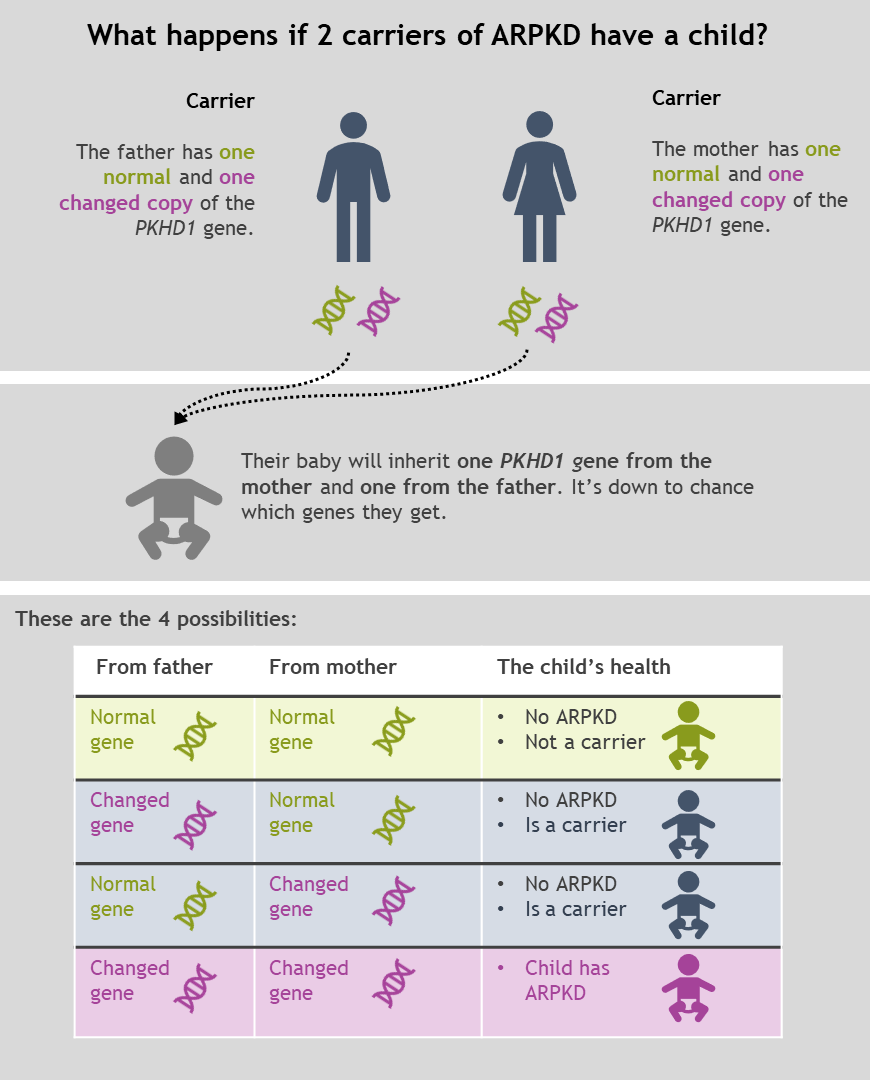
The 4 possible outcomes when 2 carriers of ARPKD have a child.
Yes, but the chance is very low.
Most people with ARPKD inherited changed PKHD1 genes from each parent.2 Much less often, a person inherited a changed PKHD1 gene from one parent and a change in their other PKHD1 gene happened by chance.
These new changes can happen in a father’s sperm or mother’s egg. They can also happen after conception (when a sperm fertilizes an egg). These new changes are sometimes called ‘spontaneous mutations’ or ‘de novo mutations’.
Out of 100 people with ARPKD, about 95 to 98 inherited a changed gene from each parent. About 2 to 5 in 100 have a new gene change that happened by chance.
What is genetic testing?
A genetic test can look for gene changes that cause health conditions.
A lab can do the test on any source of DNA. Usually, you give a blood sample. Doctors take other samples for genetic testing before birth — we explain this later.
In a genetics lab, a technician will use a machine called a sequencer to read the person’s DNA code. They’ll check the code for changes linked to ARPKD.
The technician might check the codes of specific genes linked to ARPKD and other kidney conditions. Or they might read a person’s entire DNA code. This is called ‘genomic testing’ (because a whole DNA code is called a genome). The genetics service should explain this to you beforehand.
Before having genetic testing for yourself or your child, you can have genetic counselling. Your GP or kidney doctor can refer you for this.
What is genetic counselling?
Genetic counselling is not the same as counselling for mental health issues. You could see a genetic counsellor, a clinical geneticist or a specialist genetic nurse. Some kidney doctors also provide genetic counselling.
They’ll give you information to help you decide whether to have a genetic test.

You’ll talk through:
- what ARPKD is
- the pros and cons of genetic testing
- the possible results
- how the results could affect you and your family
- how the gene could be inherited by future generations
People who are ARPKD carriers can also get advice on ways to have a child without ARPKD, if they choose.
After genetic counselling, you’ll choose whether you want to go ahead with the test. You don’t have to decide right away.
Expert Christine Patch tells us that having genetic counselling is very individual. People can react differently and make different choices. Your choices might be affected by:
- your views on risk
- your relationships with family members
- how others in your family react and their views
- the results of genetic tests
Families often find it hard to talk about genetic conditions and genetic testing. A specialist can give you and your family support on this.
Where will I have genetic counselling?
People usually go to their nearest NHS regional genetic centre for genetic counselling. Some centres organize clinics at local hospitals or health centres. This means you won’t need to travel as far.
The signs and symptoms of ARPKD can be similar to some other kidney conditions that cause cysts. Experts say it’s best to do a genetic test if a developing baby (fetus), newborn baby or child has multiple kidney cysts.
You can learn more about signs and symptoms of ARPKD on our pages ARPKD in babies and ARPKD in children and adolescents.
Genetic testing, can be useful in these situations:
- Your developing baby (fetus), newborn baby or child has signs of ARPKD. The test can usually confirm whether they have ARPKD or a different kidney condition.
- You and your partner have a child with ARPKD and are planning to have another child. Genetic testing can confirm whether you’re both carriers and the risk of having another child with ARPKD.
- If you and your partner are both carriers and you’re pregnant, you can have your developing baby (fetus) tested for ARPKD. You can decide whether to keep the pregnancy. If you go ahead, you and your pregnancy team can plan the right care for the birth.
- If you and your partner are both carriers and want a child without ARPKD, you might be able to have a special type of fertility treatment called preimplantation genetic testing (PGT). Your embryos will be tested and one without ARPKD will be put in the mother’s womb.

Who can have genetic testing?
Genetic tests for ARPKD are only available on the NHS to people at risk of having (or carrying) ARPKD. These people include:
- children and adolescents with signs of ARPKD
- babies with signs of ARPKD before or after birth
- parents and siblings of children with ARPKD
- developing babies (fetuses) of parents who are both carriers of ARPKD
ARPKD is very rare. Genetic testing is not available to people who aren’t at risk.
If you have a child with ARPKD and want to check whether their brothers or sisters have the disease, they may be able to have genetic testing.
Alternatively, doctors can check for ARPKD using ultrasound scans and a blood pressure check.
If you have a relative with ARPKD but they aren’t your sibling or child, you can’t usually have genetic testing on the NHS. This is because being a carrier rarely matters. The chance of your partner also being a carrier is 1 in 70.
Taking samples for genetic testing during pregnancy
If doctors think your developing baby (fetus) might have ARPKD, you might be able to have them tested for ARPKD during pregnancy. This is usually done between weeks 11 and 20 of pregnancy.
Your pregnancy doctor (obstetrician) will collect a sample of your fetus’s DNA. The two main ways to do this are:
- amniocentesis to take a sample of amniotic fluid
- chorionic villus sampling (CVS) to take a sample of cells from the placenta
We explain these procedures below. With either procedure, there’s a small risk of losing the pregnancy.
A specialist might also be able to say whether your baby is likely to have ARPKD using an ultrasound scan.
If tests show that your developing baby has ARPKD, you can choose whether to keep or end the pregnancy. This can be an extremely hard decision for parents and support is available. We talk about this on our web page on ARPKD in babies.
Call our helpline on 0300 111 1234 for support and advice. You can also contact us by email at [email protected] or on Facebook messenger.
Amniocentesis
For amniocentesis, a doctor uses a needle to take a sample of fluid from your womb (the amniotic fluid). They’ll use an ultrasound scan to see where they’re putting the needle. We show this in the picture below.
The test is usually uncomfortable but not painful.
You can usually have this test at weeks 15 to 20 of pregnancy.
The NHS has more information on amniocentesis.
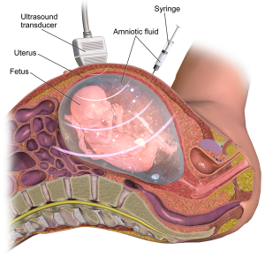
Drawing of amniocentesis. Picture from Creative Commons (Attribution-Share Alike 4.0 International license).
Chorionic villus sampling (CVS)
CVS is similar to amniocentesis, but the sample of cells is taken from the placenta [NHS CVS]. Your pregnancy doctor might put the needle through the opening to your womb (cervix) rather than through your abdomen.
The test is usually uncomfortable but not painful.
You can usually have this test at weeks 11 to 14 of pregnancy.
The NHS has more information on CVS.
How long does it take to get genetic test results?
If you or your child are the first people in your family to have genetic testing for ARPKD, the results could take a couple of months or more. If the gene change running in your family is already known, for example when undergoing genetic testing in pregnancy, your test result might come in 2 weeks. This is because the lab technicians will know which gene change they’re looking for.
What could the results of the test be?
If a person has ARPKD, genetic testing can usually find the cause.
For every 100 people with ARPKD who have testing, gene changes causing ARPKD are found in about 70 to 85 people (70–85%).
Here are the possible outcomes in more detail:
- The lab finds changes known to cause ARPKD in both PKHD1
- The lab finds a change in one PKHD1 They can’t find a change in the second PKHD1 gene.
- The lab can’t find any gene changes known to cause ARPKD.
- The lab finds an unusual code in the PKHD1 This code hasn’t been seen in other people and doctors aren’t sure whether it can cause ARPKD.
There’s also a small chance the lab will find a change in a different gene linked to ARPKD (DZIP1L or CYS1).
If you have a child with ARPKD but genetic testing doesn’t find any gene changes, you might still be able to have testing in future pregnancies. The lab will compare your DNA sample with those taken from your embryos or fetus.
Can genetic tests help doctors predict how severe a person’s ARPKD will be?
It’s hard for doctors to predict how severe a person’s ARPKD will be based on their genetic test results. This is because people with the same gene change sometimes have different ARPKD symptoms at different ages.
If both PKHD1 genes have changes called ‘truncating mutations’, ARPKD is usually severe. For other PKHD1 changes, doctors can’t always predict how severe ARPKD will be.
In one study, people with changes in the DZIP1L gene had milder ARPKD. They had kidney cysts but no liver cysts.
Your kidney specialist might be able to estimate how severe your baby’s or child’s ARPKD will be based on:
- whether they showed signs before birth
- what symptoms they have now, and when they started
Make sure you understand how accurate their predictions are.
Is a person’s DNA code stored after genetic testing?
The lab often reads a person’s complete DNA code when they have a genetic test for ARPKD. This is called ‘whole genome sequencing’. Although the machine reads all the DNA, the lab will only look at the genes linked to ARPKD and other kidney conditions.
Your doctor may ask if your (or your child’s) full DNA code can be stored in the National Genomic Research Library. This is done anonymously (meaning your name is not stored in the database). Researchers can ask to use the anonymous data in studies about the diagnosis and treatment of diseases.
You can choose whether or not to agree.
In one study, people with changes in the DZIP1L gene had milder ARPKD. They had kidney cysts but no liver cysts.
Your kidney specialist might be able to estimate how severe your baby’s or child’s ARPKD will be based on:
- whether they showed signs before birth
- what symptoms they have now, and when they started
Make sure you understand how accurate their predictions are.
Can I have a genetic test for ARPKD at a private clinic?
If you can’t have genetic testing on the NHS, ask your doctor to explain why. It might be that you’re not at risk of having ARPKD.
Some companies offer private genetic testing (meaning it’s not done by the NHS). You need to pay for this yourself or via health insurance. Before using a private company, ask about the expertise of the lab and the doctor analysing the results.
Genetic tests are technical and the results can be hard to understand. There are over 750 different changes in the DNA code that can cause ARPKD. So, it’s important the service is familiar with them.
What do the genes related to ARPKD do?
The 3 genes associated with ARPKD are codes for 3 different proteins:
- PKHD1 is the code for fibrocystin
- DZIP1L is the code for DZIP1L
- CYS1 is the code for cystin
These 3 proteins are found in cells that line fine tubes in the kidneys. These tubes are where urine (wee) is made.
The proteins are all found in special structures called cilia on the surface of cells. Cilia act like tiny sensors.
Researchers are still working out what jobs these proteins do. It’s possible they help to control how often new cells are made in kidney tubes.
Changes to the DNA code may alter the proteins, stopping them working properly. Sometimes, a DNA change means a protein isn’t made at all.
Experts think cysts might occur when too many cells grow in the kidney tubes. This can make a bulge, which could become a cyst.
Fibrocystin is also found in the liver. When there’s not enough fibrocystin in liver cells, scar tissue can form in the liver (fibrosis).
More from the PKD Charity
- ARPKD in babies
- ARPKD in children and adolescents
- Family planning for couples who are ARPKD carriers
Getting more information and support
- The NHS website has information on genetic and genomic testing.
- PatientPlus has a general overview of genetic testing.
- The Genetic Alliance has a lot of information on genetic testing, including a list of NHS genetic services.
- Tommy’s (a pregnancy and baby charity) has information on screening tests in pregnancy, including amniocentesis and CVS.
Authors and contributors
Original version written by Christine Patch, PhD RN, Reader in Genomic Healthcare, King’s College London, in 2016. Updated by Hannah Bridges, PhD, independent medical writer, HB Health Comms Limited, in 2025. Expert review by Dr Shalabh Srivastava, Consultant Nephrologist, City Hospitals Sunderland and South Tyneside NHS Foundation Trust, UK.
With thanks to all those affected by ARPKD who contributed to this publication.
Ref No: ARPKD.GCT.V2.0
Review Date: September 2029
Disclaimer: This information is primarily for people in the UK. We have made every effort to ensure that the information we provide is correct and up to date. However, it is not a substitute for professional medical advice or a medical examination. We do not promote or recommend any treatment. We do not accept liability for any errors or omissions. Medical information, the law and government regulations change rapidly, so always consult your GP, pharmacist or other medical professional if you have any concerns or before starting any new treatment.
Disclaimer regarding imagery: All photography appearing on this web page is for illustrative purposes only and is freely available via Pexels. The medical history of persons shown is unknown
We welcome feedback on all our health information. If you would like to give feedback about this information, please email [email protected]
If you don't have access to a printer and would like a printed version of this information sheet, or any other PKD Charity information, call the PKD Charity Helpline on 0300 111 1234 (weekdays, 9am-5pm) or email [email protected]
The PKD Charity Helpline offers confidential support and information to anyone affected by PKD, including family, friends, carers, newly diagnosed or those who have lived with the condition for many years.