
Maggie's Story
Volunteering with Heart
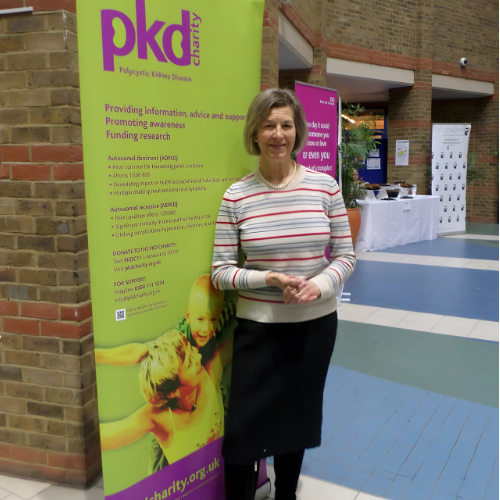
In our 25th year – and to mark Volunteers’ Week – we’re proud to celebrate the incredible contributions of Maggie, our very first volunteer who helped shape many of the ‘firsts’ in our charity’s history.
A PKD patient, Maggie has played a vital role in shaping the support we offer today. Here, she shares her story – from diagnosis to helping others, and what volunteering has meant to her.
“I was born in Kent and later moved to London to train as a general nurse. Over the years, I also worked in midwifery, as a health visitor and college lecturer. I’ve been married for 57 years, and we have two children. One has been tested for PKD and is clear. The other doesn’t want to be tested, and I respect that.
During both my pregnancies, I developed pre-eclampsia and had kidney infections. There was a family history of PKD, so in 1975 I had an X-ray – but it didn’t show any cysts. It wasn’t until 1987, when I was referred to the blood pressure unit at Charing Cross Hospital due to consistently high readings, that a scan finally revealed kidney and liver cysts.
I was frightened. I tore up the information leaflet and only told my husband and sister. She already had a diagnosis – she’s now 90! I’d seen other relatives suffer too. My aunt had a heart attack at 44 and later died of kidney failure. My uncle had a brain haemorrhage, and another relative had strokes and infections. Looking back, they likely had PKD too.
I was referred to Professor Anand Saggar at St George’s Hospital, co-founder of the PKD Charity, and a genetic test showed I had PKD2 – a milder, slower-progressing form of the disease compared to PKD1.
From Patient to Volunteer
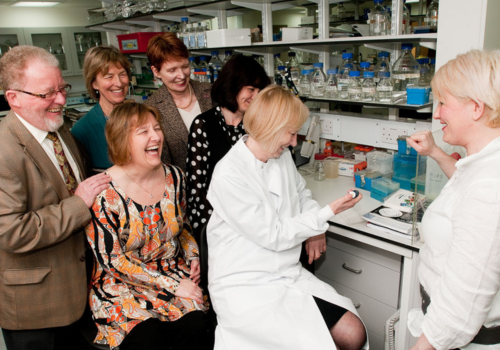
I joined one of Anand’s research projects. I remember carrying around 24-hour urine samples concealed in a Harrods bag while teaching! I also had to go through a long day of blood tests at the hospital. I was proud to contribute.
As the setting up of the charity was starting to take shape, I was invited to be a patient representative. There were just a few of us at the start – a doctor, a clinic manager, a researcher, and another patient who later became chair. My first task? Opening a bank account with our first £57 donation!
As the charity grew, I focused on patient support – something I cared deeply about. I remembered the shock, fear, and isolation I felt at diagnosis, and I wanted to make sure no one else felt that alone.
Supporting Others
With Tess Harris, who was CEO until she passed away in 2024 (and who became a great friend), I helped start the London support group. We first met in the crypt at St Martin-in-the-Fields, and later at the Rose Garden Café in Regent’s Park. I also travelled around the country attending information days and sometimes ran workshops on managing pain.
I answered the helpline for a few years, which was incredibly rewarding. Later, I helped set up a telephone befriending service, where volunteers were trained to support people with PKD through regular phone calls.
I led Befriender training days in London, Edinburgh and Glasgow – funded by the charity – because we felt it was so important to come across as professional and credible. Even when only one person attended, like in Glasgow, it was still worth it.
For a few years, I also took care of the Christmas card mailing – writing personal notes when we had fewer people on the list.
Our local post office was always happy to help!
Looking Back
One of my strongest memories is from the first Information Day in Cambridge. I travelled there with Gloria, our clinic manager.
I think around 50 people came. I was struck by how unwell some looked. There were talks from Anand, the chair, and a clinician who said, “I enjoy speaking to patients. I don’t usually get the chance.” That meant a lot.
The hardest part of living with PKD is knowing there’s no cure. It can be difficult for others to understand. People have more sympathy for heart problems – hearts are associated with love. Kidneys? People just think of urine. It’s not the same.
Now, as I approach 80, I feel lucky. My kidney function is still good for my age. I often feel guilty meeting people on dialysis or who’ve had transplants. Yes, I’ve had other symptoms, but I know I’ve been very fortunate.
Volunteering with the PKD Charity gave me purpose and helped me feel connected. I only stepped back when I took on more care for my grandchildren. Having PKD myself, I hope I was able to offer understanding and reassurance to others.”
We want to say a heartfelt thank you to Maggie – and to every volunteer who’s made a difference. Your time, care, and dedication have helped shape this charity into the strong, supportive community it is today. If Maggie’s story inspires you, please consider volunteering. Whether you’ve been affected by PKD or simply want to support a worthy cause, we’d love to welcome you as part of this journey.
If you would like to speak to us about what support we can offer you or a loved one, please visit PKD Support or contact us today and speak to a member of our team.