
What's happening in PKD research?
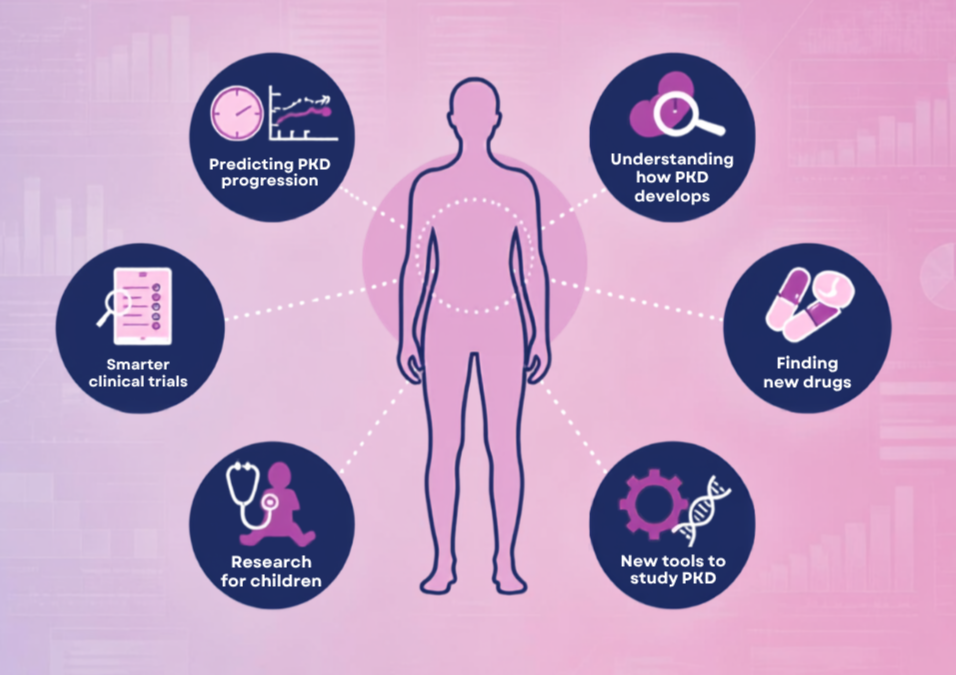
Research into polycystic kidney disease (PKD) is moving faster than ever. Scientists, doctors and other experts are working together to understand every stage of the disease.
Some researchers are studying why kidney cysts form and grow. Others use this knowledge to find new ways to slow down or stop cyst growth. These ideas can then be tested as possible new treatments for both autosomal dominant PKD (ADPKD) and autosomal recessive PKD (ARPKD), in adults and children.
Research is being supported by the new PKD Partnership. This is a collaboration between Kidney Research UK and the PKD Charity. It aims to improve our understanding of PKD and support the development of new treatments.
Below are some of the main areas of PKD research today.

Understanding how PKD develops
Researchers already know a lot about the genes and biology involved in PKD. New technology is helping them learn even more about how PKD affects individual people.
Scientists can now study:
- How PKD genes work
- How proteins behave in the body
- How different types of cells are affected by the disease
This information helps researchers understand why PKD develops. It also helps explain why the disease affects people in different ways.

Finding new drugs
At the moment, Tolvaptan is the only approved medicine for slowing the progression of ADPKD. However, it is not suitable for everyone and some people experience side effects. This means there is an urgent need for more treatment options. Researchers are looking at whether existing medicines could be used to treat PKD. They are also developing new medicines that could slow or stop the disease.
Before a new treatment is tested in people, it is studied in PKD cells in the laboratory. This helps researchers see whether a treatment is likely to work. It also improves the chances of success in clinical trials.
New tools to study PKD
Much of the progress in PKD research comes from improved laboratory techniques and technology. Researchers can now grow PKD cells in the laboratory. They can also create three-dimensional "mini kidneys" called organoids. These models behave in similar ways to real kidneys and can be used to test possible treatments.
Scientists are also exploring gene therapy. This involves introducing a healthy or repaired copy of a PKD gene into cells. Very early studies are looking at whether this approach could work for PKD. Advanced imaging technology lets researchers study PKD cells, cysts and kidney tissue in far more detail than before. This helps them understand how the disease develops and how treatments affect it.
Predicting PKD progression
Biomarkers are substances found in blood or urine that can provide information about a disease. Researchers are looking for biomarkers that can show how quickly PKD is progressing and whether a treatment is working. These markers may help doctors understand how the disease is changing over time. In the future, biomarkers could help doctors identify people who are more likely to develop symptoms sooner.
Smarter clinical trials
Research is helping to make clinical trials more accurate and efficient. Scientists combine information from laboratory studies, genetics, biomarkers and patient registries. These registries contain information such as medical records. This helps researchers match treatments to the people most likely to benefit from them. It also reduces the risk of treatments failing in clinical trials.

Research for children
Children are often unable to take part in clinical trials because of ethical concerns and limited research data. The PKD Partnership aims to support research that builds the evidence needed to develop better treatments for children with ADPKD and ARPKD. This work is important for helping children benefit from future advances in PKD research.
PKD Charity's role in research
The PKD Charity has supported research in many ways over the years. We have funded research projects, helped train future researchers and supported databases that allow scientists to learn from large groups of people affected by PKD. Today, most of our research funding is delivered through the PKD Partnership, a collaboration with Kidney Research UK. We also work to make sure people affected by PKD have a voice in research.
We believe research should focus on the issues that matter most to people affected by PKD. People affected by PKD can help researchers:
- Decide what questions need answering
- Improve the design of studies
- Guide research as it develops
This is called Patient and Public Involvement (PPI).
Through our Research Hub, we help researchers work with people affected by PKD. We also share opportunities to take part in research studies and clinical trials. This gives people with PKD and their families the chance to take part in research. It also helps shape future treatments.
The bigger picture
If you or someone you care about has PKD, progress can sometimes feel slow. Developing new treatments takes time.
However, every study helps us learn more about PKD. It helps us understand how the disease develops, who it affects and what might help slow it down.
We believe the people most affected by PKD should help shape the future of research. Research works best when it reflects the experiences of people affected by PKD. That is why we are committed to involving the PKD community whenever possible.
To learn more about taking part in research, visit our Take Part in a Study page. You can also use the comments box below to share your thoughts on the information above.
- Hits: 692