

Helpline

0300 111 1234

ADPKD basics

This information is for people who have recently found out they have autosomal dominant polycystic kidney disease (ADPKD). It’s also for their friends, families and carers. It answers many of the initial questions you may have about ADPKD.

Finding out you have ADPKD can be a difficult time. If you’d like emotional support, practical advice and information, contact our confidential helpline. Call 0300 111 1234 (9.30 am to 5.00 pm Monday to Friday, except bank holidays), email [email protected] or use Facebook messenger.

Key facts

  • Autosomal dominant polycystic kidney disease (ADPKD) is a rare health condition that some people are born with.
  • It causes fluid-filled pouches (cysts) to grow in your kidneys.
  • These cause damage to your kidneys over time, stopping them working properly.
  • However, most people stay in good health for decades after their diagnosis.
  • A kidney doctor (nephrologist) can check whether you have ADPKD using a kidney scan or genetic test.
  • ADPKD can lead to: high blood pressure, urinary tract infections, cyst infections, blood in your wee, kidney stones, pain and discomfort, and low kidney function.
  • People with ADPKD have regular check-ups with their kidney doctor and GP throughout life.
  • There is no cure for ADPKD.
  • Treatments can help with many of its symptoms.
  • Some people can take a medicine called tolvaptan to slow down kidney damage.
  • Many people eventually need dialysis or a kidney transplant.

What is ADPKD?

ADPKD is a rare health condition that some people are born with. It’s caused by a gene that’s usually inherited from a parent.

ADPKD is not a disease you can catch. It’s also not cancer.

It causes fluid-filled pouches (cysts) to grow in your kidneys. Some people with ADPKD get cysts in other organs too.

With the right care, people with ADPKD can stay healthy for much of their lives.

Kidney cysts grow over time, causing kidney damage. Your kidneys may eventually stop working properly, causing symptoms. This often happens at middle age.

Hearing that your kidneys might fail in the future can be scary. However, there are good treatments available. Most people live for many years after reaching kidney failure.

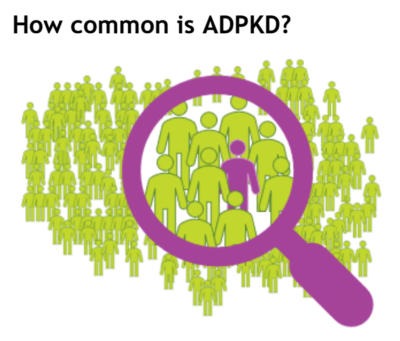
How common is ADPKD?

In the UK, about 1 person in every 1,000 to 2,500 are born with ADPKD. There could be between 30,000 and 70,000 people with ADPKD in the UK.

ADPKD can affect men and women and people of different ethnicities.

Illustration of a crowd of people, zooming in on a person with ADPKD.

Kidney cysts

Your kidneys contain fine tubes that filter your blood to make urine (wee). ADPKD causes fluid-filled pouches called cysts to form in these tubes.

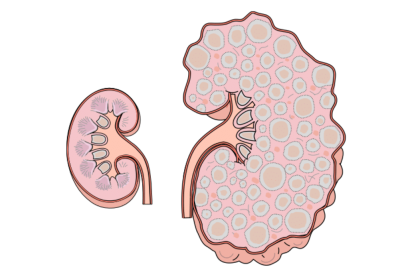
Kidney cysts caused by ADPKD grow bigger over time. The largest ones can be the size of a grapefruit. Many are smaller, such as the size of a pea.

Over time, these cysts could make your kidneys very large. We show this in the picture below.

A picture of a normal kidney compared with an ADPKD kidney. The ADPKD kidney is much larger and has many cysts of varying size.

Diagram: A normal kidney versus ADPKD kidney. The inside of a normal kidney is shown on the left, and a kidney of a person with ADPKD is shown on the right. The ADPKD kidney is much larger and has many cysts of varying size.

Kidney cysts can stop your kidneys working well. Eventually, your kidneys may stop working altogether. This is called kidney failure. It can be treated with dialysis, a kidney transplant, or with medicines to help with symptoms.

On average, people with ADPKD get kidney failure at about age 55 or 60 years. The timing differs a lot from person to person.

Some people with ADPKD never get kidney failure.

Cysts in other organs

Most people with ADPKD (8 out of 10) have liver cysts by their mid-thirties. Your liver will probably still work well. However, liver cysts can make your liver very large, causing symptoms.

Around 1 in 10 people get cysts in their pancreas. These almost never cause problems.

Some men with ADPKD get cysts in the tubes that carry semen and sperm. These cysts probably don’t affect fertility.

We explain further symptoms and problems caused by ADPKD later on this page.

How did I get ADPKD?

ADPKD is usually inherited. This means it’s caused by a gene that’s passed from a parent to their child. This happens at conception (when an egg and sperm meet to make an embryo).

Photo of two parents with their children.

Genes are codes for the proteins our cells need to grow and function. You can think of each gene as a recipe. We all have two copies of each gene, one from each parent.

If a gene code changes, this can alter the protein it makes. The protein may work less well or differently to normal. You might hear this gene change called a ‘mutation’ or ‘variant’. These changes can be inherited.

Most people with ADPKD inherited a gene change from a parent.

Less often, a new gene change causing ADPKD happens by chance when a baby is forming. This is called a spontaneous or de novo mutation.

Which genes cause ADPKD?

ADPKD is most often caused by a change in the PKD1 or PKD2 gene.

About 67 out of every 100 people with ADPKD (67%) have a PKD1 gene change.

About 15 out of every 100 (15%) have a PKD2 gene change.

Less often, ADPKD is caused by a different gene. For a few people with ADPKD, genetic tests don’t find the cause.

An illustration showing strands of DNA twisted together in a helix shape.

Picture: an illustration showing DNA strands, which make up genes.
Image by geralt, CC0, via Wikimedia Commons.

How is ADPKD diagnosed?

A kidney doctor (nephrologist) can check whether you have ADPKD using a kidney scan or genetic test.

Kidney scans

Kidney doctors often diagnose ADPKD using imaging scans of the kidneys.

Most often they use an ultrasound scan, which uses soundwaves to see inside your body. Less often, they use computed tomography (CT) or magnetic resonance imaging (MRI). A CT scan uses X-rays, while an MRI uses a powerful magnet and radio waves.

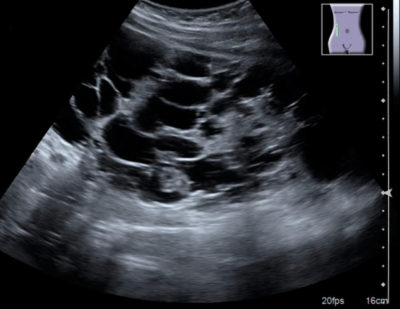
If you have cysts caused by ADPKD, your kidney doctor will see them on the scan.

An ultrasound image of a PKD kidney. The cysts appear as circles in a different colour.

Picture: Ultrasound image of a kidney in a person with ADPKD. The darker circles are cysts in the kidney. Image by Kristoffer Lindskov Hansen, Michael Bachmann Nielsen and Caroline Ewertsen, CC BY 4.0, via Wikimedia Commons.
Genetic tests

A genetic test looks for gene changes that can cause ADPKD. To do the test, a doctor or nurse will take a sample of your blood (or body fluid or tissue). They’ll send this to a laboratory to test.

These tests can be useful if:

  • your relative has ADPKD and the causing gene has been found — you can be tested to see if you have the gene change too
  • you have signs of ADPKD but a kidney scan doesn’t clearly show whether you have the condition
  • you have ADPKD and knowing which gene change you have would help your kidney doctor to plan your care
  • you have (or are approaching) kidney failure and a relative has offered to donate a kidney to you — the genetic test can check your relative doesn’t have ADPKD too, which would make them an unsuitable donor

Further health checks

If your kidney doctor diagnoses you with ADPKD, they’ll offer you more tests.

These may include:

  • blood and urine tests to see how well your kidneys are working
  • a check of your blood pressure
  • a review of your overall health
  • a liver scan to check for liver cysts
  • a brain scan to check for a swollen blood vessel in your brain (called a brain aneurysm), if you’re at higher risk

Brain aneurysms are more likely in people with ADPKD than the general population. If you’re at high risk of a brain aneurysm (for example, because a family member has had one), your treatment team will offer you a screening test.

Based on the results of these tests, your kidney doctor will explain how ADPKD is affecting you and any treatments you need. They can also explain how ADPKD might affect you in the future.

If you haven’t seen a kidney doctor yet, ask your GP to refer you.

Learn more on our webpage How is ADPKD diagnosed?

What problems does ADPKD cause?

ADPKD causes changes to your kidneys which can lead to symptoms and health problems. Some people also get problems in other areas of their body, including their liver and bowel (guts).

We cover the more common symptoms and problems caused by ADPKD below.

Not everyone with ADPKD gets these problems. They become more likely as you get older.

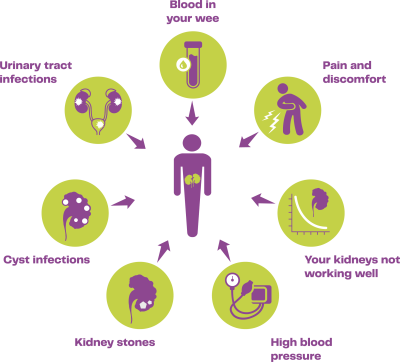
Diagram showing the more common symptoms of ADPKD: high blood pressure, urinary tract infections, cyst infections, blood in your wee, kidney stones, pain and discomfort, and your kidneys not working well.

Diagram: Symptoms and health problems caused by ADPKD.

High blood pressure

About 5 in every 10 people with ADPKD have high blood pressure. The medical term for this is hypertension.

On average, people with ADPKD get high blood pressure at about 30 years old. Some people get it earlier or later than this. Risk increases with age.

It’s important to treat high blood pressure because it can damage your kidneys. It can also increase your risk of having a stroke and heart problems.

Find out more on our webpage High blood pressure.

Urinary tract infections

Your urinary tract includes your kidneys, bladder and the tube you wee through (urethra).

Urinary tract infections are common in people with ADPKD. Women are more likely to get them than men.

Symptoms of urinary tract infections include:

  • pain or burning when you wee
  • needing to wee more often and suddenly
  • a high or low temperature (fever or chills)

If you get these symptoms, see your GP. They can run tests to check the cause and give you antibiotics.

Find out more on our webpage Urinary tract infections.

Cyst infections

Kidney and liver cysts can get infected with bacteria.

Symptoms of a cyst infection include:

  • pain in your back, side or abdomen (tummy)
  • blood in your wee
  • a high or low temperature (fever or chills)

If you get these symptoms, see your GP or kidney doctor right away. They can do tests to find the cause.

If you have an infection, you’ll need antibiotics.

Picture of a woman looking at a thermometer.

Kidney stones

Kidney stones are made of salts and minerals that have stuck together. They can be the size of a piece of gravel or a pebble.

People with ADPKD are more likely than the general population to get kidney stones. By middle age, at least 1 in every 10 people with ADPKD has been diagnosed with a kidney stone.

Symptoms of kidney stones include:

  • strong pain in your back or side
  • blood in your wee
  • a high or low temperature (fever or chills)

These symptoms are similar to those of cyst infections.

See your GP or kidney doctor if you have these symptoms. They can run tests to find the cause and get you the right treatment.

Find out more on our webpage Kidney stones.

Blood in your wee

About 6 in every 10 people with ADPKD get visible blood in their wee at times. The medical term for this is haematuria.

Blood in your wee can make it pink, red or brown. You might also see small lumps of solid blood.

This bleeding could be from:

  • a burst kidney cyst
  • kidney damage from a hard knock (during sport, for example)
  • a urinary tract infection
  • a cyst infection
  • a kidney stone

Usually, the bleeding stops in a few days with simple steps such as drinking plenty of fluid and rest.

See your GP or kidney doctor if:

  • the bleeding continues
  • you have other symptoms
  • you’re losing a lot of blood in your wee

They can do a urine test and refer you for further tests if needed.

Find out more on our webpage Blood in your wee.

Pain and discomfort

Cysts in the kidneys and liver can make these organs large. The larger they get, the more space they’ll take up.

This can cause:

  • a swollen abdomen (tummy)
  • pain in your abdomen, side or back pain
  • indigestion (heart burn)
  • feeling full early on in a meal
A photo of a person holding the side of their back.

Six out of every 10 people with ADPKD have long-term pain (chronic pain).

See your GP or kidney doctor if you’re in pain or discomfort. They’ll organize tests to find the cause, so you can have the right treatment.

Long-term pain is sometimes hard to treat. A team of specialists may be involved in your care.

Find out more on our webpage Pain.

Reduced kidney function

Our kidneys have several jobs:

  • They balance levels of chemicals and fluid in our blood, getting rid of what’s not needed.
  • They remove waste and toxins from our blood.
  • They help to control blood pressure.
  • They tell our bodies when to make more red blood cells (which carry oxygen).

Having ADPKD can make it harder for your kidneys to do these jobs. This is known as reduced kidney function.

Although ADPKD causes damage to the kidneys, the remaining healthy tissue can work well for decades.

Until your kidney function gets very low, you probably won’t have symptoms.

Your kidney doctor will keep track of your kidney function using blood tests and scans. Together, you’ll plan the care you need.

Find out more on our webpage Progression.

Kidney failure

Kidney failure means your kidneys are doing less than a sixth of the work of healthy kidneys. It’s also known as end-stage kidney disease or stage 5 chronic kidney disease.

On average, people with ADPKD reach kidney failure at about age 55 or 60 years. The timing differs a lot from person to person. Some people with ADPKD never get kidney failure.

Kidney failure causes a lot of problems but good treatments are available to help. These include dialysis, a kidney transplant and medicines to treat symptoms.

Your kidney team can usually predict a year or two before you get kidney failure. This means you can consider your treatment options and make plans ahead of time.

Find out more on our webpage Kidney failure.

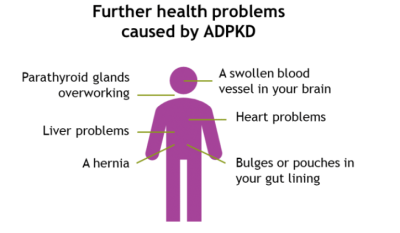
Further health problems caused by ADPKD

ADPKD can cause:

Monitoring and treatments are available for these problems.

Diagram showing further health problems caused by ADPKD, as listed below.

Check-ups throughout life

You’ll have regular check-ups with your kidney doctor and GP throughout your life. This is so they can monitor your health and get you the right treatments when needed.

Depending on your symptoms, you may see other specialists. Examples are a liver doctor (hepatologist), surgeon, pharmacist, dietitian and mental health counsellor.

Most people with kidney disease have check-ups 1 to 4 times a year. How often you’ll have check-ups will depend on your kidney health, general health, and which treatments you’re having.

Photo of a patient and doctor discussing test results.

Tests at check-ups can include:

  • blood and urine tests to check your kidney function
  • blood pressure checks
  • scans of your kidneys

Measuring kidney function

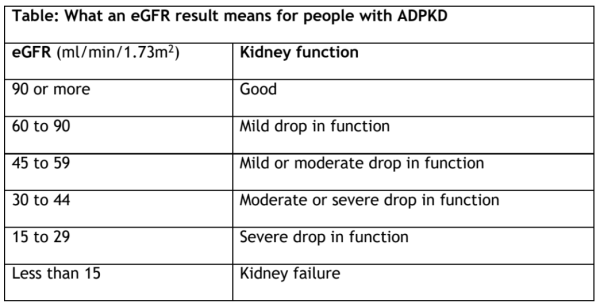
Kidney doctors usually use a measure called estimated glomerular filtration rate (eGFR) to check your kidney function. Your eGFR is an estimate of how much blood your kidneys can filter in 1 minute. It’s based on a blood test. We explain it more in the next section.

Other tests to check kidney function include:

  • a blood test for creatinine
  • a urine test for albumin
  • a urine test for blood in your wee

Your kidney doctor will explain the results.

Understanding your eGFR values

Kidneys that are working perfectly can filter about 100 ml of blood per minute.

The lower your eGFR, the worse your kidney function. We show this in the table.

It can help to think of eGFR as a percentage. For example, an eGFR of 40 means your kidneys are doing about 40% of the work they should be.

eGFR is a good estimate but the results sometimes come out a little high or low. The way your eGFR changes over months or years shows how fast your kidney function is falling.

Blood pressure tests

Blood pressure is a measure of how strongly your blood pushes against your artery walls as your heart beats.

ADPKD can cause high blood pressure, which may need treatment. So people with ADPKD usually have their blood pressure checked at least once a year.

You may have these checks at the kidney clinic, your GP surgery or a pharmacy. Your kidney doctor may suggest you monitor your blood pressure at home too.

Photo of a person having a blood pressure test. The person has an inflatable cuff on their arm which is linked to a pressure gauge and air pump.

Learn more about blood pressure monitoring on our webpage High blood pressure.

Getting the most out of check-ups

To get the most out of your health appointments:

  • Prepare well. For example, note down your recent symptoms and the questions you have.
  • Mention the most important points first (even if they’re tricky to talk about).
  • Ask the doctor or nurse to explain anything that isn’t clear.
  • Check your notes before you leave to make sure you’ve covered everything.
  • Ask who you can contact later if you have any questions.

For more advice, see our webpage Appointment tips.

How is ADPKD treated?

There is no cure for ADPKD but treatments can help with many of its symptoms. In addition, some people can take a medicine called tolvaptan to slow down kidney damage.

Treating symptoms

Medicines can help with many ADPKD symptoms. Different medicines can lower your blood pressure, treat infections or help to manage pain, for example.

Some people need to have surgery or smaller procedures, for example to drain and treat a cyst.

A person holding a pill and a water glass.

Tolvaptan to slow progression

A drug called tolvaptan can slow down cyst growth and kidney damage in some adults.

Tolvaptan might be suitable for you if:

  • you have reduced kidney function
  • your ADPKD is progressing rapidly

Find out more on our page on Medications to treat ADPKD.

Treating kidney failure

If your kidneys fail, treatment can help to filter your blood. This is known as kidney replacement therapy.

The best option is usually a kidney transplant, where you receive a donated kidney from a living or deceased donor.

If this isn’t possible, or if you would prefer, you can have dialysis.

There are two main types of dialysis:

  • For haemodialysis, a machine filters your blood to remove waste and extra fluid.
  • For peritoneal dialysis, you add fluid into a space in your abdomen (tummy). The fluid absorbs waste and fluid from your blood.

A third option is called conservative care. This means you receive treatments to help with the symptoms of kidney failure only.

A kidney transplant will do about half (50%) the work of a healthy kidney. Dialysis will do about one tenth (10%). This removes enough waste and fluid from your blood to reduce your symptoms and extend your life.

Find out more on our pages on Kidney transplants and ADPKD, and An introduction to dialysis.

How will ADPKD affect my life?

Finding out you have ADPKD can be a shock but it doesn’t mean you need to change your life greatly. Most people stay in good health for decades after their diagnosis.

A photo of an older woman enjoying a lunch outside with a group of people.

Daily life

Most people with ADPKD can still work, have children, go on holiday (including abroad) and keep active.

Of people with good or moderate kidney function, over 8 in every 10 say ADPKD doesn’t affect their daily life. Many report as good or better quality of life than the average person.

These people may still have symptoms occasionally. These are often due to a particular problem (such as an infection) and clear up with treatment. When symptoms occur, they can make it harder to work and keep active.

ADPKD might affect your life more as you get older and your kidney health worsens.

Of people with low kidney function or kidney failure, over 6 in every 10 say ADPKD affects their daily life. They may have ongoing symptoms such as daily pain and tiredness.

Living with long-term symptoms can be hard. Adjusting your routine and getting practical and emotional support can help.

We list some places to get support (including our helpline) later on this webpage.

Emotions and mental health

Finding out you have ADPKD may cause a range of emotions.

It’s common to:

  • be fearful of how ADPKD will affect your health, life and family
  • feel stressed, anxious or frustrated because doctors can’t say for sure how and when ADPKD will affect you
  • feel sad about how your life may change
  • resent that you inherited ADPKD or feel guilty about passing it to children

Photo of two people holding hands.

At least 3 in 10 people with ADPKD have anxiety or depression at some point in their life. Signs of depression can include loss of sex drive, difficulty sleeping and tiredness.

Your GP and kidney team are there to support your mental health as well as your physical health. If anxiety, depression or other issues are affecting your day-to-day life, let them know. They can help you get the right mental health support.

You can also get emotional support from:

Find out how others with ADPKD feel and how they manage their ADPKD on our webpage Living well.

Work

Most people with ADPKD can work, including those with low kidney function.

You might sometimes need time off work if your ADPKD causes symptoms. This is more likely as your kidney function falls.

You don’t have to tell your employer that you have ADPKD. However, if you explain how ADPKD affects you, your employer must make changes to help you do your job, if they can. These are called ‘reasonable adjustments’.

Find out more on our page Employment: PKD and work.

Insurance

Having a family history of ADPKD or a diagnosis of ADPKD could affect the cost of some insurance. This includes travel, life, private medical and critical illness insurance.

If you or other family members have been diagnosed with ADPKD, share this information if asked. If you don’t say, you might not be covered by your insurance if you need to make a claim.

If you’ve had a genetic test to predict whether you could develop ADPKD in the future but you don’t have symptoms and all other test results are normal, you don’t need to tell your insurance company.

Find out more on our page Insurance.

Driving

You must tell the DVLA if you have certain health problems.

A photo of a person driving a car.

We cover the rules for ADPKD and some related health problems in the table below.
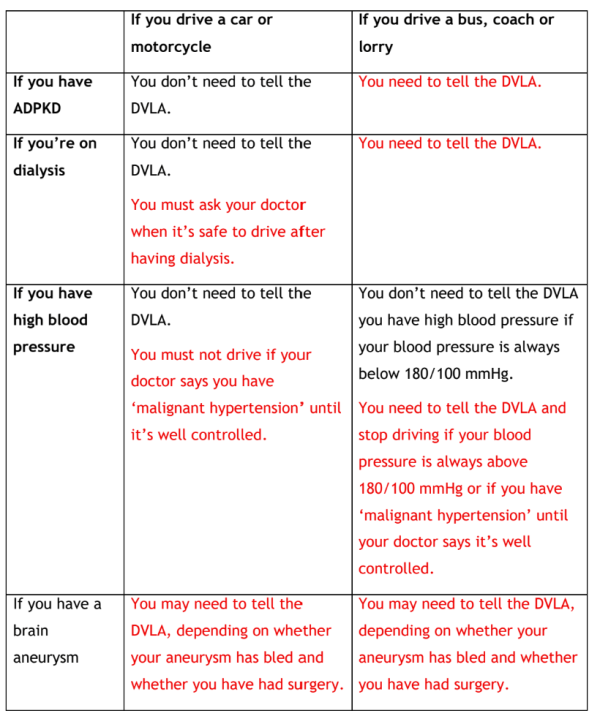
Ask your doctor for advice and always check with the DVLA for full advice.

What can I do to protect my kidneys?

Follow our tips below to stay as healthy as possible and protect your kidneys.

Don't smoke

Smoking can speed up kidney damage in people with kidney diseases. There have not been studies in ADPKD in particular. Smoking can increase your risk of a brain aneurysm and is bad for your general health.

Take blood pressure seriously

High blood pressure can damage your kidneys. It can also increase your risk of having a stroke and heart problems. If you have high blood pressure, control it as well as possible by taking your blood pressure medicine and following your doctor’s advice on diet and lifestyle.

Eat healthily

Dietitians don’t recommend a special diet for people with ADPKD unless they have low kidney function. A balanced diet can help you stay a healthy weight. This helps to slow down kidney damage and control your blood pressure.

Eat less than 5 grams of salt a day. This helps to slow down kidney damage and control your blood pressure.

You can drink alcohol but follow general NHS advice on safe amounts.

Exercise

Dietitians don’t recommend a special diet for people with ADPKD unless they have low kidney function. A balanced diet can help you stay a healthy weight. This helps to slow down kidney damage and control your blood pressure.

Eat less than 5 grams of salt a day. This helps to slow down kidney damage and control your blood pressure.

You can drink alcohol but follow general NHS advice on safe amounts.

Drink plenty of fluid

Experts think that drinking plenty of water (and other fluids) might slow down cyst growth and help to control blood pressure. While this isn’t proven, experts think it’s worth trying and unlikely to cause harm. Drink enough to stay well hydrated (meaning your wee is light in colour). Avoid having lots of drinks containing sugar or caffeine.

Use pain medications other than NSAIDs

Don’t take non-steroidal anti-inflammatory drugs (NSAIDs) to treat pain and swelling. Examples of NSAIDs are aspirin, ibuprofen, Nurofen® and diclofenac. These medicines can damage your kidneys. Only use them if your doctor says it’s okay. Your doctor or pharmacist can suggest other pain medicines, such as paracetamol.
What’s the chance of my child having ADPKD?

If you have ADPKD, there’s usually a one in two (50%) chance you’ll pass it on to each child you have.

Our cells contain thousands of genes. We have two copies of each gene — one inherited from our mother and one from our father.

If you have ADPKD, you’ll have one altered gene that is causing your condition. The other gene copy is probably normal.

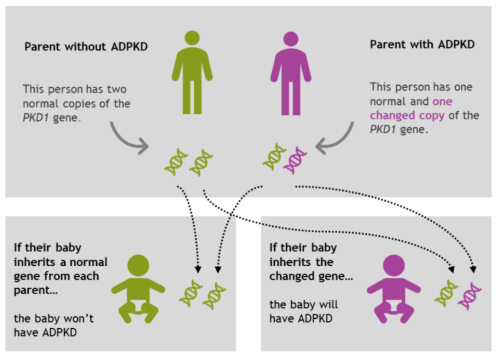
When you have a baby, it’s down to chance whether your baby will inherit the normal gene or the changed gene. If they get the changed gene, they’ll have ADPKD.

We show this in the diagram below using the PKD1 gene as an example.

Diagram showing how ADPKD is inherited, as explained in the text.

Diagram: How ADPKD is inherited. To keep things simple, we only show the PKD1 gene in this diagram. If you have an altered PKD2 gene or a rarer gene causing your ADPKD, the chance of you passing the gene on to your child is usually the same.

Nearly all people with ADPKD have a 50% chance of each baby having ADPKD. However, some people with de novo mutations can pass the gene on to their children and others can’t. Your kidney doctor or genetics specialist can explain this to you.

Find out more on our webpage Genetic testing and counselling.

Is there a way to have a baby without ADPKD?

If you want to be sure you have a baby without ADPKD, ask your doctor about preimplantation genetic testing. This is a special type of in vitro fertilization (IVF) where the clinic tests a couple’s embryos for ADPKD. They then put an embryo without ADPKD into the mother’s womb.

Find out more on our webpage ADPKD and pregnancy.

Nearly all people with ADPKD have a 50% chance of each baby having ADPKD. However, some people with de novo mutations can pass the gene on to their children and others can’t. Your kidney doctor or genetics specialist can explain this to you.

Find out more on our webpage Genetic testing and counselling.

What research is being done on ADPKD?

Researchers are studying ADPKD to better understand how it develops and how it can be treated. The PKD Charity helps to fund some of this research, sometimes in partnership with Kidney Research UK.

We also help to fund:

  • A library of thousands of cell, tissue, and fluid samples from people with and without ADPKD (The PKD Bioresource Bank). Researchers can ask to use the samples for their studies.
  • A registry of people with ADPKD, which collects data on their health and how their ADPKD progresses over time. This ADPKD Patient Registry is helping us to better understand ADPKD.

If you’re interested in joining the ADPKD Patient Registry, please email us at [email protected].

You can find out more about ADPKD research in our Research web area.

More from the PKD Charity

  • Our website has a wealth of information on ADPKD, including symptoms, treatments, and living well.
  • You’ll also find videos from educational events, including ‘Newly Diagnosed with PKD – a Q&A’ with kidney specialist Dr Matthew Gittus.
  • Find out about upcoming educational events on our website.
  • For printed information, emotional support and practical advice, contact our confidential Helpline. Call 0300 111 1234 (weekdays, 9.30 am to 5.00 pm, except bank holidays), email [email protected] or use Facebook messenger.

Information and support from others

  • Kidney Care UK provides emotional, practical, and financial support to people with kidney disease.
  • The National Kidney Federation supports people with kidney disease in the UK. They can connect you with another person with experience of kidney disease for support.
  • Kidney Research UK has information on kidney disease and research.
  • InfoKID provides information to parents and carers of babies, children, and young people with kidney disease.
  • The NHS website has information on a wide range of health topics.

The photos on this webpage are freely available on Pexels.com. The medical history of the persons shown is unknown.

Authors and contributors

Written by Hannah Bridges, independent medical writer, HB Health Comms Limited. Reviewed by Osasuyi Iyasere, Consultant Nephrologist, University Hospitals of Leicester NHS Trust, and Honorary Senior Lecturer, University of Leicester.

With thanks to all those affected by ADPKD who contributed to this publication.

Ref No: ADPKD.IWTKM.V3.0

Last updated: September 2025

Next scheduled review: September 2028

Disclaimer: This information is primarily for people in the UK. We have made every effort to ensure that the information we provide is correct and up to date. However, it is not a substitute for professional medical advice or a medical examination. We do not promote or recommend any treatment. We do not accept liability for any errors or omissions. Medical information, the law, and government regulations change rapidly, so always consult your GP, pharmacist, or other medical professional if you have any concerns or before starting any new treatment.

If you don't have access to a printer and would like a printed version of this information sheet, or any other PKD Charity information, call the PKD Charity Helpline on 0300 111 1234 (weekdays, 9am–5pm) or email [email protected].

The PKD Charity Helpline offers confidential support and information to anyone affected by PKD, including family, friends, carers, newly diagnosed individuals, or those who have lived with the condition for many years.

Feedback

We welcome feedback on the information provided on this webpage. If you have any feedback regarding the information provided on this webpage, please complete the Feedback Form