Helpline

0300 111 1234

Giving birth with ADPKD

Giving birth with ADPKD 

This information is for women with autosomal dominant polycystic kidney disease (ADPKD) who are planning the birth of their baby. It’s also for their partner, family and friends. It explains the extra care that is available during birth to help keep you and your baby safer. We also have web pages on planning a pregnancy and being pregnant.  

If reading about the risks of birth causes you any worry, our helpline is available on 0300 111 1234, Facebook Messenger and by email on [email protected]

Contents

Key facts

  • You can choose where you give birth. 
  • Your pregnancy care team (antenatal team) will explain the pros and cons of different settings. 
  • Your pregnancy doctor (obstetrician) may advise you to give birth in hospital if your kidneys don’t work well. 
  • They might also advise this if you have high blood pressure, pre-eclampsia or have had other pregnancy problems. 
  • Your midwife or obstetrician will monitor your baby during your labour. 
  • They may offer extra monitoring for your baby’s heart. 
  • Some but not all women with ADPKD have surgery (a caesarean) to deliver the baby. 
  • Your midwife or obstetrician will explain different types of pain relief for labour and birth. 
  • If your kidneys don’t work well, some pain killers might not be suitable for you, or you may need a lower dose.  
  • You should have a check-up with your kidney specialist within 6 months of giving birth. 

Where will I give birth? 

You can choose where you give birth. This could be at home, at a birth centre led by midwives, or in the hospital. For more information on these options, see the Tommy’s website. Tommy's are a charity that provide information and support around pregnancy.  

Your antenatal team will explain the pros and cons of different settings. This depends partly on how your pregnancy has gone and any previous births you’ve had. 

Your pregnancy doctor (obstetrician) may advise you to give birth in hospital if your kidneys don’t work well. They might also advise this if you have high blood pressure, pre-eclampsia or have had other pregnancy problems. 

Hospitals are best equipped to monitor you and your baby closely. They can quickly give you any extra care needed.  

Your antenatal team should respect your choices for the birth. 

A photo of a couple looking at their newborn baby

How will our baby be monitored during labour and birth? 

Your midwife or obstetrician will monitor your baby during your labour. They may offer extra monitoring for your baby’s heart. This is called continuous cardiotocography (CTG).  

CTG allows midwives and doctors to see your baby’s heart rate. If there are any signs of problems, they can give you and your baby the care you need right away.  

What type of delivery will I have? 

Your obstetrician will talk you through options for your baby’s delivery.  

The two options are: 

  • giving birth through your vagina  
  • having surgery (a caesarean or ‘C-section’)  

You can learn about types of delivery on the Tommy’s website.  

Your obstetrician will explain the pros and cons of each option. 

If you’ve had some problems during pregnancy, your obstetrician might recommend you give birth early. This could be 1 or 2 weeks before your due date, for example.  

If you have the baby early options are: 

  • a caesarean 
  • using medicines or devices to start your labour (induction) 

Some but not all women with ADPKD have a caesarean.  

If you or a close relative have had a brain aneurysm, your obstetrician might recommend a caesarean.  

What options will I have for pain relief during labour and birth? 

Your midwife or obstetrician will explain different types of pain relief for labour and birth. They’ll offer all options unless there’s a reason some wouldn’t be suitable. 

You can choose to give birth without medicines for pain relief if you prefer.  

Options for pain relief include: 

  • a machine that uses a small electric current to reduce pain, called a transcutaneous electrical nerve stimulation (TENS) machine 
  • injections of strong pain killers (pethidine and diamorphine) 
  • breathing a mix of nitrous oxide gas and air (Entonox®) 
  • an injection of numbing medicine (anaesthetic) into your spine, which is called an epidural 

If your kidneys don’t work well, some pain killers might not be suitable for you, or you may need a lower dose.  

Using a birthing ball or giving birth in water might help to ease pain a little.  

Which pain killers can I use after the birth? 

Ask your doctor which pain killers you can use after the birth. 

  • Don’t take non-steroidal anti-inflammatory drugs (NSAIDS), such as ibuprofen (Nurofen®) or diclofenac (Voltarol®) unless your doctor says this is okay. These medicines can harm your kidneys.  
  • You can use paracetamol even if you’re breastfeeding. 
  • Don’t take codeine if you’re breastfeeding.  

Can I breastfeed? 

If you want to breastfeed, check with your GP or kidney doctor that this is safe with any medicines you take. If any medicines would be a problem, you might be able to change them.

How can we find out whether our baby has ADPKD?  

Unless you have had pre-implantation genetic testing (PGT) or chorionic villus sampling, you won’t know whether your baby has ADPKD before they’re born. We explain these tests on our webpage on planning a pregnancy. 

It’s uncommon for signs of ADPKD to show up on scans during pregnancy. Most children with ADPKD don’t have symptoms until they’re older. 

Children can be tested for ADPKD if either parent has the condition. 

The two types of test are: 

  • a kidney scan 
  • a genetic test to look for a gene causing ADPKD  

You can find out about these tests on our webpage Symptoms of ADPKD and tests in children. 

Do I need a kidney check-up after birth? 

You should have a check-up with your kidney specialist within 6 months of giving birth.  

They’ll check your kidney function and blood pressure. They’ll suggest changes to any blood pressure medications you take, if needed, to control your blood pressure better.   

Where can I get practical and emotional support? 

For information, practical advice and emotional support from people with experience of ADPKD, ring our confidential PKD Helpline 0300 111 1234. We’re open 9:30am to 5:00pm, Monday to Friday, except bank holidays. 

You can connect with other people with ADPKD via our Facebook group or PKD support groups. 

The charities Tommy’s and the National Childbirth Trust (NCT) also offer advice on pregnancy, birth, miscarriage, caring for babies and more.  

A private doula can also provide practical advice and emotional support. Doulas are not medically trained but have experience of how to help people through pregnancy, birth and afterwards. Find out more on the Tommy’s website. 

Will my ADPKD affect how well I can parent? 

Having ADPKD won’t stop you being a good parent.  

You might need more support with childcare if you’re unwell or having treatment.   

Ask your kidney doctor to explain how your ADPKD may affect your health as you get older. 

Chat with your partner, family and friends about any worries. Having their support and putting plans in place can be reassuring.  

You may find it helpful to talk to other parents with ADPKD. You can connect with them through our Facebook group or support groups.

More information from the PKD Charity 

Useful information from others 

  • Tommy’s (a pregnancy and baby charity) has lots of information on giving birth. 
  • The NHS website has information on birth. 

Authors and contributors

Written by Hannah Bridges, independent medical writer, HB Health Comms Limited. Reviewed by Dr Mairéad Hamill, Nephrology Specialist Registrar, Kings College London, London, UK. 

This page was adapted from an earlier version written by Dr Kate Bramham, Consultant Nephrologist and Olivia Snowball, Research Midwife. 

With thanks to all the people affected by ADPKD who contributed to this publication. 

Ref No: ADPKD.BEP.V4 
© PKD Charity 2026 (Charity no: 1160970)
First published: August 2026 
Due to be medically reviewed: August 2029 
 

Disclaimer: This information is primarily for people in the UK. We have made every effort to ensure that the information we provide is correct and up to date. However, it is not a substitute for professional medical advice or a medical examination. We do not promote or recommend any treatment. We do not accept liability for any errors or omissions. Medical information, the law and government regulations change rapidly, so always consult your GP, pharmacist or other medical professional if you have any concerns or before starting any new treatment. 

If you don't have access to a printer and would like a printed version of this information sheet, or any other PKD Charity information, call the PKD Charity Helpline on 0300 111 1234 (weekdays, 9am–5pm) or email [email protected] 

The PKD Charity Helpline offers confidential support and information to anyone affected by PKD, including family, friends, carers, newly diagnosed or those who have lived with the condition for many years. 

Read more …Giving birth with ADPKD

  • Hits: 604

Planning a pregnancy if you have ADPKD

Planning a pregnancy if you have ADPKD

This information is for people with autosomal dominant polycystic kidney disease (ADPKD) who are thinking of having a baby. It’s also for their family and friends. It answers questions you’re likely to have, such as whether you can get pregnant or will your baby have ADPKD? Also, what extra steps help to look after you and your baby’s health? We have separate pages on being pregnant and giving birth.

If reading about the risks of pregnancy causes you any worry, our helpline is available on 0300 111 1234, Facebook Messenger and by email on [email protected].

Contents

Key facts

  • It’s a good idea to talk to your GP and kidney doctor before trying to get pregnant.
  • They can explain any extra care you might need and check whether you need to stop or swap any medicines.
  • How well women’s kidneys work can affect how easily they get pregnant (their fertility).
  • ADPKD doesn’t usually affect men’s fertility but may cause difficulties with sex.
  • If you and your partner are having problems getting pregnant, fertility services and other treatments can often help.
  • Most women with ADPKD have successful pregnancies.
  • If you have ADPKD, your chance of having some problems during pregnancy may be higher than other women.
  • Treatments are available for these problems.
  • If your kidneys don’t work well, your baby is more likely to grow slowly. They could be born a low weight, be born early and need care in a special unit.
  • If you want to be sure you have a baby without ADPKD, you might be able to have a special type of in vitro fertilization (IVF) where your embryos are tested for ADPKD.
  • Another option is to have your developing baby (fetus) tested for ADPKD early in pregnancy.
  • The amount that pregnancy could affect your kidneys depends, in part, on how well they work currently.
  • Your alternatives to pregnancy may include surrogacy or adoption.

Can women with ADPKD get pregnant?

How well your kidneys work may affect how easily you can get pregnant (your fertility).

If your kidneys work quite well, ADPKD probably won’t affect your fertility.

If your kidneys don’t work well, it might be harder to get pregnant. You may have low levels of some hormones in your body. This means your ovaries are less likely to release an egg each month (ovulate).

If you’re not having success getting pregnant, ask your GP (doctor) to refer you to a fertility specialist. They can look into why and talk you through options to help.

In vitro fertilization (IVF) helps many people with kidney disease to have a baby. It has a few risks.1 Ask the fertility specialist to explain these.

Find out how IVF works on the Tommy’s website. Tommy's are a charity that provide information and support around pregnancy.

Photo of a couple holding a pregnancy test stick.

Can men with ADPKD father children?

ADPKD doesn’t usually affect men’s fertility (the chance of their sperm fertilizing an egg).

Some men with ADPKD have cysts in the tubes that carry semen and sperm.3 ADPKD can also affect sperm (for example, reducing how well sperm can swim).

Despite these changes, most men with ADPKD are probably fertile. There hasn’t been much research on this so we can’t be sure.

Men whose kidneys don’t work well (chronic kidney disease) often have problems getting or keeping an erection. Some may have less interest in sex or have problems ejaculating (‘coming’).

If you’re trying for a baby and aren’t having success, speak to your GP. Changing your kidney treatments or using treatments for erection problems may help. Your doctor can also arrange for you to see a fertility specialist or suggest counselling to work through sexual issues.

How might ADPKD affect my pregnancy?

If you have ADPKD, your chance of having some problems during pregnancy may be higher than other women. The worse your kidneys work, the greater the chance of problems. We explain some of these problems below.

Some problems during pregnancy could affect your health or your baby’s. However, most problems can be managed with treatment and careful monitoring.

Most women with ADPKD have successful pregnancies. This includes women with ADPKD who have had a kidney transplant.

Before getting pregnant, speak to your kidney doctor (nephrologist) about how your ADPKD might affect pregnancy. Also ask your GP to refer you to a pregnancy specialist (obstetrician) for advice. 

A team of pregnancy experts called an antenatal team will monitor you carefully throughout your pregnancy. This means they can pick up any problems quickly and get you the right treatment.

Miscarriage

Loss of a pregnancy before week 23 is called miscarriage. Miscarriage is common in the UK. It happens in about 15 out of every 100 pregnancies in the general population.

We are not sure whether having ADPKD affects your chance of having a miscarriage.

Studies have shown that women with chronic kidney disease have a higher risk of miscarriage. However, many women with ADPKD at childbearing age have kidneys that work quite well. So, the results of studies in chronic kidney disease might not be relevant to all women with ADPKD. 

You can learn more about miscarriage on the Tommy’s website.

Blood pressure problems

If you have ADPKD, you’re more likely to get blood pressure problems during your pregnancy than other women. This is why your blood pressure should be monitored during pregnancy.

  • If you already have high blood pressure, this could worsen during pregnancy.
  • If you don’t have high blood pressure, you could develop it during pregnancy (this is called gestational hypertension).
  • You could get a problem called pre-eclampsia, where your blood pressure gets very high. This can be dangerous for you and your baby.

You’re more likely to get pre-eclampsia if your kidneys work poorly.

Most women with high blood pressure and pre-eclampsia have successful pregnancies. However, these conditions need careful management to keep you and your baby safe.

Very high blood pressure caused by pre-eclampsia usually reduces within days of giving birth.

Urinary tract infections

Women with ADPKD are more likely to get urinary tract infections while pregnant than other women. These infections sometimes travel to the kidneys.

If you get an infection, you’ll need antibiotics to treat it.

Effects on the baby

If your kidneys don’t work well (low kidney function), your baby is more likely to:

  • grow slowly or be born a low weight
  • be born early (premature birth)
  • need care in a special unit (a neonatal unit) after birth

A recent study looked at over 1600 pregnant women with ADPKD in the UK. These women were not on dialysis, had not had a transplant and most had near normal kidney function. Fewer than 2 in every 10 women (17%) had a premature baby (birth before 37 weeks). (A full-length pregnancy is about 40 weeks.)

A different study looked at pregnant women with ADPKD who had low or very low kidney function. About 7 in every 10 women (70%) had a premature baby (birth before 37 weeks). The women with high blood pressure were most likely to have a premature baby.

Premature babies often need special care in a neonatal unit. You can find out more about specialist neonatal care on the NHS website.

Will our baby have ADPKD?

If you or your partner have ADPKD, there’s a 1 in 2 (50%) chance of your baby having ADPKD. This risk is the same for each child you have.

ADPKD is caused by a gene change:

  • If your baby inherits the changed gene from the parent with ADPKD, they’ll have ADPKD.
  • If your baby inherits a healthy gene from both parents, they won’t have ADPKD.

Find out more about how ADPKD is passed to children on our page Genetic testing and counselling for ADPKD.

Are there ways to have a baby without ADPKD?

If you or your partner have ADPKD and you want a baby without the condition, your options may include:

  • If the man has ADPKD, you could use a sperm donor.
  • If the woman has ADPKD, you could use an egg donor.
  • You might be able to have a special type of IVF that selects an embryo without ADPKD. This is called pre-implantation genetic testing (PGT).
  • You could have your developing baby (fetus) tested for ADPKD early in pregnancy. This is called chorionic villus sampling. You can choose whether to continue the pregnancy depending on the results.

Pre-implantation genetic testing

A few fertility clinics can offer people with ADPKD a special type of IVF called pre-implantation genetic testing (PGT).

For PGT, the clinic will test embryos made by IVF to find ones without ADPKD. An embryo without ADPKD is put in your womb. This means your baby won’t have ADPKD.

About a third of couples having PGT have a baby.

If you want to look into PGT, the first steps are:

  • Ask your GP whether PGT is available on the NHS in your area.
  • Ask your doctor to refer you to a genetics specialist to discuss PGT.
  • If the genetics service agrees you can have PGT, you’ll need to go to a specialist centre. There are not many in the UK so you may need to travel quite far.

To have PGT, the person with ADPKD will need genetic testing to find the gene causing their ADPKD.

Find out more about PGT on the Genetic Alliance website.

You may choose to have PGT privately if you can’t get NHS funding. Learn about choosing a clinic on the Human Fertilisation and Embryology Authority website.

Chorionic villus sampling

If you or your partner have ADPKD, you can have your developing baby (fetus) tested for ADPKD in the womb. This is called chorionic villus sampling. It’s done at weeks 11–14 of pregnancy.

To do the test, your pregnancy doctor will take a sample of cells from the placenta. This is usually done by putting a needle through your abdomen (tummy).

There’s a small risk of the test leading to miscarriage. This happens in fewer than 1 in every 200 women.

Doctors only recommend chorionic villus sampling when the results would help you decide whether to end a pregnancy. 

See the NHS website for more on:

Our helpline is available on 0300 111 1234, Facebook Messenger or email ([email protected]) for emotional support.

The charity Antenatal Results and Choices has a helpline for people considering the results of these tests. Call 0207 713 7486 or text 07908 683004.

How should we plan a pregnancy?

Here are 4 tips on planning a pregnancy.

1. Use contraception until the time is right

Use contraception until you’re ready to start trying for a baby. Your GP or kidney doctor can suggest suitable contraceptives for you.

They might suggest you use a contraceptive that doesn’t contain oestrogen. This depends on how ADPKD is affecting you. For example, your doctor may recommend you use contraceptives without oestrogen if you have liver cysts or if you have high blood pressure.

Emergency contraception (‘the morning after pill’) made with progesterone only is usually safe for women with kidney disease.2 Remember to let the pharmacist or GP know you have ADPKD.

2. Ask your GP or kidney doctor for advice

It’s useful to talk to your GP or kidney doctor before getting pregnant.

They can explain:

  • how ADPKD might affect your pregnancy
  • how having a baby might affect your kidneys
  • whether you need to change any medicines before or during pregnancy
  • the chance of your baby having ADPKD

They can also refer you to other experts for advice, such as:

  • a pregnancy doctor (obstetrician)
  • a specialist in genetics
  • a fertility specialist

They can make sure your kidney health and blood pressure are managed well, ready for pregnancy.3

If you’re on dialysis, your kidney doctor will explain any changes you might need to make.2

3. Take folic acid

All women trying to get pregnant (including those with ADPKD) should take folic acid Women usually take folic acid when trying to get pregnant and for the first 12 weeks of pregnancy.

Folic acid reduces the risk of problems with your baby’s spine and spinal cord.

4. Follow general advice on healthy living before pregnancy

Health advice for women trying to get pregnant includes:

  • stay a healthy weight
  • don’t smoke
  • don’t drink alcohol

You can learn more about trying to get pregnant on the NHS website.

What if we’re having trouble getting pregnant?

If you’re having trouble getting pregnant, speak to your GP. They’ll refer you to a fertility clinic or can provide treatment to help.

A doctor at a fertility clinic will explain:

  • the different fertility treatments available
  • the chance of success
  • any risks involved

One of the options might be in vitro fertilization (IVF).

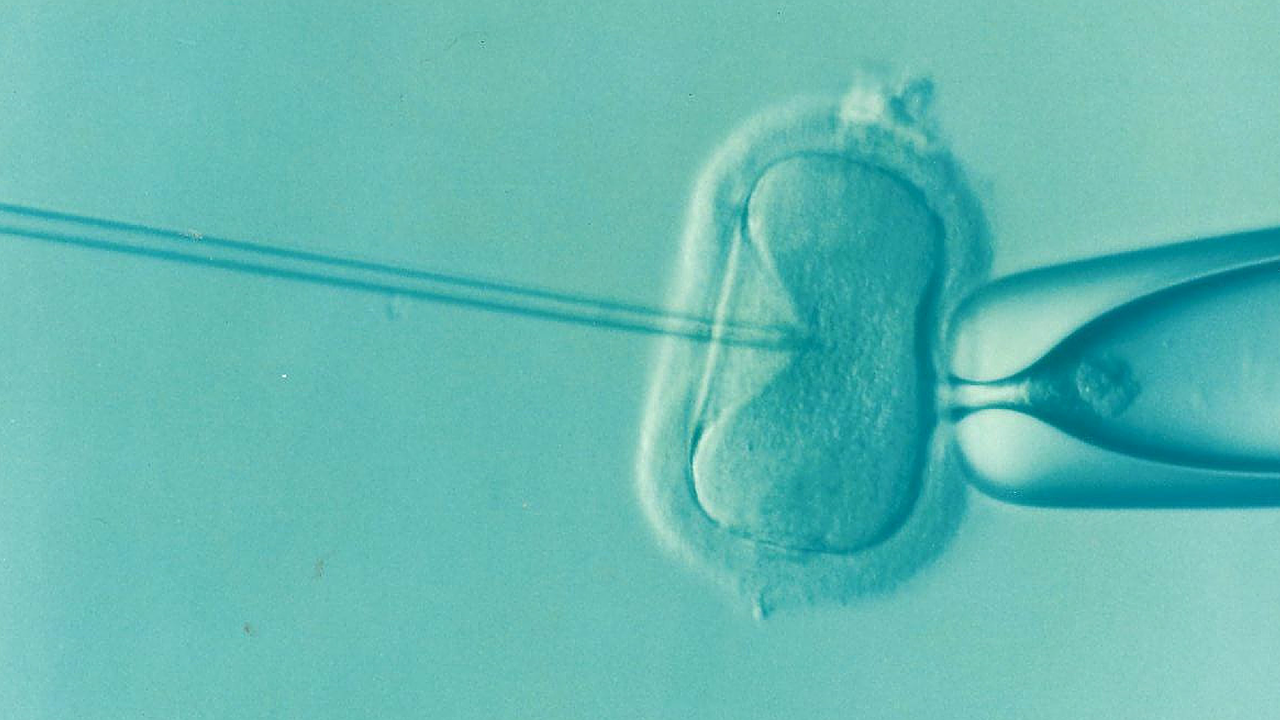
Image of an egg being injected with a sperm using a minute needle

Having IVF

If a fertility specialist thinks IVF may help you, a group of people (a local board) will decide whether the NHS will pay. Rules can differ by area of the UK.

The board’s decision may depend on:

  • your age
  • how long you’ve been trying to get pregnant
  • your weight
  • whether you smoke
  • whether you already have children
  • why your fertility is low

You can learn more about IVF on the NHS website.

You may choose to pay for IVF yourself if you can’t get NHS funding. Learn about choosing a clinic on the Human Fertilisation and Embryology Authority website.

Your fertility specialist may advise you against standard IVF if ADPKD is badly affecting your kidneys or liver. This is because the high doses of hormones used could make things worse. You might be able to have IVF without taking these hormones but it’s less likely to work.

Medicines in pregnancy

Which medicines can be a problem during pregnancy?

Some medicines are unsafe to use during pregnancy. They could harm your growing baby in the womb. We list some of these medicines in the table below.

Ask your doctor to review your medicines before you get pregnant. If you’re already pregnant, ask for a review right away.

Never stop taking medicines without talking to a doctor first. This could put you or your baby at risk.

You might need to swap to a different medicine, rather than stopping treatment. For example, women taking medicine for high blood pressure usually swap to a different medicine during pregnancy. This ensures that their blood pressure is still controlled, which is important for pregnancy.

Medicines that your doctor may advise you to stop or swap during pregnancy

Medicines to reduce cyst growth 

  • Tolvaptan (Jinarc®)

Medicines to control blood pressure

  • Angiotensin converting enzyme inhibitors (ACE inhibitors): captopril, enalapril, fosinopril, imidapril, lisinopril, moexipril, perindopril, quinapril, ramipril and trandolapril 
  • Angiotensin-II receptor blockers (ARBs): azilsartan, candesartan, eprosartan, irbesartan, losartan, olmesartan, telmisartan and valsartan  
  • Thiazide-like diuretics: chlortalidone, indapamide, metolazone and xipamide  

Medicines to treat overactive parathyroid glands 

  • Calcimimetics: cinacalcet and etelcalcetide

Medicines to treat high phosphate levels 

  • Non-calcium-based phosphate binders: sevelamer, lanthanum and sucroferric oxyhydroxide.

Antibiotics

·       Erythromycin and clarithromycin if you’re also taking the immunosuppressant tacrolimus or ciclosporin.

Immunosuppressants (used after kidney transplant)

  • Mycophenolate mofetil, methotrexate, cyclophosphamide, sirolimus and everolimus 
  • Rituximab (if a different medicine is suitable for you) 

Will being pregnant harm my kidneys?

Pregnancy can cause some damage to your kidneys. 

If your kidney function is medium (chronic kidney disease stage 3), having a baby could slightly affect your kidneys. The damage is about the same as ADPKD would usually cause over 2 years. 

If your kidney function is poor (chronic kidney disease stage 4 or 5), having a baby could affect your kidneys quite a bit. The damage is about the same as ADPKD would usually cause over 5 years. 

If you get high blood pressure during pregnancy, your kidneys are more likely to get some damage. 

Your kidney doctor can explain: 

  • how pregnancy might affect your kidney health 
  • how you can reduce risks 
  • signs of kidney problems to look out for 
  • treatments to help  

Will being pregnant harm my liver?

Many women with ADPKD have cysts in their liver. This is known as polycystic liver disease (PLD).  

Pregnancy can increase the growth of liver cysts. However, experts think pregnancy doesn’t increase your chance of having serious problems from PLD. There’s not been much research on this, so we can’t be sure.  

What about surrogacy or adoption?

If pregnancy is impossible or dangerous for you, surrogacy might be an option. This means another woman (the surrogate) carries your baby for you. Surrogacy is also an option for same-sex couples and people who are single.

The NHS does not fund surrogacy.

Find out about surrogacy on the Human Fertilisation & Embryology Authority website.

Another option for you may be adoption. As part of the approval process for adoption, the agency will assess your health. People with a long-term condition like ADPKD might be allowed to adopt.

The agency will explore with you:

  • whether your health might affect your ability to bring up children
  • the support you’ll have from your partner, close family and friends

Find out about adoption on the You Can Adopt website.

Where can I get practical and emotional support?

For information, practical advice and emotional support from people with experience of ADPKD, ring our confidential PKD Helpline 0300 111 1234. We’re open 9:30am to 5:00pm, Monday to Friday, except bank holidays.

You can connect with other people with ADPKD via our Facebook group or PKD support groups.

The charities Tommy’s and the National Childbirth Trust (NCT) also offer advice on pregnancy, birth, miscarriage, caring for babies, and more.

Will my ADPKD affect how well I can parent?

Having ADPKD won’t stop you being a good parent.

You might need more support with childcare if you’re unwell or having treatment. 

Ask your kidney doctor to explain how your ADPKD may affect your health as you get older.

Chat with your partner, family and friends about any worries. Having their support and putting plans in place can be reassuring.

You may find it helpful to talk to other parents with ADPKD. You can connect with them through our Facebook group or support groups.

More information from the PKD Charity

Useful information from others

Authors and contributors

Written by Hannah Bridges, independent medical writer, HB Health Comms Limited. Reviewed by Dr Mairéad Hamill, Nephrology Specialist Registrar, Kings College London, London, UK.

This page was adapted from an earlier version written by Dr Kate Bramham, Consultant Nephrologist and Olivia Snowball, Research Midwife.

With thanks to all the people affected by ADPKD who contributed to this publication.

Ref No: ADPKD.PLANPREG.V4.0
© PKD Charity 2026 (Charity No. 1160970)
First published: August 2026
Due to be medically reviewed: August 2029

Disclaimer: This information is primarily for people in the UK. We have made every effort to ensure that the information we provide is correct and up to date. However, it is not a substitute for professional medical advice or a medical examination. We do not promote or recommend any treatment. We do not accept liability for any errors or omissions. Medical information, the law and government regulations change rapidly, so always consult your GP, pharmacist or other medical professional if you have any concerns or before starting any new treatment.

If you don't have access to a printer and would like a printed version of this information sheet, or any other PKD Charity information, call the PKD Charity Helpline on 0300 111 1234 (weekdays, 9am–5pm) or email [email protected]

The PKD Charity Helpline offers confidential support and information to anyone affected by PKD, including family, friends, carers, newly diagnosed or those who have lived with the condition for many years.

Read more …Planning a pregnancy if you have ADPKD

  • Hits: 872

Living well

Living well

Whether you’re newly diagnosed or have been living with ADPKD (autosomal dominant polycystic kidney disease) for some time, having ADPKD is likely to affect you emotionally at times.

This web page brings together advice from other people with PKD and experts. We hope it helps you to find practical ways to live well with ADPKD and to feel freer and positive about the future.

Contents

Three ways to lighten the load of PKD

Polycystic kidney disease (PKD) is lifelong but it needn’t be life defining. Different people with PKD face different challenges and cope in different ways. Finding practical and emotional ways of coping that work for you can help you regain control of your life.

We asked 12 people affected by PKD to share the ways in which they cope. Some have PKD personally, while others care for a partner or family member with PKD. Each person coped differently, but three themes were common:

1. Be informed

Knowledge is power! Many people with PKD tell us that knowing more about the disease has helped them to feel in control. Being clued up can help you to look after your kidneys and protect your physical and mental health. You could research the best lifestyle and diet for you or the treatments and care to which you’re entitled, for example.

“Read up on the disease. Basically, stay well informed.
I found it took away a lot of the worry.” Julie

Get in the habit of asking questions of your GP, your kidney specialist and those with first-hand experience. You can find information on our website or through our educational events or PKD helpline (0300 111 1234; open Mon to Fri 9.30 am to 5.00 pm, except bank holidays).

2. Talk to others

You may feel that others don’t understand your PKD. Sometimes, friends, family, colleagues and healthcare professionals may struggle to grasp how it affects you.

However, you’re not alone! Others with PKD may well have faced challenges similar to yours. They can listen and understand.

You can connect with people through our support groups, Facebook groups or PKD helpline (0300 111 1234; open Mon to Fri 9.30 am to 5.00 pm, except bank holidays).

Be open and honest with friends and family too, so they know how to help.

 “Join the Facebook group to hear the views and support from those who are experiencing or have experienced what you’re going through — who 'get it' when it comes to PKD.” Andy

3. Own your life

A philosophy of living life to the full — and not letting PKD rule your life — is shared among many people with PKD. This can be hard to do at times, but the mental shift can have a big positive effect. For some, it means taking each day as it comes. For others, it means staying active or not setting limits on what they can and can’t do.

Not letting PKD define your life is about staying positive and learning to adapt, but it’s not about powering on regardless. To stay strong emotionally and physically, accept when you need to recharge.

“Don’t let PKD interfere with life until it has to.” Melanie

See below for advice on positive thinking and being mentally resilient.

Expert online advice on coping

Although PKD brings unique experiences and challenges, coping strategies that can help are quite universal. Here is a collection of useful websites and resources on coping from other organizations. Some of these organizations specialize in kidney disease, while others have a broader focus.

Emotional Resilience. By Kidney Care UK and the Renal Association (UK)
Leaflet (PDF)
Introduces emotional resilience. It provides tips on how emotional resilience can help you to cope with stresses in your life.

Coping with Physical Illness. By the Royal College of Psychiatrists (UK)
Website  │  Video
Information to help you identify when you’re anxious or depressed. It covers when to seek help, treatments available, how to help yourself, and how friends and family can help too.

Dealing with anxiety. By the PKD Charity (UK)
Newsletter article (PDF)
How to recognize, accept and lessen feelings of anxiety.

Relaxation. By MIND (UK)
Website  │  Booklet (PDF)
8 ways to relax.

Mindfulness. By MIND (UK)
Website  │  Booklet (PDF)
Introduces mindfulness: a technique to help you feel more self-assured, calm, and able to cope. It gives exercises you can try right away and explains how you can learn mindfulness.

Positive Thinking. By The Mayo Clinic (USA)
Website
A good starting point for people interested in positive thinking. It describes positive and negative thinking and explains how you can practice overcoming negative thoughts.

Talking Therapies and Counselling. By MIND (UK)
Website
Explains what talking therapies are, what happens during therapy, how to get the most out of therapy, and where to find a therapist.

Cognitive Behavioural Therapy (CBT). By MIND (UK)
Website │  Booklet (PDF)
Explains the theory behind CBT, the conditions it can help to treat (including pain, anxiety and depression), what happens in CBT sessions, and how to find a therapist.

What challenges do people with PKD face?

People with PKD and those caring for them can face a range of challenges. Each person’s experience is unique and will change over time.

Here are aspects of PKD that 12 people with PKD told us can be challenging:

  • receiving a diagnosis
  • concerns about future health
  • not knowing when kidney function will worsen
  • financial concerns
  • others’ lack of knowledge and understanding
  • effect on day-to-day life
  • following a special diet
  • dialysis or a transplant
  • lack of support.

What emotions can PKD cause?

Receiving a diagnosis of PKD personally or hearing of a loved one’s diagnosis can be a very emotional time. Many people describe it as a time of crisis, although others feel numb at first.

Although people with PKD adjust over time, the ongoing challenges of living with the disease can sometimes cause intense emotions, stress, anxiety and depression. Some people with ADPKD describe it as an emotional roller coaster.

There may be particular periods when it becomes harder to cope, such as when waiting for a transplant. As your kidney function decreases, imbalances of chemicals in your blood and the side effects of medications can alter your emotions too.

Challenging emotions

Everybody is different. Below are some feelings that you may experience after a PKD diagnosis and at periods in your life. These are all emotions that people with or without PKD are likely to feel in their life. However, living with a long-term condition can make these emotions more frequent, intense or sudden.

Distress

Confusion

Loneliness

Anxiety

Shock

Denial

Disbelief

Anger

Frustration

Guilt

Resentment

Sadness or depression

Fear

Helplessness

Loss of confidence

Altered self-image

Grief


Exploring your emotions

Emotions are not random. They can remind us what really matters to us, although we don’t get to choose when they show up.

While we may crave moments of happiness and calm, being willing to experience (rather than ignore) more challenging emotions is important too. Being curious and kind in acknowledging your own emotions can help you to control their intensity and decide how to respond positively.  

Ask yourself what you’re feeling and why. This might take some time and space to do. Your emotions may show up in your body too, for example as tension.

To learn more about how to spot your emotions and process them, see Expert online advice on coping above.

Signs of stress

Living with PKD can cause emotional stress.

Recognizing the signs means you can be kind to yourself and get the practical and emotional support you need. Signs include:

  • feeling irritable, sad or guilty
  • problems concentrating or making decisions
  • increased or decreased weight or appetite
  • altered sleep patterns or difficulty switching off
  • loss of interest or enjoyment in hobbies or socializing
  • negative thinking.

Finding support

For different ways to get emotional and practical support, see the support area of our website.

There are many ways to connect, including support groups, Facebook groups, and via our helpline 0300 111 1234 (open Mon to Fri 9.30 am to 5.00 pm, except bank holidays).

Authors and contributors

Written by Hannah Bridges, independent medical writer, HB Health Comms using the views and feedback of people with ADPKD.

With thanks to all those affected by ADPKD who contributed to this publication.

Ref No. ADPKD.LW.V2.0 last updated June 2023 next review June 2026

Disclaimer:  This information is primarily for people in the UK. We have made every effort to ensure that the information we provide is correct and up to date. However, it is not a substitute for professional medical advice or a medical examination. We do not promote or recommend any treatment. We do not accept liability for any errors or omissions. Medical information, the law and government regulations change rapidly, so always consult your GP, pharmacist or other medical professional if you have any concerns or before starting any new treatment.

We welcome feedback on all our health information. If you would like to give feedback about this information, please email [email protected]

If you don't have access to a printer and would like a printed version of this information sheet, or any other PKD Charity information, call the PKD Charity Helpline on 0300 111 1234 (weekdays, 9am-5pm) or email [email protected]

The PKD Charity Helpline offers confidential support and information to anyone affected by PKD, including family, friends, carers, newly diagnosed or those who have lived with the condition for many years.

Read more …Living well

  • Hits: 19445

Diet and lifestyle in ADPKD

Diet and lifestyle in ADPKD

This factsheet is for people living with autosomal dominant polycystic kidney disease (ADPKD) who have normal to moderately reduced kidney function (chronic kidney disease stage 1, 2 or 3), their family and friends. It gives information and tips on a diet and lifestyle that can help to keep you healthier if you have ADPKD.

Your own diet and lifestyle needs might differ from those given in this factsheet. The advice we give might not be right for you if:

  • you have severely reduced kidney function or kidney failure (chronic kidney disease stage 4 or 5)
  • you’re on dialysis 
  • you’ve had a kidney transplant.

Always seek the personalized advice of a kidney specialist before making any changes to your own or your child’s diet or exercise plans.

Contents

Six tips to protect your health

No diet or lifestyle measures have been shown to prevent cysts developing in people with autosomal dominant polycystic kidney disease (ADPKD). However, a healthy lifestyle may: 

  • help to protect your kidney function
  • reduce your blood pressure
  • lower your risk of heart and blood vessel problems (cardiovascular disease), such as stroke. 

Keeping your blood pressure down is especially important because high blood pressure can damage your kidneys if you have ADPKD.  

Tips for a healthy diet and lifestyle include: 

  1. Stay a healthy weight
  2. Drink enough fluid to stay hydrated
  3. Have a healthy diet that is low in salt
  4. Drink alcohol in moderation only
  5. Exercise regularly
  6. Stop smoking

We explain these below. 

1. Stay a healthy weight

If you have early ADPKD, being a healthy weight can help to reduce the speed at which your kidney disease worsens. For everyone, being a healthy weight can reduce your risk of high blood pressure and cardiovascular problems.

While it can affect your health to be overweight, being underweight can make you unwell too. This is because your body isn’t getting the nutrients it needs.

Your doctor can advise you on the weight that is healthy for you. A common way of checking your weight is to calculate your body mass index (BMI) and compare this to the healthy range. To calculate your BMI, you’ll need to know your height and weight. The NHS website has a simple, online BMI calculator.

A healthy BMI is between about 18.5 and 24.9 kg/m2 for most people. Being over 24.9 kg/m2 usually means you’re overweight, while being less than 18.5 kg/m2 means you’re underweight.

Check with your doctor if:

  • your kidneys or liver are larger than normal ­— you may need to take this into account when working out your healthy weight
  • you’re of South Asian, Black or minority ethnic origin, as your ideal BMI may be slightly lower than the range given above.

If you want to lose weight, see the NHS website for how to make a weight-loss plan and for advice. Also talk to your doctor about a referral to a dietitian for advice and support. You can also ask for a referral to a dietitian if you’re underweight.

2. Drink enough fluid to stay hydrated

It is not proven that drinking extra fluid can be helpful if you have ADPKD. No studies have shown that drinking extra fluid slows the growth of kidney cysts.

Expert recommendation for people with ADPKD 

Kidney experts recommend that you drink enough so you don’t get thirsty, but don’t drink excessively.

In the UK climate, drinking about 6-8 glasses (about 1.2 litres) of water or other liquids each day should be about right to keep you hydrated. This guidance is for everyone, not just people with ADPKD. If you’ve lost more fluid through sweating or diarrhoea, you may need to drink more.

Be careful not to have a lot of sugary drinks. These can cause tooth decay and have many calories.

There is nothing to suggest that people with ADPKD shouldn’t drink caffeine. Some researchers have a theory that caffeine could affect cyst growth, but this hasn’t been proven. Drinking a low amount of caffeine each day doesn’t affect cardiovascular health. While it seems sensible to avoid lots of caffeine, drinking up to 2 cups of coffee or 4 cups of tea a day is thought to be okay.

How do you know if you’re drinking enough water to stay hydrated? The urine colour chart below will give you an idea.

Checking the colour of your urine

This urine chart is a rough guide only. It doesn't apply to people who have been given specific medical advice about how much fluid to drink. Computer screens and printers can make colours appear different. If you have any concerns about your urine colour, please speak to your doctor.

3. Have a healthy diet

There is no recommended special diet that people with ADPKD should follow. But, a healthy diet can help control your weight, which helps to reduce your blood pressure and risk of cardiovascular disease.

For a healthy balanced diet:

  • eat 5 portions of fruit or vegetables a day
  • base your meals on starchy foods, such as potatoes, bread, rice or pasta
  • eat some dairy (or dairy alternatives, such as soya drinks)
  • have protein, such as beans, pulses, fish, eggs, or meat
  • only have small amounts of food high in salt, sugar, and fat, and choose unsaturated fats
  • choose unsaturated oils and spreads and eat these in small amounts.
  • use fresh ingredients to limit the amount of processed and ready-made food you eat.

You’ll find more advice about healthy eating at the NHS Live Well and the British Nutrition Foundation websites.

Do you have a health condition in addition to ADPKD that requires you to avoid certain foods? Talk to your doctor about how you can best manage the dietary requirements of your different conditions. You can ask them for a referral to a dietitian if you need more advice and support on this.

Eat less salt

Salt is made up of sodium and chloride. Pure sodium can also be found in some foods. Keeping salt (and sodium) intake down can be good if you have ADPKD. This is because too much salt can speed up ADPKD progression and increase your blood pressure.

In a study of people with ADPKD, those who ate more salt than recommended had a faster decline in kidney function than those who stuck to recommendations. Those eating more salt also had bigger increases in kidney size over time.

Salt can be used as an ingredient in many foods, including bread, breakfast cereals, bacon, ham, sausages, takeaways and ready meals. It’s sometimes listed in ingredients as sodium.

Expert recommendations for people with ADPKD

If you’re an adult, aim to keep your daily salt intake to no more than 5g, preferably less. This is just under a teaspoon of salt, which is the same amount of sodium as 2g of pure sodium. This includes salt added at the table or during cooking, as well as ‘hidden’ salt in food.

Children under 11 and babies should eat less salt than adults.

The recommended maximum amount of salt that children and babies should eat per day depends on age:

  • 1-3 years old — no more than 2g salt a day (0.8g sodium)
  • 4-6 years old — no more than 3g salt a day (1.2g sodium)
  • 7 and older — no more than 5g salt a day (2g sodium).

Especially, if you eat a lot of processed or ready-made food, keeping your salt intake down takes dedication. Check food labels carefully for the amount of salt (sodium).

Some packages use colour coding

  • Red= high salt (more than 1.5g salt per 100g)    
  • Amber = medium salt (between 0.3g and 1.5g of salt per 100g)
  • Green = low salt (0.3g salt or less per 100g)

Some manufacturers show salt content by portion size, while others show it per 100g or 100ml. Either way, remember to take into account how much of the food you’re eating when calculating your salt intake.

If the label shows the amount of sodium, you’ll need to multiply this figure by 2.5 to find out how much salt the food contains.

In "low salt" or "low sodium" products, manufacturers may have replaced some of the sodium with potassium. This can be a problem for a very small number of people with ADPKD. Ask your kidney specialist whether you need to limit the potassium in your diet. Don’t avoid potassium unless they tell you to, because your body may miss out on some of the nutrients it needs. 

If you’re interested in campaigning for less salty foods at your local restaurants or shops, see the Action on Salt website.

Eat a moderate amount of protein

Protein provides energy. It’s needed for growth and to maintain good health. Foods rich in protein include meat, fish, eggs, dairy, soya products, nuts and pulses.

A recent study of people with ADPKD found no link between the amount of protein they ate and kidney function or size. There is little proof to suggest otherwise.

The amount of protein you need depends on your age and body size. Eating very little protein might stop your body getting all the nutrition it need. However, eating very high amounts of protein might not be good for your kidneys. This has been shown in the general population but not in people with ADPKD.

Expert recommendations for people with ADPKD

Adults with ADPKD without severely decreased kidney function should eat a moderate amount of protein. This is about 0.8-1.0 g of protein for each kg of your body weight each day. For example, if you weigh 65kg you should eat about 52-65g of protein each day.

Ask your doctor for advice if your kidney function is severely decreased. This would be chronic kidney disease stage 4 or 5 or an estimated glomerular filtration rate (eGFR) below 30 ml/min/1.73 m2.

Table: Protein content of common foods

Animal - protein per 100g Protein per portion
Cooked red meat or chicken breast - 29-32g

38—40g in half a hand size piece

Cooked fish - 20-25g

30g in a half a hand size piece

Cow's milk – 3.4g

4.4g in half a glass (125mg)

Cheddar cheese - 25g

7.6g in a piece the size of 2 thumbs

Plain yoghurt - 5-6g

5.8g in 4 tablespoons

Eggs - 14g

5g in 1 egg

Vegetable - protein per 100g Protein per portion
Cooked pulses (eg beans/lentils) - 5-8g

About 10g in 6 tablespoons

Tofu - 8g

8g in a 100g slice

Nuts - 14-20g

About 4.1g in 2 tablespoons

Eat less processed food

Highly processed foods (sometimes called ‘ultraprocessed’ foods) might increase risks of kidney disease. This has been shown in the general population, but not in people with ADPKD.

Highly processed foods tend to contain a lot of salt, sugar and additives. Examples are some sausages and ham, ice cream, crisps, pizza, breakfast cereals, carbonated drinks, and biscuits.

Instead, make meals from fresh ingredients when you can. A way to do this is to eat a plant-based diet.

If you follow a plant-based diet, you’ll eat mainly vegetables, fruits, nuts, seeds, wholegrains, beans, pulses and lentils. You’ll have few or no animal products (meat, milk, cheese or eggs). Kidney Care UK has information on plant-based diets for people with chronic kidney disease.

What about fasting, low-carb diets, or keto diets?

There’s no proof that restricting the number of calories you eat, restricting when you eat, or following a low-carbohydrate diet can slow ADPKD progression. Some of these eating plans are called ‘keto diets’ or ‘ketogenic diets’.

The evidence so far on keto diets is mainly from studies of mice and rats. A large well-controlled trial has not been done in humans yet, but some trials are underway.

We will update our blog on keto diets as results come out.

 The PKD Charity’s view

We do not recommend a keto diet for people with ADPKD. This is because we can’t be sure there are any benefits or that these would outweigh the risks.

We recommend you speak to your kidney specialist, doctor, or a dietitian specializing in kidney disease before trialling any diets that differ to a normal healthy diet.

Help selecting healthy foods

The best way to select healthy foods is to choose fresh food. This has little processing or additives.

Modern lifestyles mean many of us eat some processed food, even if it’s only a small amount. Some products are surprisingly high in salt, added sugar, saturated fats and calories. Apps are available to help you select healthy food. Also, many products have the traffic light system on them.

With the free NHS Food Scanner app you can scan barcodes on foods, to see what’s in the product and get suggestions for simple, healthier switches. 

Many food packages — especially supermarket brands — now have a colour-coded summary on the front. This helps you to tell whether the food is high in fat, saturated fat, sugar and salt:

  • red = high
  • amber = medium
  • green = low.

The more green on your food labels, the better!

4. Drink alcohol in moderation only

Your liver is the main organ that breaks down alcohol in your body. Unless you prefer to do so, there’s no need to avoid alcohol completely if you have ADPKD and are otherwise healthy. But alcohol does increase people’s risk of accidents and diseases including cancer, stroke, heart disease and liver disease.

Expert recommendations for all people

For lower risk drinking:

  • Drink no more than 14 units a week regularly (whether you’re a man or a woman).
  • Don’t drink any alcohol on 2—3 days of the week.
  • Spread your drinking out over the week, rather than drinking a lot of alcohol in one session.

Drink Aware website has lots of information on reducing your alcohol intake. It also explains the amount of alcohol in common drinks and the effects of alcohol.

5. Exercise regularly

Regular exercise is an important part of a healthy lifestyle because it helps to control your weight and blood pressure. Reducing your blood pressure means you’re less likely to have cardiovascular disease. Healthy blood pressure can also help to protect your kidneys from damage.

There are no special guidelines for people with ADPKD on the minimum amount of exercise to do.

Expert recommendations for all people

  • If you’re 19–64 years old aim for 2.5 hours of moderate or vigorous physical activity a week
  • Children and young people (5–18 year olds) should aim for at least 60 minutes of moderate to vigorous physical activity every day
  • Whatever your age, try not to spend long periods of time sitting or lying down

Moderate physical activity is enough to get you slightly out of breath, raise your heart rate, and make you warmer. You can split your exercise into sessions of 10 minutes or more throughout the week. So for example, you could do 5 exercise sessions of 30 minutes on 5 days of the week.

Suggestions include:

  • Brisk walking
  • Swimming
  • Dancing
  • Cycling
  • Vigorous gardening and housework

Simple changes can add up. Choosing to walk or cycle part of the way to work or choosing the stairs instead of the lift could help you to keep fit.

If you have enlarged kidneys, there’s a risk you could damage a kidney by taking part in riskier sports (for example horse riding) or contact sport (for example rugby, hockey, or martial arts). If you do damage your kidneys playing sport, it could cause a burst cyst, bleeding and pain.

It’s your choice which sports you do, but consider your doctor’s advice, especially if your kidneys are very large.

People with ADPKD can be at higher risk of having an aneurysm (a ballooning of a blood vessel). If you have an aneurysm and are unsure whether this affects the physical activity you can do, ask your doctor for advice.

For ideas of activities and tips on how to stay active, see the NHS website.

6. Stop smoking

Smoking is bad for anyone, but it’s especially important to avoid smoking if you have any type of kidney disease. Smoking can increase the speed at which your ADPKD progresses and lead to kidney damage. Smoking is also a known cause of cardiovascular disease.

It’s never too late to stop smoking, but it can be difficult if you have been smoking for many years. You can find ways to quit at Smokefree. Or ask your doctor to refer you for free, expert support from your local NHS Stop Smoking Service.

More information from the PKD Charity:

Information and support from others:

Authors and contributors

Authors and Reviewers: Dr Hannah Bridges, Independent medical writer; Helen Botham, Salford Royal NHS Foundation Trust for the first version; Jane Richardson, Renal Dietitian, Manchester Foundation Trust for this version.

With thanks to all those affected by ADPKD who contributed to this publication.

Ref No: ADPKD.DL.V3.0
Last updated: June 2023
Next scheduled review: June 2026

Disclaimer:  This information is primarily for people in the UK. We have made every effort to ensure that the information we provide is correct and up to date. However, it is not a substitute for professional medical advice or a medical examination. We do not promote or recommend any treatment. We do not accept liability for any errors or omissions. Medical information, the law and government regulations change rapidly, so always consult your GP, pharmacist or other medical professional if you have any concerns or before starting any new treatment.

We welcome feedback on all our health information. If you would like to give feedback about this information, please email [email protected]

If you don't have access to a printer and would like a printed version of this information sheet, or any other PKD Charity information, call the PKD Charity Helpline on 0300 111 1234 (weekdays, 9am-5pm) or email [email protected]

The PKD Charity Helpline offers confidential support and information to anyone affected by PKD, including family, friends, carers, newly diagnosed or those who have lived with the condition for many years.

Read more …Diet and lifestyle in ADPKD

  • Hits: 140500

Talking to your child about ADPKD

Talking to your child about ADPKD

This information is for parents, guardians and carers. It gives tips on talking to children and young people if they or another family member has autosomal dominant polycystic kidney disease (ADPKD). We include suggestions for how to explain the condition and its treatment. 

If you’re looking for information on symptoms and testing in children, we have a separate web page on this topic.

Contents

Why talking helps

If your child has ADPKD, you may find it difficult to know what information to give them, especially if you feel it worries them. Likewise, if you or another family member has ADPKD, talking to your child (or children) about the condition might be stressful.

Children usually want information first from their parents or guardians.

A picture of a group of children.

Conversations can help children and young people to:

  • cope and feel less confused
  • feel valued and respected
  • get accurate information
  • feel able to ask questions
  • be confident talking with others

Talking with children as they grow up allows them to gradually understand ADPKD and what it means for them and their family. In general, children cope well with new information and don’t dwell on the risk of disease. They’re focussed on living their lives, friendships, school and personal interests.

Finding out about ADPKD later can be more of a shock. Young people may ask difficult questions but not be emotionally prepared for the answers.

If you want to talk with your child about ADPKD, the tips below may help you prepare.

Starting a conversation

  • Look for natural opportunities to talk, for example after a TV programme or school lesson about health or kidneys.
  • Watch out for changes in behaviour that might suggest your child is worried about something they have seen or heard. It might be time to talk.
  • Prompt your child to ask questions. By age 8, children may hold back from asking questions for fear of upsetting their parents. Let them know it’s okay to ask.
  • Keep it informal. Children and young people often prefer to chat while in the car or cooking, for example.
  • Prepare emotionally. Talking about ADPKD can be hard on adults. Choose a time when you’re ready and calm.

Having a good conversation

  • Check you understand what your child is asking.
  • Use simple words they can understand.
  • Provide small amounts of information at a time.
  • Be ready to explain things several times. Children might not understand first time round. Like adults, they need time to digest information.
  • Give the condition a name: ADPKD, PKD, or kidney cysts. This reduces fear and gives control.
  • Talk about emotions. Reassure your child that they’re not alone in how they feel. Share how you’re feeling too.
  • Listen.
  • Don’t avoid answering a question. Children like trust and honesty.
  • Check that you’ve answered your child’s questions. If you cannot answer, explain why. Give the answer later if you can.

After the conversation

  • Your child might need time. After getting new information, their schoolwork may be affected for a short time.
  • Encourage future chats. Just like adults, children take time to process information and may have questions later.
  • Be prepared for future questions. If these come up at tricky moments, agree a good time to chat later.

Suggested topics and wording by age

There is no ‘right age’ to talk. Children learn at different speeds. You can begin to talk about ADPKD from when your child is 2 years old. Below we give some suggestions about suitable topics and phrases by age group.

Choose words to suit your child’s age. For example, ‘PKD’ is an easier term for younger children to remember, whereas older children might want to get used to the full term ‘ADPKD’.

You’ll need to address issues specific to your family as they arise. For example, if a family member is soon to have a kidney transplant, you could explain why it’s needed, recovery times, and any changes to childcare.

Aged 7 or younger

Children this age often understand short-term illnesses (for example, having a cold).

You could talk about:

  • What kidneys are: “You have two kidneys inside you. Each is the size of your closed hand. They clean your blood and make pee with the water you don’t need.”
  • Having a kidney condition: “My kidneys are poorly.”
  • Trips to hospital: “I need to go to the hospital sometimes so doctors can help my kidneys feel a bit better.”
  • Reassurance: “It’s not your fault that I’m sad today.”

Age 8 to 11

Children this age often understand longer term illness and the idea that you can inherit features from a parent.

You could talk about:

  • What PKD is: “I have a kidney problem. My kidneys have lots of balls of fluid in them called cysts. This means my kidneys don’t work as well as usual. I was born with this problem. It’s called PKD.”
  • Genes control how your body is made and how it grows. Sometimes the genes for kidneys can cause cysts to grow. These cysts can stop the kidneys from working well.
  • How PKD is inherited: “I have PKD because I inherited a gene that causes the condition from grandpa.”

Age 12 to 14

Children this age often understand genes and inheritance.

You could talk about:

  • The chance of your child having ADPKD: “Because I have ADPKD, there’s a chance you could have it too.”
  • Why one child has ADPKD and the other doesn’t: “You and your brother/sister have many different genes. You have PKD because you inherited a gene that causes the condition from me/your mum/your dad. Your brother/sister doesn’t have the same gene.”
  • The age that ADPKD causes symptoms: “Most people with ADPKD are about 30 or 40 years old when their kidneys stop working so well. The age at which problems begin differs between people.”
  • Having checkups: “I go to hospital once a year to check how well my kidneys are working.”
  • Treatments: “No treatments can cure ADPKD. Lots of treatments can help with the problems it causes though. For example, when I had a kidney infection, I took antibiotics and that got rid of the infection.”

Age 15 to 17

Children this age often understand how inherited conditions might affect them and their future children.

You could talk about:

  • The chance your child has ADPKD: “Because I have ADPKD, there’s a chance you have it too. It’s a 1 in 2 chance (50%).”
  • Why one child has ADPKD and the other doesn’t: “About half of your genes are different to your brother’s/sister’s. You inherited a gene that causes ADPKD from me/your mum/your dad. Your brother/sister doesn’t have ADPKD because they inherited a different gene from me/your mum/your dad.”
  • Tests for ADPKD: “You could be tested to see if you have ADPKD. A doctor could check your kidneys using a scan or could do a blood test to look for the PKD gene.”
  • Deciding whether to be tested: “Would you like to know whether you have ADPKD? You can talk to me or a specialist about the good and bad sides to testing whenever you feel ready.”
  • Check-ups: “If you have ADPKD, you probably won’t get any problems until you’re much older. Every year or two, doctors can do simple tests to check your kidneys are doing ok.”

Videos to show your child

Videos are a great way to help children take in new information in a relaxed way.

Check any video before playing it to your child:

  • Is it aimed at their age group?
  • Is the topic right?
  • Does the information seem accurate?
  • Is anything shown or said that could cause worry?

Here are some suggestions of videos that introduce how the kidneys work:

Getting support and advice

You may find it helpful to talk to other family members, friends and health professionals about how to talk with children about health problems. Chatting to other parents through our face-to-face and online support groups and Facebook groups might be useful too.

You may want to chat to the school at times you think your child could be worried about their own or a relative’s health. This means teachers can be mindful and ready to give support.

The Genetic Alliance UK also has a team to answer questions about inherited conditions. Call 0300 124 0441 or email [email protected] to get in touch.

More from the PKD Charity

Information and support from others

Authors and contributors

Original version by Alison Metcalfe, Professor of Health Care Research & Dean for Research, King’s College London, and Gill Plumridge, University of Birmingham. Edited and updated in 2025 by Hannah Bridges, PhD, Independent Medical Writer and HB Health Comms Limited, UK.

With thanks to all those affected by ADPKD who contributed to this publication.

Ref No: ADPKD.TAATC.V2.0

© May 2025.

Latest version: May 2025.

Due for medical review: May 2028.

Disclaimer: This information is primarily for people in the UK. We have made every effort to ensure that the information we provide is correct and up to date. However, it is not a substitute for professional medical advice or a medical examination. We do not promote or recommend any treatment. We do not accept liability for any errors or omissions. Medical information, the law and government regulations change rapidly, so always consult your GP, pharmacist or other medical professional if you have any concerns or before starting any new treatment.

If you don't have access to a printer and would like a printed version of this information sheet, or any other PKD Charity information, call the PKD Charity Helpline on 0300 111 1234 (weekdays, 9am–5pm) or email [email protected]

The PKD Charity Helpline offers confidential support and information to anyone affected by PKD, including family, friends, carers, newly diagnosed or those who have lived with the condition for many years.

Read more …Talking to your child about ADPKD

  • Hits: 32122

Symptoms and testing in children

Symptoms of ADPKD and tests in children

This information is for parents who have been told that their child might have autosomal dominant polycystic kidney disease (ADPKD). It’s also for parents of children already diagnosed with ADPKD. Most older teenagers will be able to follow this information too. It explains how ADPKD can affect children, the tests available to diagnose ADPKD, and what happens next.

Contents

Key facts

  • ADPKD is a rare condition causing many fluid-filled pouches (cysts) to grow in the kidneys.
  • Most children with ADPKD don’t have symptoms that cause problems.
  • Up to a quarter of children get symptoms such as weeing often, high blood pressure, pain or urinary tract infections.
  • Children with a close relative who has ADPKD can usually have a kidney scan or blood test to check for ADPKD.
  • Your doctor can put you in touch with a kidney specialist and specialist in inherited conditions to help you decide whether to get your child tested.
  • Children with ADPKD usually have check-ups on their kidneys and blood pressure once every 2 years.
  • Most children with ADPKD don’t need treatment until they reach adulthood.
  • If your child has high blood pressure, medicines can help to lower it.
  • A healthy diet and lifestyle are good for all children, whether or not they have ADPKD.
  • Always check with your doctor or pharmacist that any medicine is safe for your child before giving it to them.

What is ADPKD?

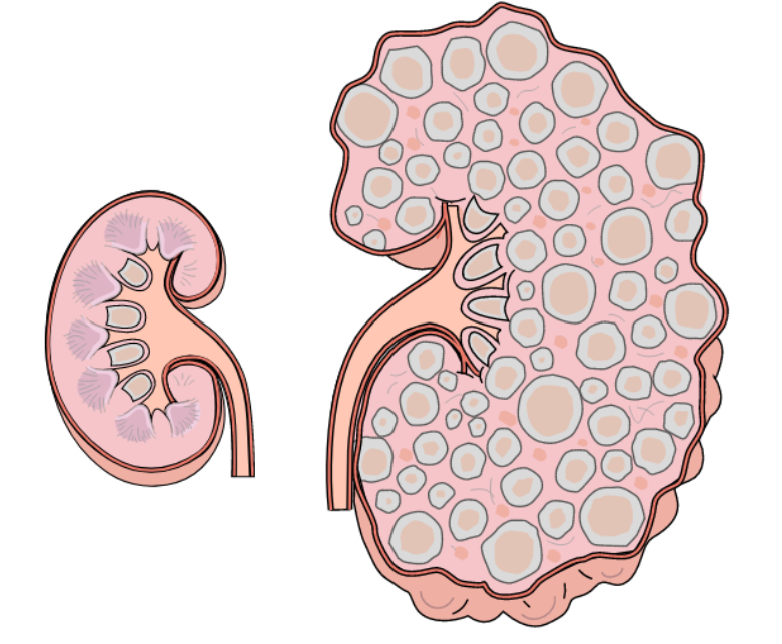
About 1 in every 1,000 to 2,500 people are born with ADPKD. The condition causes many fluid-filled pouches (cysts) to grow in the kidneys. These cysts form in the fine tubes that filter blood to make urine. As the cysts become larger, the kidneys grow in size and stop working properly.

A picture of a normal kidney compared with an ADPKD kidney. The ADPKD kidney is much larger and has many cysts of varying size.

ADPKD is a ‘progressive’ condition, meaning it gets worse over time. It usually takes decades for the cysts to grow as much as those shown in the drawing.

Symptoms of ADPKD in children

Often, ADPKD doesn’t cause problems until adulthood.

Kidney cysts can start forming in childhood, but children usually have plenty of normal kidney tissue to filter their blood.

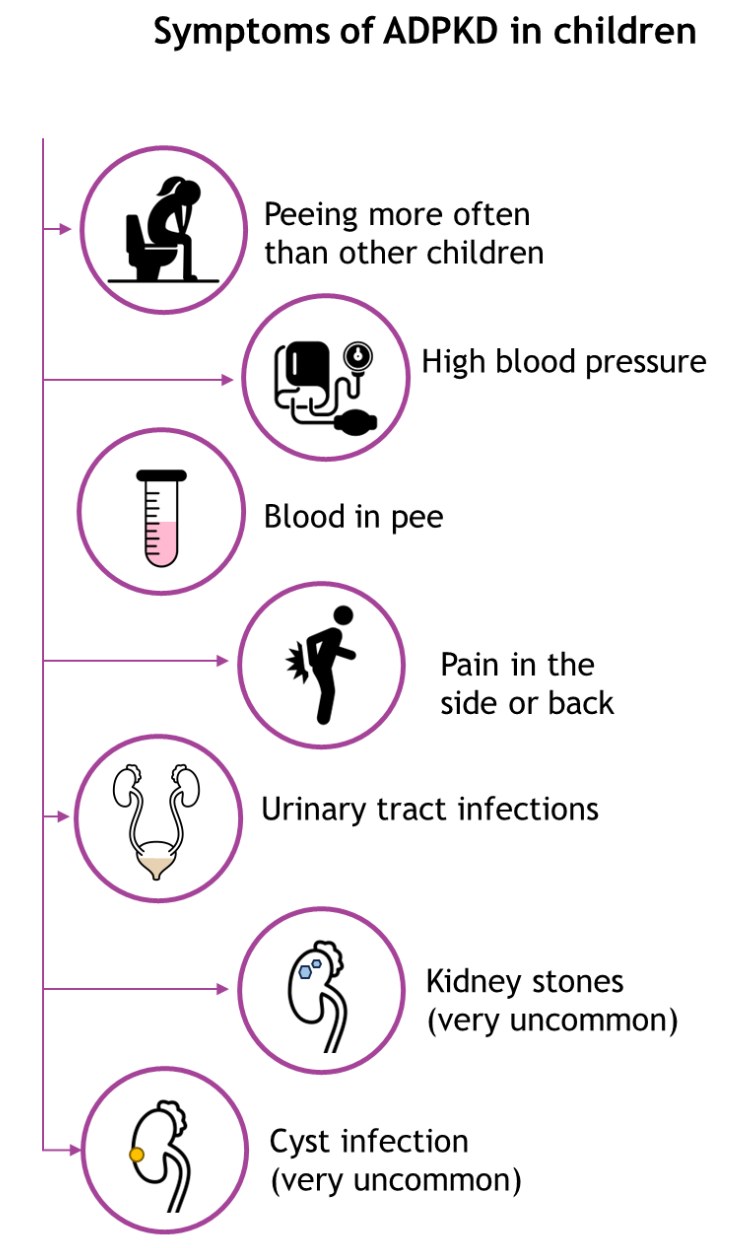
Most children with ADPKD don’t have symptoms that cause problems. However, up to a quarter of children with ADPKD have some symptoms or problems related to ADPKD. These can include:

A picture of the symptoms of ADPKD in children, as listed in the text above.

About 1 in every 5 children with ADPKD has high blood pressure. This usually doesn’t cause symptoms but can be picked up using a blood pressure monitor. High blood pressure is often the first sign of ADPKD (although many people don’t get it until adulthood).

When you have high blood pressure, it means your blood is being pumped around your body with more force. It’s important that blood pressure is checked in people with ADPKD and treated if it becomes too high. We explain this later. 

Children are more likely to get symptoms as their ADPKD gets worse and their cysts become bigger.

Can children be tested for ADPKD?

Tests are available to check for ADPKD in children and adults. If a child’s biological mum or dad has ADPKD, there is a 1 in 2 (50%) chance that the child has ADPKD too. By ‘biological’, we mean parents by birth, not by fostering or adoption.

Children with a biological parent or other close relative with ADPKD can have a test for ADPKD if their parents and doctor agree. Children who are old enough to understand should help to decide.

Children who don’t have a close relative with ADPKD can’t normally have a test for ADPKD. This is because the condition is so uncommon. However, if a doctor notices a possible sign of ADPKD (for example, kidney cysts on a scan done for other reasons), then the child may be offered an ADPKD test.

If you (or your child’s other parent) have ADPKD and you’d like to look into getting your child tested, speak to your doctor. They can refer you to a kidney specialist and a specialist in inherited conditions to help you decide.

How are tests for ADPKD done?

There are two tests that can be used to diagnose ADPKD:

  • an ultrasound scan
  • a test to look for ADPKD genes

Children with a close relative with ADPKD can have either test. Children without a relative with ADPKD but with a possible sign of ADPKD usually have a gene test.

Ultrasound

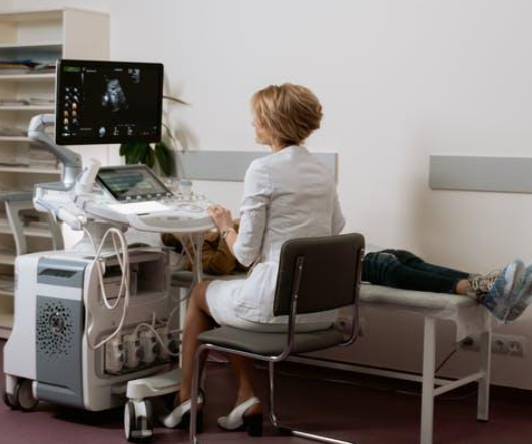
A radiologist can use an ultrasound machine, which uses sound waves, to see inside the body.

A radiologist sits on a chair with an ultrasound machine and screen in front of them. A person lies on a bed next to the radiologist, ready for their scan.

Using ultrasound they can check for kidney cysts in children. It takes 15–45 minutes, is painless, and the sound waves don’t cause harm.

If your child has a close relative with ADPKD and more than one cyst is seen on their ultrasound scan, it’s very likely that they have ADPKD. To confirm this for sure, they’ll need either another scan when they’re older or a genetic test.

If cysts are not seen, this could mean either:

  • your child does not have ADPKD
  • your child has ADPKD but their cysts are too tiny to see on a scan

In this case, your doctor will suggest another scan when your child is 15–18 years old or an adult. Your child can decide if and when to have this future scan.

Tests for ADPKD genes

ADPKD is caused by an altered gene. Genes are instructions in the cells of our bodies and tell the body how to grow and function. People with ADPKD usually have an alteration (a mutation) in a gene called PKD1 or PKD2. Uncommonly, a different gene is involved. The altered gene causes some changes to a person’s kidneys, which is why the cysts grow.

A person can be tested to see whether they have a faulty PKD gene. These tests for are usually done on a small sample of blood.

A laboratory worker checks the DNA in the blood cells for a faulty PKD gene. If they look for a single gene (or only a few genes), this is called a genetic test. If they read the whole genetic code, this is called genomics. Either test can be used to diagnose ADPKD.

If the precise gene alteration causing ADPKD in other family members is already known, a genetic or genomic test can say for sure whether or not your child has ADPKD.

For more information on the genetics of ADPKD and these tests, see our factsheet Genetic testing and counselling for ADPKD.

Deciding whether to go ahead with an ADPKD test

When a parent has ADPKD, they often ask us whether or not they should get their child tested. Parents, children (if old enough to understand) and doctors should decide together.

There are some good and bad points to having your child tested. Your doctor can put you in touch with a kidney specialist and a specialist in inherited conditions to help think it through.

Some of the good sides are:

  • Often, the test gives a clear answer on whether or not a child has ADPKD. This can mean less uncertainty for you and your child.
  • If your child is diagnosed with ADPKD, you and they can mentally prepare for the future. For example, you can get used to the idea that they may need dialysis or a transplant when they’re older.
  • If your child’s test confirms they don’t have ADPKD, it will be a relief and mean you and they worry less about their future.
  • If new treatments for ADPKD become available, doctors may be able to offer these to your child.

Some of the downsides are:

  • Sometimes, a test for ADPKD doesn’t give a clear answer on whether or not a child has ADPKD. This can be frustrating.
  • Some children might regret knowing that they have ADPKD because it makes them worry or feel different to others.
  • If your child is diagnosed with ADPKD, doctors won’t be able to tell you with certainty how it will affect them and at what age.
  • If your child is diagnosed with ADPKD, this could affect their health insurance or life insurance.

To help you talk about ADPKD as a family, see our web page Talking to children and young people. We also have a web page on insurance.

If you decide not to get your child tested for ADPKD yet, it’s still a good idea to have their blood pressure checked every year or so.

Check-ups for children with ADPKD

Children with ADPKD are unlikely to show symptoms, although changes are already starting in their kidneys. This is where check-ups can help.

The aims of check-ups for children with ADPKD are:

  • to check for high blood pressure
  • to check for signs of kidney damage
  • to give advice and support

Children with ADPKD usually have a check-up once every year or two. This includes a blood pressure test. Your child’s kidney specialist (nephrologist) might suggest other tests too, depending on your child’s symptoms and kidney health.

Your child will continue to have check-ups as an adult.

Blood pressure checks

About 1 in every 5 children with ADPKD has high blood pressure (hypertension). It’s more common in children with a parent whose ADPKD progressed quickly.

High blood pressure becomes more likely as people get older and their ADPKD gets worse.

Having high blood pressure might put strain on the heart and blood vessels.Because of this, experts recommend that all children diagnosed with ADPKD (or at risk of having ADPKD) have a blood pressure check done at the doctor’s every 1 or 2 years.Children with high blood pressure can take medicines to reduce it.

A blood pressure check is quick and simple. It involves your child wearing a blood pressure cuff on their arm for a minute or so while it measures the pressure of their blood.

A picture showing a person having a blood pressure reading. They have a cuff wrapped around their upper arm. Their lower arm is resting on a table. A cable comes from the cuff to a device which displays their blood pressure.

If your child is aged 5 years or older, your doctor might recommend they have a blood pressure check using a device that measures their blood pressure at home over 24 hours. This is called ‘24-hour blood pressure monitoring’ or ‘ambulatory blood pressure monitoring’. The cuff inflates and deflates automatically many times over 24 hours, both day and night.

If 24-hour blood pressure monitoring is not available or suitable for your child, it’s okay to have a blood pressure check at the doctor’s or using a home monitor instead.

Some parents and children find it reassuring to do regular blood pressure checks at home. If you decide to buy a blood pressure monitor, make sure you use a cuff the right size for your child’s arm. This helps you get accurate readings.

If your child could have ADPKD but you have chosen not to get them tested for yet, they can still have blood pressure checks.

If your child is diagnosed with high blood pressure, your doctor might refer them to a heart specialist (cardiologist) to check their heart. This test is called an echocardiogram and uses ultrasound to make an image of the heart. The cardiologist can use an echocardiogram to check your child doesn’t have a thickened heart wall (called left ventricular hypertrophy). This can sometimes happen as a result of high blood pressure.

Urine tests

Urine tests show how well your child’s kidneys are working. If their kidneys are not working as well as they should, protein levels in their pee will rise. Experts are not sure how often it’s best to do urine tests in children with ADPKD. Your doctor is likely to suggest a test every few years, depending on your child’s kidney health.

Kidney scans

Doctors can use scans, such as an ultrasound scan or magnetic resonance imaging (MRI), to check the size of your child’s kidneys and to look for cysts. This helps your doctor to work out how quickly your child’s ADPKD is getting worse.

How often your child has a scan will depend, in part, on whether they have symptoms:

  • If your child’s ADPKD is getting worse, they may have scans up to once a year.
  • If your child has no symptoms or cysts, they might not need another scan until they’re 15 to 18 years old.

Why scans for brain aneurysms aren’t routine

A brain aneurysm is a swollen blood vessel, like a small berry, in the brain. They can occur in adults with ADPKD. Uncommonly they can burst, which is dangerous.

However, it’s rare for children with ADPKD to get a brain aneurysm, and it’s extremely rare for them to burst in children.

Hundreds of thousands of children across the world have ADPKD, yet there are very few reports of brain aneurysms causing problems in children.

Because of the low risk, experts recommend that children should not routinely have brain scans to check for aneurysms. The risks that come with these scans and with treatment (if needed) could be greater than the benefits.

We understand that brain aneurysms can be a scary thought for parents and children. If they’re causing you or your child ongoing worry, talk to your child’s GP or kidney specialist.

Do children with ADPKD need treatment?

Most children with ADPKD don’t need treatment for ADPKD or its symptoms until they reach adulthood.

A person holding a packet of tablets.

Treating high blood pressure

If your child has high blood pressure, your doctor might refer them to a specialist in childhood kidney conditions (a paediatric nephrologist) or other local expert.

The doctor or specialist may recommend a medicine such as an ACE inhibitor (angiotensin-converting enzyme inhibitor) or ARB (angiotensin receptor blocker) to reduce your child’s blood pressure. This is to help protect your child’s kidneys and reduce their risk of having heart problems or blood vessel disease in the future.

Ask your doctor to explain the benefits and risks of different medicines available for your child.

Treating a urinary tract infection

If your child has a urinary tract infection, their doctor will treat this with antibiotics.

Treating tummy pain

If your child has abdominal (tummy) pain, it’s unlikely to be caused by their ADPKD. To be sure, their doctor might want to do tests to check for an infected or bleeding cyst or a kidney stone. This will depend on your child’s symptoms.

Doctors usually recommend that children with ADPKD don’t take non-steroidal anti-inflammatory drugs (for example ibuprofen or Nurofen®). These medicines can harm the kidneys of people with ADPKD.

Your doctor or pharmacist can recommend safer painkillers for your child.

Medicines to slow ADPKD progression

Currently, there are no medicines to stop ADPKD worsening in children.

A drug called tolvaptan (brand name Jinarc®) can help to slow down kidney damage in some adults but it’s not licensed for use in children.

A recent trial found some evidence that tolvaptan might work in children. Children taking tolvaptan had less growth in their kidney size than children taking a placebo (‘dummy’ pill). Side effects that could affect a child’s day-to-day life were common, such as thirst and weeing often.

The trial was short and the results were not strong enough to pass statistical tests. More research is needed before experts can decide whether tolvaptan is suitable for children.

Helping children with ADPKD to stay healthy

Parents often ask us if there is anything they can do to protect their child’s kidneys from damage. Unfortunately, doctors have few answers. A healthy diet and lifestyle are good for all children, whether or not they have ADPKD. Here is a summary of what we know so far:

Diet and lifestyle

No specific diets have been tested in children with ADPKD. A normal healthy diet is thought to be fine. Children with ADPKD should eat a normal amount of protein, not an unusually high amount.

Weight

ADPKD might start to cause changes to the kidneys sooner in people who are overweight or obese. A healthy diet and exercise can help your child to stay a healthy weight.

Salt

Eating too much salt can speed up kidney damage in adults with ADPKD. Although we don’t know whether salt affects children in the same way, it’s a good idea to help your child avoid too much salt.

The NHS has general advice on how much salt children should eat according to their age. Don’t add salt to your child’s food. Avoid processed foods as much as possible, as these tend to have a lot of salt.

Drinking fluid

It’s not proven that drinking extra fluid can help children with ADPKD. Your child should drink enough to avoid feeling thirsty, but they don’t need to drink unusually large amounts. You can check that your child is drinking enough by looking at the colour of their urine — it should be clear to light yellow.

Dangerous sports

If your child has very large kidneys or cysts that tend to bleed, their kidney specialist may recommend that they avoid some sports (for example, rugby or martial arts). This is to reduce the risk of them injuring their kidneys. This doesn’t mean your child needs to avoid all sport.

Smoking

Explain to your child the dangers of smoking. As well as the usual risks (including cancer), smoking can increase the speed at which ADPKD worsens and can lead to kidney damage.

Medicines to avoid

Always check with your doctor or pharmacist before giving your child any medicine to check it’s safe for them. This includes medicines you can buy without a prescription. Most medicines are fine but some can damage the kidneys of people with a kidney condition.

Examples of medicines that people with a kidney condition should only take if a doctor says it’s okay are non-steroidal anti-inflammatory drugs (ibuprofen and Nurofen®).

Ask for safe alternatives for your child.

More from the PKD Charity

Information and support from others

Further information

All of our publications are based on references but these are removed for ease of reading on our webpages. A version of this webpage with references included is available upon request by emailing [email protected]

Authors and contributors

Written by Dr Matko Marlais, Consultant Nephrologist, Great Ormond Street Hospital, London, and Hannah Bridges PhD, Medical Writer, HB Health Comms Ltd, London.

With thanks to all those the people affected by ADPKD who contributed to this publication.

Last updated: © February 2025 (v3.0).

Due for medical review: February 2028.

Ref No: ADPKD.ICYP.V3.0

Disclaimer: This information is primarily for people in the UK. We have made every effort to ensure that the information we provide is correct and up to date. However, it is not a substitute for professional medical advice or a medical examination. We do not promote or recommend any treatment. We do not accept liability for any errors or omissions. Medical information, the law and government regulations change rapidly, so always consult your GP, pharmacist or other medical professional if you have any concerns or before starting any new treatment.

If you don't have access to a printer and would like a printed version of this information sheet, or any other PKD Charity information, call the PKD Charity Helpline on 0300 111 1234 (weekdays, 9am–5pm) or email [email protected]

The PKD Charity Helpline offers confidential support and information to anyone affected by PKD, including family, friends, carers, newly diagnosed or those who have lived with the condition for many years.

Read more …Symptoms and testing in children

  • Hits: 38595

Complementary therapies

Complementary therapies

The term ‘complementary and alternative medicine (CAM)’ covers any medical and healthcare practice that is not part of mainstream or conventional medicine

There are many types of CAM. A few have been well researched and have some scientific basis, while others are based on a range of theories that are not supported by current scientific knowledge. Some forms of CAM—e.g. Chinese/herbal medicines and vitamin supplements — should always be avoided by anyone with kidney disease. Others (e.g. massage, meditation) are unlikely to do you any harm and may help you to cope better with your symptoms. It has been found in some cases that acupuncture can reduce pain, and meditation can help to reduce blood pressure.

Contents

If you decide to try CAM:

  • Before embarking on any form of treatment, get the go-ahead from your doctor to make sure that you will not harm your health.
  • Never, never, ever stop a treatment prescribed by your doctor just on the advice of a CAM practitioner.
  • You may well have to pay for each session of your treatment. Although your GP may be able to refer you for some CAM therapies, local health organisations are limiting access to these treatments, citing lack of evidence for their effectiveness and safety, as well as many other calls on limited NHS resources.
  • Choose a CAM practitioner who is a member of an independent professional organisation that has standards for qualification, a code of practice, and insurance to cover you if there are problems.
  • Find out as much information as possible about the treatment you want to try: what are its benefits? Is it safe? What are the side effects? Does it interact with treatments from your doctor?
  • Remember the power of the placebo (dummy treatment). Did you feel better because the practitioner was able to spend a long time discussing your problems? And would your problem perhaps have gotten better without any treatment?
  • If something sounds too good to be true, it probably is. So be sceptical of claims to cure ADPKD—often only in exchange for large amounts of your money.

More information

There is a helpful description of the various CAM disciplines in the Sixth Report of the House of Lords Science and Technology Committee (2000).

For a list of CAM professional bodies, go to the website of the Research Council for Complementary Medicine.

Further information

All of our publications are based on references but these are removed for ease of reading on our webpages. A version of this webpage with references included is available upon request by emailing [email protected]

Authors and contributors

Written by: Hannah Bridges

With thanks to all those affected by ADPKD who contributed to this publication.

Ref No: ADPKD.CAM.V1.0

UNDER REVIEW

Disclaimer: This information is primarily for people in the UK. We have made every effort to ensure that the information we provide is correct and up to date. However, it is not a substitute for professional medical advice or a medical examination. We do not promote or recommend any treatment. We do not accept liability for any errors or omissions. Medical information, the law and government regulations change rapidly, so always consult your GP, pharmacist or other medical professional if you have any concerns or before starting any new treatment.

If you don't have access to a printer and would like a printed version of this information sheet, or any other PKD Charity information, call the PKD Charity Helpline on 0300 111 1234 (weekdays, 9am–5pm) or email [email protected]

The PKD Charity Helpline offers confidential support and information to anyone affected by PKD, including family, friends, carers, newly diagnosed or those who have lived with the condition for many years.

Read more …Complementary therapies

  • Hits: 13937

Medicines to avoid if you have ADPKD

Medicines to avoid if you have ADPKD

This webpage is for people with autosomal dominant polycystic kidney disease (ADPKD), their families, friends and carers. It explains which medicines you may need to avoid if you have ADPKD.

Contents

Introduction

ADPKD often leads to the kidneys not working as well as usual, especially as people get older. This is known as reduced kidney function or chronic kidney disease.

If you have ADPKD and reduced kidney function, some drugs might be unsuitable for you. You might also need to take some medicines at a lower dose than standard. Your doctor can advise you on this.

A picture of a person taking a tablet

Before taking any medicine check with your kidney doctor, GP or pharmacist that the medicine is safe for you. This includes medicines you can buy without a prescription.

Medicines to avoid

If you have reduced kidney function, you should only use these medicines if your doctor says it’s okay:

  • non-steroidal anti-inflammatory pain killers, for example:
    • ibuprofen (Nurofen®, Advil®, Brufen® and other brands)
    • diclofenac (Voltarol® and other brands)
    • high doses of aspirin
  • treatments for indigestion that contain potassium, aluminium, sodium or magnesium
  • a medicine for heartburn (acid reflux) called cimetidine (Tagamet® and other brands)
  • decongestants such as pseudoephedrine (Sudafed® and other brands)
  • any medicine that you dissolve in water that fizzes (an effervescent) as these tend to contain sodium

If you have good kidney function, your doctor might say some of these medicines are okay for you to use. Never use them without checking first with a doctor or pharmacist.

There may be other medicines you need to avoid that are not listed here. Ask your doctor or pharmacist for advice before taking any medicines.

What doses of aspirin are okay to use?

Low doses of aspirin are 150 mg a day or less.

A doctor may advise you to take low-dose aspirin to reduce your risk of:

  • cardiovascular disease (if you’re at increased risk)
  • a problem called pre-eclampsia that can occur during pregnancy

Experts say all women with ADPKD who are pregnant should take low-dose aspirin from week 12 to 36 of pregnancy.

Only take low-dose aspirin if a doctor advises you to. They’ll explain the risks and benefits. Only take aspirin at the dose they recommend and for as long as they advise.

When aspirin is used as a painkiller, people take a higher dose (for example, 300 to 600 mg every 4–6 hours). People with reduced kidney function should usually avoid taking high-dose aspirin.

Why are some medicines unsafe for me?

Some medicines may not be safe for you if you have ADPKD because:

  • Your kidneys might not clear the medicine out of your body quickly enough, which could lead to side effects.
  • The medicine might damage your kidneys.
  • The medicine might not work properly.
  • It might contain ingredients that you should avoid (such as sodium).

Although there are certain medicines you should avoid, this doesn’t mean you have to cope with untreated symptoms. Ask your doctor which medicines you can use instead.

More from the PKD Charity

More information

The photos on this webpage are freely available on Pexels.com. The medical history of the persons shown is unknown.

Further Information

All of our publications are based on references but these are removed for ease of reading on our webpages. A version of this webpage with references included is available upon request by emailing [email protected]

Authors and contributors

Adapted by Hannah Bridges, PhD, Medical Writer, HB Health Comms Ltd, from the longer resource Medications to treat ADPKD.  

With thanks to all those affected by ADPKD who contributed to this publication.

Ref No: ADPKD.MTA.V2.0

Last Updated: © September 2025 (v2.0).

Due for medical review: September 2028.

Disclaimer:  This information is primarily for people in the UK. We have made every effort to ensure that the information we provide is correct and up to date. However, it is not a substitute for professional medical advice or a medical examination. We do not promote or recommend any treatment. We do not accept liability for any errors or omissions. Medical information, the law and government regulations change rapidly, so always consult your GP, pharmacist or other medical professional if you have any concerns or before starting any new treatment.

We welcome feedback on all our health information. If you would like to give feedback about this information, please email [email protected]

If you don't have access to a printer and would like a printed version of this information sheet, or any other PKD Charity information, call the PKD Charity Helpline on 0300 111 1234 (weekdays, 9am-5pm) or email [email protected]

The PKD Charity Helpline offers confidential support and information to anyone affected by PKD, including family, friends, carers, newly diagnosed or those who have lived with the condition for many years.

Read more …Medicines to avoid if you have ADPKD

  • Hits: 41603

Kidney failure

Kidney failure

This information is for people with autosomal dominant polycystic kidney disease (ADPKD) who are nearing, or have, kidney failure. It’s also for their families, friends and carers. Read here what kidney failure is, how it’s diagnosed and treated, and how it may affect your life.

Contents

Key facts

  • Kidney failure means your kidneys are doing less than a sixth of the work of healthy kidneys.
  • At this point, they can no longer clean your blood properly or remove enough water.
  • Kidney failure can also lead to anaemia, high blood pressure and overactive parathyroid glands.
  • On average, people with ADPKD reach kidney failure at about age 55 or 60 years.
  • The timing differs from person to person and some never get kidney failure.
  • Your kidney doctor can predict whether you’re likely to get kidney failure in the next few years.
  • They can diagnose kidney failure using a blood and urine test.
  • Treatment options are a kidney transplant, dialysis, or treatment for symptoms only (conservative care).
  • A kidney transplant is usually the best option — it can extend your life and improve your quality of life.
  • Dialysis can also extend your life.
  • Living with kidney failure can be a lot to adjust to. You can still lead a good life.

What is kidney failure?

Kidney failure means your kidneys are doing less than a sixth of the work of healthy kidneys. It’s also known as end-stage kidney disease or stage 5 chronic kidney disease.

Doctors diagnose kidney failure when a person’s estimated glomerular filtration rate (eGFR) is below 15 millilitres per minute. eGFR is a measure of how well your kidneys are working. We explain it later on this page.

Failing kidneys struggle to:

  • filter toxins, salts, minerals (such as potassium and phosphorus) and acid from your blood
  • remove extra water from your body
  • tell your body to make red blood cells
  • control your blood pressure

Toxins, minerals and extra water can collect in your body. This is called uraemia. It can make you unwell.

On average, people with ADPKD reach kidney failure at about age 55 or 60 years. The timing differs a lot from person to person.

Some people with ADPKD never get kidney failure.

What are the symptoms of kidney failure?

Most people only get symptoms when their eGFR has fallen below 15 millilitres per minute. Kidney doctor Grahame Wood tells us that many of his patients don’t get noticeable symptoms until their eGFR falls under 12 millilitres per minute.

Symptoms of kidney failure include:

  • Tiredness
  • Feeling or being sick
  • Swollen legs, ankles, feet and hands
  • Getting out of breath easily
  • Not feeling hungry and losing weight
  • Getting itchy
  • Finding it hard to keep your legs still (restless legs)
  • Not sleeping well (insomnia)
  • Having to wee often, including at night
  • Bone pain
  • Muscle cramps
  • Women not having periods
  • Men not being able to get or keep an erection
  • A metallic taste in your mouth
  • Your breath smelling different

Can kidney failure cause other health problems?

If you have kidney failure, it can cause other health problems (complications).

These include:

We explain these below.

Anaemia

Healthy kidneys make a hormone that tells the body when to make more red blood cells. These cells carry oxygen around your body. If you have too few, this can make you tired and short of breath.

Treatments can increase your red blood cells. Examples are:

  • An erythropoietin-stimulating agent like erythropoietin (EPO)
  • Roxadustat (brand name Evrenzo®)

Overactive parathyroid glands

Your parathyroid glands control levels of calcium and phosphate in your body. Kidney failure can make your parathyroid glands work too hard. This is called having overactive parathyroid glands or hyperparathyroidism.

It happens because the glands try to correct low levels of calcium caused by kidney failure.

Having overactive parathyroid glands can lead to weak bones and other problems.

Changes to diet and medicines can help. Some people need surgery to remove the glands.

You can learn more about overactive parathyroid glands, including treatments, on our website.

High blood pressure that’s hard to control

Many people with ADPKD have high blood pressure. This can become hard to control if you have kidney failure.

A woman having her blood pressure checked

Failing kidneys can struggle to make a hormone that helps to control blood pressure. Also, failing kidneys can’t remove enough water from your body. This means there is more water in your blood vessels, increasing the pressure.

Medicines don’t always work well to lower blood pressure when you have kidney failure. You may need to take a number of different ones.

How do doctors diagnose kidney failure?

Kidney health can be checked using:

  • A blood test for creatinine
  • A urine test for albumin and creatinine

We explain these below.

Your kidney doctor may do more tests to check your kidney health and plan your care.

Blood test for creatinine

Creatinine is a waste product from digesting food and from muscles. Your kidneys clean it from your blood.

High levels of creatinine in your blood can signal kidney problems.

Your kidney doctor will use your creatinine level to calculate how much blood your kidneys can filter in 1 minute. This is called the estimated glomerular filtration rate (eGFR).

If your eGFR is below 15 millilitres per minute this suggests kidney failure.

Urine test for albumin and creatinine

Your kidneys should clean waste from your blood, but they shouldn’t remove protein. High amounts of a protein called albumin in your wee signal kidney problems. The medical term for this is albuminuria or proteinuria.

A good way to measure albumin levels in wee is to compare them to creatinine levels. Your kidney doctor can do this by looking at your albumin to creatinine ratio (ACR).

An ACR of over 300 milligrams per gram suggests severe kidney problems.

Learn more about measures of kidney function on our webpage Progression of ADPKD.

Can my kidney doctor predict when I might get kidney failure?

Yes. If your kidney function is quite low, your kidney doctor can calculate whether your kidneys are likely to fail in the next 2 or 5 years. They should do this at least once a year if your eGFR is below 60 millilitres per minute.

A doctor looking at a patient’s results

If you’re close to kidney failure, your kidney doctor will explain your treatment options.

How is kidney failure treated?

The treatments for kidney failure are:

Your kidney doctor will explain the pros and cons of each option.

A kidney transplant or dialysis will replace some of the work of your kidneys. Conservative care only helps to manage some of the effects of kidney failure.

Experts agree that a kidney transplant is usually the best way to treat kidney failure caused by ADPKD.

A transplant usually improves both life expectancy and quality of life more than other options can.

People on dialysis tend to live longer than those choosing conservative care. Quality of life may be about the same with dialysis or conservative care, but people choosing conservative care are often older and have more health problems, so comparisons can be difficult.

A man talking to another person on the sofa

Reasons people have dialysis include:

  • They’re waiting for a kidney transplant
  • A kidney transplant would be unsuitable for them
  • They choose to have dialysis rather than a transplant

Conservative care lessens the symptoms of kidney failure. It involves:

  • Taking medicines and supplements
  • Following a special diet
  • Being very careful about how much fluid you drink
  • Lifestyle changes

You can learn more about kidney transplants and dialysis on our website. Kidney Research UK has information on conservative care.

At what point will I need to make decisions and start treatment?

Your kidney team will help you think about your preferences at least a year before you might need treatment for kidney failure.

How quickly you’ll plan things and get a transplant or start dialysis will depend on many factors. These include:

  • How quickly your kidneys are failing
  • How kidney failure is affecting you
  • Your general health
  • How dialysis would affect your physical health, mental health, and life
  • Whether someone has offered to be a living donor for you

Here’s a rough timeline of what happens when. This was kindly provided by kidney doctor Grahame Wood.

How will kidney failure affect my life?

Living with kidney failure can be a lot to adjust to.

You’ll probably need to make changes to your diet, how much fluid you drink, and your lifestyle.

If you’re having dialysis, this can take up a lot of time and leave you tired. You’ll still be able to work, study, drive, exercise, and have holidays. You may need to change your schedule and take on less.

A kidney transplant will give you more freedom.

A counsellor or psychologist can help you to:

  • Think through your options
  • Work through your feelings
  • Adapt to your health and treatment
Two people talking outside over coffee

Ask your kidney doctor, dialysis team, or transplant team if you’d like to talk to a counsellor or psychologist.

You may also find it helpful to talk to other people with kidney failure. You can connect with others through our Facebook groups and support groups.

You can also contact our helpline on 0300 111 123, on Facebook Messenger, or by emailing [email protected].

Can kidney failure be prevented?

Not everyone with ADPKD gets kidney failure. Once ADPKD damages your kidneys, this can’t be reversed.

You may be able to slow down damage to your kidneys with these steps:

  1. Follow your doctor’s advice to control your blood pressure if it’s high.
  2. Follow our tips on diet and lifestyle.
  3. Avoid medicines that may harm your kidneys.
A woman taking part in an exercise class

If your kidney function is not low but is getting worse quickly, you might be able to take tolvaptan (Jinarc®). In clinical trials, tolvaptan slowed the speed at which some people’s kidneys grew. It also slowed their kidney damage.

Find out more about tolvaptan on our web page on medications to treat ADPKD.

More from the PKD Charity

Information and support from others

The photos on this webpage are freely available on Pexels.com. The medical history of the persons shown is unknown. 

Further information

All of our publications are based on references but these are removed for ease of reading on our webpages. A version of this webpage with references included is available upon request by emailing [email protected].

Authors and contributors

Written by Hannah Bridges, PhD, Independent Medical Writer at HB Health Comms Limited. Expert review by Dr Grahame Wood, Consultant Renal Physician, Salford Royal Hospital, Salford.

Ref No: ADPKD.KF.V1.0
© PKD Charity 2025
First published: September 2025
Due to be medically reviewed: September 2028

Disclaimer: This information is primarily for people in the UK. We have made every effort to ensure that the information we provide is correct and up to date. However, it is not a substitute for professional medical advice or a medical examination. We do not promote or recommend any treatment. We do not accept liability for any errors or omissions. Medical information, the law and government regulations change rapidly, so always consult your GP, pharmacist or other medical professional if you have any concerns or before starting any new treatment.

If you don't have access to a printer and would like a printed version of this information sheet, or any other PKD Charity information, call the PKD Charity Helpline on 0300 111 1234 (weekdays, 9am–5pm) or email [email protected]

The PKD Charity Helpline offers confidential support and information to anyone affected by PKD, including family, friends, carers, newly diagnosed or those who have lived with the condition for many years.

Read more …Kidney failure

  • Hits: 8172

Feedback

We welcome feedback on the information provided on this webpage. If you have any feedback regarding the information provided on this webpage, please complete the Feedback Form