Helpline

0300 111 1234

Polycystic liver disease

Polycystic liver disease

This information is for people with autosomal dominant polycystic kidney disease (ADPKD) and their families and friends. Many people with ADPKD have cysts in their liver, which is called polycystic liver disease (PLD). Find out here about the symptoms, diagnosis and treatment of PLD.

Contents

Key facts

  • Most people with ADPKD have liver cysts by their mid-thirties. This is known as polycystic liver disease (PLD).
  • If a doctor diagnoses you with ADPKD, they should offer you a liver scan to check for liver cysts.
  • Your liver is likely to work well despite the cysts. You probably won’t get symptoms or need treatment.
  • However, a few people with PLD get very large livers. This can make you feel full, bloated and give you a large tummy. It can also cause acid reflux (heartburn), pain and make you out of breath.
  • A few people with PLD get problems that need treatment. For example, a cyst may bleed or get infected. Liver cysts might also squash a vein in their liver.

What does the liver do?

Your liver sits under your ribs on the right side of your body.

Its jobs include:

  • to process digested food from the gut
  • to control levels of sugar, fat and amino acids in your blood (your body uses amino acids to make proteins)
  • to remove drugs and toxins from your blood
  • to fight infections
  • to make bile (which helps you digest fat)
  • to store iron, vitamins and other chemicals
A picture showing the liver in the body. Your liver sits under your ribs, mainly on the right side of the body.

What is PLD?

ADPKD is mainly thought of as a kidney condition. However, if you have ADPKD you’re likely to get cysts in your liver too. This is called polycystic liver disease (PLD).

Most people with ADPKD (8 out of 10) have PLD by their mid-thirties. Women tend to be diagnosed with PLD at a younger age than men. Women’s liver cysts tend to be larger than men’s.

People without ADPKD can get PLD but this is rare.

PLD is unlikely to stop your liver doing its main jobs. This is because the cysts develop in bile tubes not liver tissue.

Most people with ADPKD and PLD don’t have liver symptoms. However, a few people with PLD get very large livers. This can cause symptoms.

Causes of liver cysts

Genes that cause kidney cysts (for example, PKD1 or PKD2) probably cause liver cysts too.

Oestrogen (a female hormone) seems to increase the growth of liver cysts.

Growth of liver cysts is linked to:

  • being pregnant more than once
  • using contraception with oestrogen in it
  • using hormone replacement therapy (for the menopause)

However, most women with ADPKD get liver cysts regardless of these things.

Symptoms of PLD

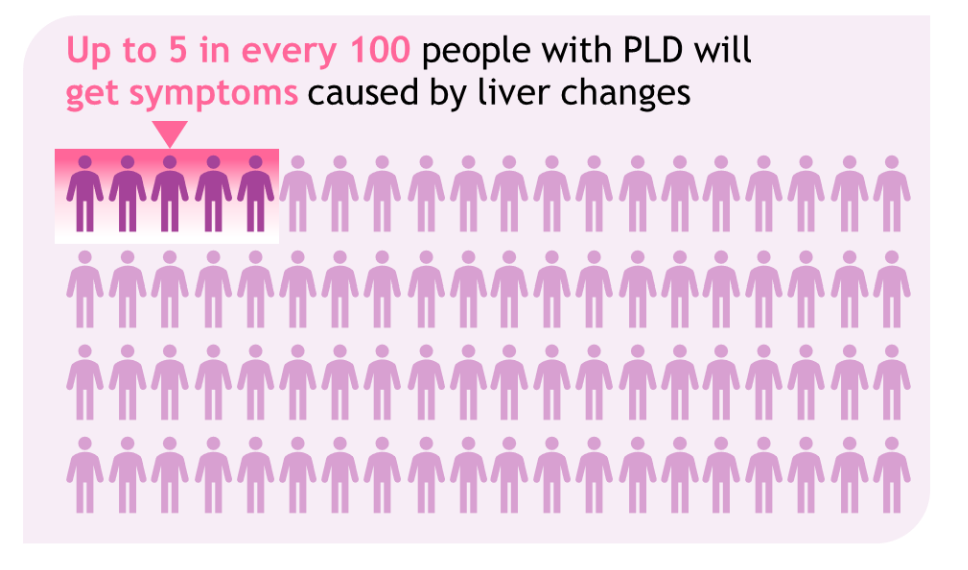
Most people with PLD (over 95 out of 100) don’t have any PLD symptoms.

However, a few people (up to 5 in 100) have PLD symptoms. These could affect their life.

Diagram showing 5 out of 100 people.

You may get symptoms if your liver gets very large and pushes on other organs or blood vessels. Symptoms can also be caused by fluid in your abdomen (tummy).

Symptoms can include:

  • feeling bloated
  • having a large abdomen
  • feeling full early on in a meal
  • a burning feeling in your chest known as acid reflux or heartburn
  • pain in your back or abdomen
  • getting out of breath

Less often, a large liver can cause shoulder pain.

If you have any of these symptoms, tell your GP or kidney team. They can refer you to a liver specialist (hepatologist) for tests and treatment.

If you have a very large abdomen:

  • you may find it hard to bend over
  • sleeping on your side or front might be uncomfortable
  • it may affect your confidence and how you feel about yourself (your self-esteem)
  • your sex life may be affected

Tell your doctor if having a large abdomen is affecting you. They can talk you through treatment options.

A few people with PLD get a bleeding or infected liver cyst. Sometimes liver cysts can squash a vein or tube in the liver, causing problems.

We explain these problems and their treatment later.

Diagnosing PLD

If a doctor diagnoses you with ADPKD, they should offer you a liver scan. This is to check for liver cysts.

A radiologist can use an ultrasound scan, computed tomography (CT) or magnetic resonance imaging (MRI) to check your liver. An ultrasound scan uses soundwaves to see inside your body. A CT scan uses X-rays. An MRI uses magnets and radio waves.

A doctor will diagnose you with PLD if you have 10 or more liver cysts.

You might also have a blood test to check your liver health.

Liver check-ups

Your treatment team will plan your check-ups based on your symptoms and needs.

You may have a blood test about once a year. If you have liver symptoms, you might have a liver scan every 1-3 years.

Treatment of symptoms

People with PLD usually only need treatment if they get symptoms.

Specialists who might be involved in your care include:

  • a liver specialist (hepatologist)
  • a liver surgeon
  • a specialist in using imaging to treat diseases (an interventional radiologist)
  • a specially trained nurse

Cyst infections

Sometimes, a liver cyst can get infected with bacteria (germs). This can cause pain and fever (a temperature over 38°C). It’s important to get treatment before the infection worsens.

A liver specialist can diagnose a cyst infection based on signs and symptoms and the results of a blood test and liver scan. They might take a sample of fluid from the cyst to test.

They’ll give you antibiotics but these will take time to work. You might need to take them for 4 to 6 weeks.

You might need the cyst drained if the infection won’t go away or comes back. We explain cyst drainage later.

Bleeding cysts

If a liver cyst starts bleeding, you might get sudden pain. A liver specialist can diagnose a bleeding cyst using a liver scan.

It’s often best to let the cyst heal itself. Your doctor can prescribe pain killers to reduce any pain.

Pain

If your PLD is painful, your doctor can prescribe you pain killers. Find out more about managing pain on our website.

If your pain is unbearable and pain killers aren’t working, you may need surgery to reduce your liver’s size. We explain this later.

Treating a squashed liver vein (portal hypertension)

Rarely, liver cysts can squash a big vein in the liver. This can cause a problem called portal hypertension.

If this happens, you might need surgery. A surgeon can put a tube (a stent) into the vein to hold it open. Or they can remove part of your liver, which we explain later.

Jaundice

Rarely, liver cysts can squash tubes carrying bile. A chemical in bile can get into your blood, making your skin and eyes turn yellow. This is jaundice.

Draining the problem cysts can allow the bile to flow again.

Procedures and surgeries

Most people with PLD don’t need surgery or smaller procedures.

These can include:

  • cyst drainage and treatment
  • removal of a cyst
  • removing part of your liver
  • getting a liver transplant

Your liver specialist or surgeon will recommend the simplest procedure possible. They’ll talk you through the benefits and risks, and what to expect.

Cyst drainage and treatment

If a liver cyst is large and infected, you might need it drained and treated. The treatment is called sclerotherapy and kills the cells lining the cyst.

You can learn more about cyst drainage and sclerotherapy on our website.

In a study, most people with PLD who had this treatment said their symptoms improved. Over half said their symptoms disappeared.

This treatment has some risks, which specialists will explain.

Surgery to remove cysts

If you have multiple cysts causing problems, a surgeon may be able to remove them. This surgery is called cyst deroofing. The surgeon will open each cyst, remove the fluid and remove the lining cells.

You can learn more about cyst deroofing on our website.

This treatment usually works well to reduce people’s symptoms long term. It has some risks, which your surgeon will explain.

Removing part of your liver

If you have many liver cysts close together, a surgeon may be able to remove this part of your liver. This is called partial liver resection.

A surgeon will only recommend this surgery if you have bad symptoms and other treatments have failed or aren’t possible.

They’ll explain the surgery and its risks. You’ll need to stay in hospital for about 10–15 days to recover.

Most people who have had a partial liver resection for PLD say their symptoms improved. However, about half had some problems after surgery.

Having a liver transplant

Very few people with PLD need a liver transplant. This surgery is usually only used for people with bad symptoms when other treatments are not possible or have failed.

In this surgery, your liver is removed and replaced by a donated liver. If you need a kidney transplant too, you might have both surgeries together.

A liver transplant cures liver cysts and their symptoms. However, it’s common to have problems after the surgery. You’ll need to take medicines called immunosuppressants for life. These stop your body fighting the donated liver.

Preventing liver cysts

There are no ways to stop liver cysts forming in people with ADPKD. There are also no approved medicines to slow the growth of liver cysts.

Medicines to slow cyst growth

Research has shown a medicine called a somatostatin analogue might slow the growth of liver cysts. However, this medicine didn’t work in all clinical trials.

Somatostatin analogues are not approved for use in the UK for people with ADPKD. This means NHS doctors can’t prescribe them unless they make a special case.

You might be able to try a somatostatin analogue through a clinical trial.

Avoiding oestrogen

If you’re a woman and want to use contraception, your doctor will suggest types without oestrogen. This is because oestrogen might speed the growth of liver cysts.

Likewise, if you have menopausal symptoms your doctor will probably not recommend HRT because it contains oestrogen. Ask your doctor to explain the benefits and risks of you using HRT. They can explain other ways to help menopausal symptoms.

Diet and lifestyle

There’s no special diet or lifestyle to slow the growth of liver cysts.

It’s good to follow general advice for people with ADPKD. See our webpage on diet and lifestyle for tips.

More from the PKD charity

Information and support from others

Further information

All of our publications are based on references but these are removed for ease of reading on our webpages. A version of this webpage with references included is available upon request by emailing [email protected]

Authors and contributors

Written by Hannah Bridges, PhD, Independent Medical Writer, HB Health Comms Limited. Expert review by Dr Ahmed Elsharkawy, Consultant Hepatologist, University Hospitals Birmingham NHS Foundation Trust.

Ref No: ADPKD.PLD.V3.0
© PKD Charity 2025
First published: June 2025
Due to be medically reviewed: June 2028

Disclaimer: This information is primarily for people in the UK. We have made every effort to ensure that the information we provide is correct and up to date. However, it is not a substitute for professional medical advice or a medical examination. We do not promote or recommend any treatment. We do not accept liability for any errors or omissions. Medical information, the law and government regulations change rapidly, so always consult your GP, pharmacist or other medical professional if you have any concerns or before starting any new treatment.

If you don't have access to a printer and would like a printed version of this information sheet, or any other PKD Charity information, call the PKD Charity Helpline on 0300 111 1234 (weekdays, 9am–5pm) or email [email protected].

The PKD Charity Helpline offers confidential support and information to anyone affected by PKD, including family, friends, carers, newly diagnosed or those who have lived with the condition for many years.

Read more …Polycystic liver disease

Urinary tract infections

Urinary tract infections

This information is for people with autosomal dominant polycystic kidney disease (ADPKD), their families and friends. 

People with ADPKD can get urinary tract infections (UTIs). These infections might involve the bladder, the tubes to and from the bladder, or the kidneys. Here we explain the causes and symptoms of these infections, as well as how they are diagnosed and treated.

Contents

Where can UTIs occur?

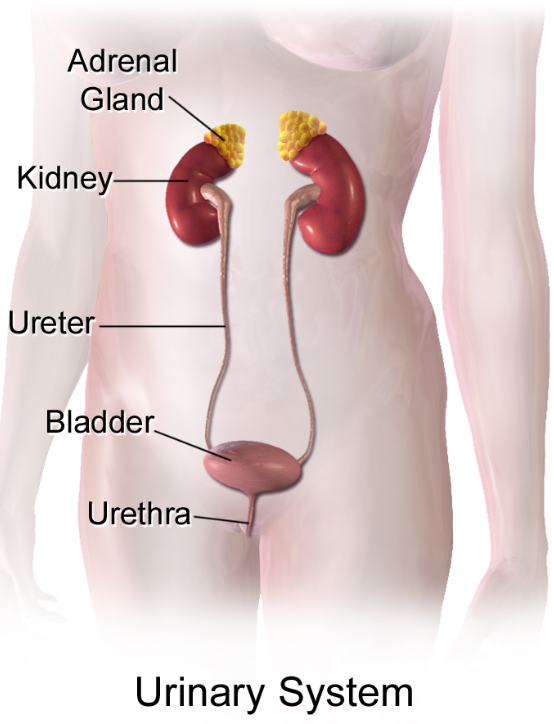
One of the more common places in the body to get an infection (whether or not you have ADPKD) is your urinary tract. These are known as urinary tract infections (UTIs) and can occur in one or more of these places:

  • a kidney — an infection here is called pyelonephritis
  • the bladder — an infection here is called cystitis
  • the tubes (ureters) carrying urine from the kidneys to the bladder — an infection here is called ureteritis
  • the tube you pee through (the urethra) — an infection here is called urethritis

In people with ADPKD, infections can also occur within cysts in the kidneys. Although these are infections within the urinary tract, they are usually thought of separately to other UTIs. We have a separate web page on cyst infections.

On this web page, we focus on infections of the bladder, connecting tubes, and general kidney infections.

A diagram showing the urinary system, which sits in the bottom half of the abdomen. Two kidneys sit above the bladder. Each kidney is connected to the bladder by a tube called a ureter. A tube at the bottom of the bladder, called the urethra, carries urine to the outside of the body.

Figure 1. The different parts of the urinary system.
By BruceBlaus, CC BY-SA 4.0, via Wikimedia Commons

What are the symptoms of a UTI?

Symptoms of a UTI can include:

  • pain or burning when you pee
  • needing to pee more often and suddenly
  • pee looking cloudy or smelling different
  • blood in your pee (which could make it look pinker or browner than usual)
  • pain in your abdomen (tummy) or lower back
  • feeling hot or shivery
  • a high temperature (above 38°C)
  • a low temperature (under 36°C)
  • feeling confused or delirious

Some of these symptoms can be caused by other complications of ADPKD, such as an infected cyst, kidney stone, or bleeding cyst. Your kidney specialist (nephrologist) will use tests to find the cause of your symptoms.

How common are UTIs in people with ADPKD?

UTIs are common among people with ADPKD. About 3-5 in every 10 people with ADPKD get at least one UTI in their lifetime.

You’re more likely to get UTIs as you get older. You’re also more likely to get a UTI if you: 

  • are a woman
  • have sex
  • need a catheter to collect urine or another procedure in your urinary tract
  • have low kidney function
  • have very large kidneys
  • take immunosuppressants (for example, because you have had a kidney transplant)

Sometimes, UTIs come back (recur) after treatment. Having a recent UTI makes it more likely you’ll get another one.

What causes UTIs?

Most UTIs in people with ADPKD are caused by bacteria that usually live in the gut, such as E. coli. The bacteria enter the urinary tract through the urethra (where you pee from) and can travel up to the bladder and kidneys. Women are more likely to get UTIs because they have a shorter urethra than men.

Bacteria can also enter your urinary tract when medical instruments are put into it, such as:

  • a catheter, which is a tube to collect urine
  • a cystoscope, which is a long, thin camera to look inside the bladder

How is a UTI diagnosed?

Your doctor (GP) will ask about your symptoms and may ask for a urine sample to test for signs of infection and micro-organisms. This is usually enough to diagnose a bladder infection. If you have signs of a kidney infection, you might be offered an ultrasound scan or other scan to check the kidneys.

How is a UTI treated?

Antibiotics

Infections should be treated promptly before they get worse. Bacterial infections are treated with antibiotics. It’s important that the right antibiotic is used for the right length of time.

Your doctor will start you on a course of antibiotics that are likely to work right away. While you start taking them, your urine sample will be tested to check which type of bacteria is causing your infection. Once the results are in, your doctor will change your prescription if needed, so that you get antibiotics that work well against the bacteria found.

Bladder infections are usually treated with a 3-5 day course of antibiotics. Kidney infections can need 1-2 weeks of antibiotics, or longer in some cases.

Sometimes, the first course of antibiotics does not work well or the infection returns. If this happens, your doctor will prescribe a different antibiotic for you to try or will give you a longer course of antibiotics.

Drinking enough water

If you have a UTI, make sure you drink plenty of fluid, so you stay hydrated, unless your doctor recommends otherwise. Limit drinks containing caffeine, such as coffee, tea, and cola.

If you’re hydrated, your pee should be clear to light yellow.

A diagram showing the colour that pee will be if you’re hydrated versus dehyrated. Urine is clear to light yellow if you’re hydrated — drink as you get thirsty. Urine is dark yellow to amber if you’re dehydrated — have a drink of water.

Pain medication

UTIs can be painful. Paracetamol can often help. If this isn’t easing your pain, ask your doctor or pharmacist which other painkillers are suitable for you. If your kidney function is low or you’ve had a transplant, talk to your doctor before using nonsteroidal anti-inflammatory drugs, for example ibuprofen or Nurofen®. 

Can you reduce the risk of getting a UTI?

General steps

To reduce your chance of getting a UTI:

  • Drink enough fluid to stay hydrated.
  • Don’t delay peeing when you need to go.
  • Pee after having sex.
  • Keep your genitals clean and dry.
  • Avoid tight or nonbreathable underwear.
  • Promptly change incontinence pads when soiled.

      Women should wash with water after sex and should wipe from front to back after going to the toilet.

      Cranberry

      Some people say that drinking cranberry juice or taking cranberry tablets or capsules can reduce the chance of getting a UTI. However, clinical studies have had mixed results. Overall, there’s no proof that cranberry products work, but they’re unlikely to do you harm. 

      Probiotics

      For women, vaginal probiotics containing Lactobacilli (‘friendly bacteria’) are claimed to reduce the risk of UTIs. These are designed to increase numbers of friendly bacteria in the vagina. They come in different forms, such as tablets to swallow or a gel or tablet to put into your vagina.

      Clinical studies of these products have had mixed results — they sometimes worked and sometimes did not. It’s possible that some Lactobacillus species work better than others.

      Lactobacillus species that might have some benefit (but are still unproven) include: 

      • Lactobacillus rhamnosus GR-1
      • Lactobacillus reuteri B-54 or RC-14
      • Lactobacillus casei Shirota
      • Lactobacillus crispatus CTV-05

      If you would like recommendations for probiotic products, ask your pharmacist.

        Antibiotics for prevention

        If you get UTIs frequently and other measures are not helping, your doctor might recommend you take antibiotics regularly long-term. They will want to chat with you after 6 months to review this plan.

        Women who have been through the menopause might be offered vaginal oestrogen (a product containing oestrogen put into the vagina). This might help to reduce the risk of UTIs.

        Your doctor will explain the risks and benefits of any medicines to prevent UTIs.

          More from the PKD Charity

          Information and support from others

          The Bladder and Bowel Foundation has helpful, general information on UTIs.

          Further information

          All of our publications are based on references but these are removed for ease of reading on our webpages. A version of this webpage with references included is available upon request by emailing [email protected]

          Authors and contributors

          PIF

          Written by Hannah Bridges, PhD, medical writer, HB Health Comms Ltd. Expert review by Dr Matt Gittus, Specialist Nephrology Registrar, Sheffield Teaching Hospitals NHS Foundation Trust.

          With thanks to all those affected by PKD who contributed to this publication.

          Ref No: ADPKD.UTI.V3.0

          Last Updated: © November 2024 (v3.0).

          Due for medical review: November 2027.

          Disclaimer: This information is primarily for people in the UK. We have made every effort to ensure that the information we provide is correct and up to date. However, it is not a substitute for professional medical advice or a medical examination. We do not promote or recommend any treatment. We do not accept liability for any errors or omissions. Medical information, the law and government regulations change rapidly, so always consult your GP, pharmacist or other medical professional if you have any concerns or before starting any new treatment.

          If you don't have access to a printer and would like a printed version of this information sheet, or any other PKD Charity information, call the PKD Charity Helpline on 0300 111 1234 (weekdays, 9am–5pm) or email [email protected]

          The PKD Charity Helpline offers confidential support and information to anyone affected by PKD, including family, friends, carers, newly diagnosed or those who have lived with the condition for many years.

          Read more …Urinary tract infections

          Pain

          Managing ADPKD Pain

          This information is for people with autosomal dominant polycystic kidney disease (ADPKD), their families, carers and friends. It explains the different options for treating and managing pain caused by ADPKD. We understand that living with pain long term is challenging. We hope this web page encourages you to persevere with finding the best approach for you so you can lead a life freer from pain.

          Reading that pain can be difficult to treat can be upsetting. Please contact our helpline (0300 111 1234, email [email protected]) if you’d like emotional support. We give further sources of support later on this page.

          We have written this web page with adults in mind. It’s less common for children with ADPKD to suffer pain, but some do. Some of the therapies we describe below are not suitable for children. Speak to your doctor for advice on treating pain in children.

          Contents

          Key facts

          • Up to 6 in every 10 people with ADPKD have pain some or most of the time.
          • The causes and strength of pain differ between people.
          • New severe pain (acute pain) is often caused by a problem such as a kidney stone, burst cyst or urinary tract infection. The pain usually gets better once the problem is treated.
          • Long-term pain (chronic pain) is often caused by enlarged kidneys or liver.
          • In general, experts recommend trying treatments for long-term pain in this order:
            • Step 1: physical therapies, psychological approaches and mild pain medicines.
            • Step 2: acupuncture, nerve stimulation and stronger pain medicines.
            • Step 3: opioid pain medicines, and procedures and surgeries to treat the cause of the pain or, less commonly, to block nerve signals.
            • Step 4: removing one or both kidneys or removing part or all of the liver.
          • Multiple specialists may help to treat your pain.
          • Share your views and choices with your doctors so you can design a plan that works well for you.

          How common is pain from ADPKD?

          Up to 6 in every 10 people with ADPKD have pain some or most the time.

          About 4 in every 10 adults in the UK general population have long-term pain.

          So, long-term pain does seem to be more common in people with ADPKD.

          How does pain affect people with ADPKD?

          Being in constant or regular pain can have a big effect on your life.

          For example, it can lead to:

          • being less able to do your job or normal daily activities, such as housework
          • not being able to look after your family or play with children as much as you would like
          • missing out on social activities
          • avoiding hobbies, such as contact sport, that you used to enjoy
          • feeling lonely, left out or not understood
          • feeling that you have less value or purpose
          • problems sleeping, leading to tiredness and low mood
          • anxiety and depression
          • reduced sex life

          You might find you can only be active for a certain amount of time before needing to rest. When pain is very bad, you might need to rest in bed.

          Depression and anxiety can make it harder to motivate yourself to do things that help your pain.

          All these issues show just how important it is to get on top of pain. There are many therapies that can help, which we explain later.

          It may also help you to connect with others with ADPKD pain so you can listen to and support one another. You can connect with people through our PKD Support Groups and Facebook groups. Our helpline is also available on 0300 111 1234 and by emailing [email protected].

          What’s the difference between acute and chronic pain?

          Acute pain

          Acute pain comes on quite quickly and is often severe. The pain can be sharp or stabbing. You may get acute pain, for example, if you have a kidney stone, burst cyst or urinary tract infection.

          As your ADPKD worsens over the years, you may get acute pain more often.

          The good news is that acute pain usually gets better with the right treatment.

          Chronic (long-term) pain

          Chronic pain is any pain that lasts for 3 months or more. We call it long-term pain here.

          Long-term pain may be quite mild, such as a nagging discomfort or dull ache. It can be bad too, such as a stabbing pain. Long-term pain in people with ADPKD is often caused by enlarged kidneys or liver. The membrane around these organs can get stretched, causing pain. Pain can also occur when these organs push on nearby organs or cause you to change your posture.

          You might feel the pain in your side, lower back or tummy (abdomen). Back pain is the most common.

          Pain in your side, back or abdomen can also be caused by things other than ADPKD. These include poor posture or problems with your back (such as your spine, muscles or ligaments):

          Man having physical therapy for back pain.

          It may seem strange, but the level of pain people get doesn’t always match their kidney and liver size. Some people with very large kidneys have little pain, and others with smaller kidneys have strong pain.

          ADPKD pain can be hard to predict too; you might have very different levels of pain from day to day.

          Once you have pain from ADPKD, your nerves can become more sensitive to pain signals, making it worse.

          What should I do if I’m in pain?

          If you have sudden severe pain, seek urgent medical care. It could be a sign of a problem such as an infection or burst cyst.

          If your long-term pain is getting worse or your current treatments aren’t working, see your GP or kidney doctor. If your pain is very bad and you can’t get an appointment quickly, call 111. They can advise you on where to get urgent medical care.

          If your GP or kidney doctor don’t ask about pain in your check-ups, raise this. Explain how pain is affecting your life and ask for specialist support.

          How will doctors assess my pain?

          Your doctor will examine you and do tests to find the cause of your pain. They might refer you to other specialists at hospital or clinics for tests or treatments.

          If your doctor thinks your pain could be linked to ADPKD, tests may include:

          • a blood test
          • a urine test
          • a scan of your kidneys or liver
          • taking a sample of fluid from a cyst

          They’ll also assess whether your pain could be caused by something other than ADPKD. For example, some back pain is caused by poor posture or problems with parts of the spine.

          People can experience pain differently, making it hard for doctors to assess. For example, how much an injury hurts does not always match the amount of damage.

          Your doctor will ask you to describe your pain, possibly using a series of questions. They’ll ask how pain is affecting your life and what makes it worse . They may ask about your mental health too because pain can cause depression and anxiety.

          Explain your pain as best you can so your doctor understand how it’s affecting you.

          They’ll recommend medicines for you to take while you wait for any test results.

          How is acute pain from ADPKD treated?

          Acute pain usually ends once the source is found and treated. For example, you may need treatment for a kidney stone, burst or bleeding cyst, or a urinary tract infection.

          While the source is being treated, your doctor can give you pain medicines to reduce the pain.

          How is long-term pain from ADPKD treated?

          Long-term ADPKD pain can be hard to treat but many different therapies can help. Which approach works best differs from person to person. It may take some time to find the best approach for you.

          The table below shows the main steps to managing long-term pain from ADPKD. Most people start at the top and work down. Your treatment team will work with you to decide what options are best for you. This depends how much pain you’re in and the likely cause.

          We explain each of the options later on this web page.

          Table: Options for managing long-term ADPKD pain, as recommended by experts

          Step 1physical therapies such as heat pads, light exercise, whirlpool baths and working on your posture and movement
          psychological techniques such as meditation and cognitive behavioural therapy (CBT)
          mild pain medicines such as paracetamol
          Step 2acupuncture
          stimulating nerves through the skin
          using prescription pain medicines such as tramadol (a weak opioid) when pain is worse, or clonidine
          Step 3stronger opioid pain medicines
          a procedure or surgery to treat cysts causing pain
          a procedure to treat nerves that carry pain signals (less common)
          Step 4removing one or both kidneys (nephrectomy)
          removing part or all the liver (hepatectomy)

          As well as trying different medicines and treatments, think about adjusting your daily routine. This can help you to get most out of the times when your pain is lower. You should rest when needed; pushing through bad pain doesn’t help.

          Keeping a pain diary is useful.

          Note down:

          • how bad your pain is (for example on a scale of 0 to 10, where 0 is no pain and 10 is the worst pain you can imagine)
          • where it is
          • when it happens
          • what triggers it

          This information will help you and your doctor find the best ways to manage your pain.

          Who will help me manage my long-term pain?

          Your GP may refer you to different specialists depending on:

          • the likely cause of your pain
          • which treatments might help

          These specialists could, for example, include a nurse, pharmacist, physiotherapist, psychological therapist, counsellor, pain specialist and occupational therapist. An occupational therapist can help you work out how to adjust your daily routine.

          A man talking to a specialist.

          These specialists might be at a hospital, outpatient clinic, health centre or special pain clinic.

          Although these people specialize in managing pain, they might not be familiar with ADPKD. So, it’s important that everyone managing your pain works together as a team. You’re part of the team too. Share your choices and views.

          If you don’t feel listened to or if people aren’t working together, give this feedback.

          Treatments for long-term pain explained

          We explain each approach to managing long-term ADPKD pain below. See the earlier table for a summary of the different steps.

          Physical therapies (step 1)

          A range of physical therapies might help with your pain. These approaches are proven to help some types of pain. They haven’t been studied in people with ADPKD.

          A physiotherapist can teach you some of the approaches below.

          Applying heat and cold

          Applying heat or cold to the skin nearest your pain might reduce it. You could try a heat pad, hot water bottle, wheat bag (which is heated in the microwave), a cold pad, or ice wrapped in a wet towel.

          It’s usual to apply heat or cold for 10–15 minutes. You can repeat this every 2 hours. Be careful not to burn yourself.

          You could also try an ice massage. Lie on your side and move ice over the area in circles.

          Light exercise

          Activities such as walking, swimming, gardening and dancing can ease pain. Light exercise helps to reduce any tension you’re holding that is making your pain worse. It also increases levels of chemicals called endorphins, which are the body’s natural painkillers.

          A woman walking in a park alongside a river.

          Showers and baths

          A warm shower or bath may help to ease pain. Whirlpool baths can be particularly good at releasing tension and decreasing pain.

          Posture and movement

          Poor posture and bad movement patterns can make pain worse. A physiotherapist can give you advice about how to hold your body better while sitting, standing and moving.

          They can also suggest equipment or shoes that might help you.

          One way to improve your posture and movement is the ‘Alexander technique’. You can learn about it on the NHS website.

          Psychological approaches (step 1)

          Pain and mental wellbeing are closely connected. Psychological approaches use your own thoughts to reduce pain and its effect on your emotions and life.

          These approaches haven’t been studied for ADPKD pain but are known to help some other types of long-term pain.

          Therapies based on thoughts and behaviour

          These therapies include cognitive behavioural therapy (CBT), mindfulness, and acceptance and commitment therapy (ACT).

          These therapies can help you to:

          • learn how the way you think can affect your pain
          • reduce negative feelings, such as feeling helpless or alone
          • find different ways to do the same thing
          • work out which things matter most to you, and achieve them

          Your GP may refer you to a counsellor or a clinical psychologist to teach you these techniques.

          You can find out more from these NHS webpages:

          Meditation and relaxation

          Relaxation and meditation can help to lessen pain. They can also help to ease anxiety and stress and improve your sleep and mood.

          A woman relaxing by meditating.

          You can learn about meditation on the NHS website. Apps are also available to help you relax and meditate. We give examples at the end of this page.

          Mild pain medicines (step 1)

          Paracetamol is usually the first pain medicine people try for ADPKD pain. It’s usually safe to use and has few side effects when taken at the correct dose.

          People with ADPKD shouldn’t use non-steroidal anti-inflammatory drugs (NSAIDs) long-term as they can damage the kidneys. Examples of NSAIDs are ibuprofen (Nurofen®), aspirin and naproxen. However, if you have acute pain and your kidneys work well, your doctor might recommend NSAIDS for a few days.

          Acupuncture (step 2)

          Acupuncture uses fine needles put through the skin at trigger points. It helps to lessen pain in the short term for some people. It hasn’t been researched for ADPKD pain.

          A person having acupuncture on their back.

          Find out more about acupuncture on the NHS website.

          Stimulating nerves through the skin (step 2)

          Transcutaneous electrical nerve stimulation (TENS) uses a weak electric current to excite your nerves. It can ease some types of pain, such as pain from kidney stones. It hasn’t been researched for long-term ADPKD pain.

          Experts think TENS works by stopping pain messages reaching your brain. It might also make your body release endorphins, which are a natural painkiller.

          Find out more about TENS on the NHS website.

          Stronger pain medicines (step 2)

          If paracetamol is not reducing your pain, your doctor might suggest adding or swapping pain medicines.

          Initial options your doctor may suggest include:

          • Using a tricyclic antidepressant (amitriptyline, dosulepin or nortriptyline) alongside paracetamol
          • Using gabapentin (a treatment for nerve pain and epilepsy) alongside paracetamol

          You might be surprised that antidepressants and epilepsy treatments are listed above. These drugs are well proven to reduce some types of nerve pain. They haven’t been researched in ADPKD but doctors sometimes prescribe them for ADPKD pain.

          A person holding a tablet and glass of water.

          If the pain medicines listed above don’t work for you (or aren’t the right options for you), another option is tramadol. Tramadol is a weaker opioid that can be used alone or alongside some other pain medicines. Your doctor might suggest using it only when your pain is bad despite taking milder medicines.

          If tramadol doesn’t work for you (or isn’t right for you), another option is clonidine.

          All of these pain medicines can have side effects. You may need to try a few different ones before finding one that works well and has side effects that you can manage.

          Opioids (step 3)

          You should only use opioids if milder pain medicines aren’t working. This is because they have many side effects and it’s easy to get addicted.

          Your body can get used to opioids, meaning you need to take higher and higher doses to have the same painkilling effect.

          The weakest opioids include codeine and dihydrocodeine. Tramadol is slightly stronger, followed by morphine, oxycodone, hydromorphone and methadone. Fentanyl and buprenorphine are much stronger opioids. They can be given as patches you put on your skin to release them slowly over days.

          Doctors usually only prescribe high doses of opioids for short-term use.

          To reduce your risk of getting dependent on opioids, keep using physical therapies and other treatments that help your pain. You can then keep your use of opioids down as much as possible.

          Be careful to use the dose your doctor prescribes you. If your kidneys don’t work well, you may need to take a lower dose of opioids than usual.

          Procedures or surgery to treat cysts (step 3)

          If a large cyst is the likely cause of your pain, your kidney doctor may suggest draining the fluid out of it. This is a useful test to see whether it reduces your pain.

          The cyst is likely to refill over time. If draining it helped you, you can have it treated to stop it coming back.

          Find out more on our webpage Draining and treating cysts.

          Procedures to treat nerves (step 3)

          Most people don’t have nerve treatments. Doctors only usually recommend them if other treatments aren’t working.

          We sense pain when nerves carry a signal about possible tissue damage to our brain. Treating nerves to block these signals often reduces pain a lot.

          These procedures are invasive. This means they involve needles or other equipment being put into the body. They have some risks and side effects, which can be severe. They also don’t work for everyone. This is why they’re only used when safer treatments have failed.

          Expert Yuki Heath tells us that nerve treatments are not widely available on the NHS to treat ADPKD pain. Availability can vary depending on the expertise at your local hospital.

          Coeliac plexus block

          This may help with pain caused by an enlarged liver. A doctor or anaesthesiologist will inject an anaesthetic (numbing medicine) into a group of nerves called the coeliac plexus. These nerves are in your abdomen (tummy).

          This injection only works short term. It’s a way to see whether a bigger procedure would help you.

          Radiofrequency ablation of the splanchnic nerve

          If a coeliac plexus block works for you, a long-term solution is to treat the nerve that’s probably carrying the pain signal from your liver or nearby tissues. This is called the splanchnic nerve.

          A doctor or anaesthesiologist will treat the nerve using radiofrequency ablation. This uses an electric current to produce heat that numbs the nerve.

          Cutting nerves from the kidneys

          If a coeliac plexus block doesn’t work for you, the pain signals might be coming from your kidneys.

          Cutting nerves from the kidneys may help, although there hasn’t been much research on this.

          There are a few different procedures and surgeries that can be used to break the nerves. A specialist will talk you through the best options for you, including the risks and benefits.

          Spinal cord stimulation

          This treatment involves surgery to put a small device into your body. This device delivers an electric current through a wire to nerves in your spine to reduce pain signals. You can control the current with a remote control.

          Spinal cord stimulation can help to reduce some types of pain, although it doesn’t work for everyone. It hasn’t been researched in ADPKD.

          Removing one or both kidneys (step 4)

          When a kidney (or both kidneys) is the source of ADPKD pain, removing it usually works very well to reduce pain. This surgery is called nephrectomy.

          Nephrectomy is major surgery and comes with risks, so it’s used only when all other methods haven’t worked.

          If you have a kidney removed, your kidney function will drop. So, you might well need dialysis or a transplant sooner than you otherwise would. If you have both kidneys removed, you will need a kidney transplant or dialysis.

          Find out more on our webpage on Kidney removal (nephrectomy).

          Removing part or all the liver (step 4)

          When an enlarged liver is the source of ADPKD pain, removing part of it usually works well to reduce pain. This is called partial hepatectomy.

          Partial hepatectomy is major surgery and comes with risks, so it’s used only when other methods fail.

          Rarely, people have their whole liver removed (full hepatectomy) followed by a liver transplant.

          Reducing your risk of ADPKD pain

          Often, ADPKD pain can’t be avoided but can be managed. Here are a few steps you can take to reduce your chance of getting pain from ADPKD:

          • Drink enough water to avoid thirst. This can help to reduce your risk of urinary tract infections and kidney stones, which can cause pain.
          • People who are obese tend to have worse ADPKD pain, so it’s a good idea to eat a healthy diet and stay active. This can help you to stay a healthy weight (usually, a body mass index under 25 kg/m2).
          • Avoid sports where you’re likely to get a knock to your kidneys. This reduces your chance of getting pain from a burst or bleeding cyst. However, balance this against the benefits of your favourite sports on your health and wellbeing.
          A man drinking water.

          Getting support

          Many of our supporters have personal experience of managing ADPKD pain. You may find it useful to join one of our support groups or Facebook groups or call our helpline. Through these groups you can listen to and support one another.

          Our helpline offers emotional support, practical advice and information. Call 0300 111 1234, email [email protected] or contact us on Facebook messenger. The helpline is open 09.30-17.00 Monday to Friday except bank holidays.

          There are organizations dedicated to helping people living with pain. These include Action on Pain, Pain Concern, and the British Pain Society. See below for contact details.

          Learn more from the PKD Charity

          Information and support from others

          The photos on this webpage are freely available on Pexels.com. The medical history of the persons shown is unknown.

          Further Information

          All of our publications are based on references but these are removed for ease of reading on our webpages. A version of this webpage with references included is available upon request by emailing [email protected]

          Authors and contributors

          Written by Hannah Bridges, independent medical writer, HB Health Comms Limited, PhD. Expert review by Yuki Heath, Specialty Doctor in Renal Medicine, University of Birmingham.

          PIF TICK: Patient Information Forum Trusted Information Creator

          With thanks to all those affected by ADPKD who contributed to this publication.

          Ref No: ADPKD.PAIN.v4.0

          © PKD Charity 2026

          Last updated: June 2026

          Next scheduled review: June 2029

          Disclaimer: This information is primarily for people in the UK. We have made every effort to ensure that the information we provide is correct and up to date. However, it is not a substitute for professional medical advice or a medical examination. We do not promote or recommend any treatment. We do not accept liability for any errors or omissions. Medical information, the law, and government regulations change rapidly, so always consult your GP, pharmacist, or other medical professional if you have any concerns or before starting any new treatment.

          If you don't have access to a printer and would like a printed version of this information sheet, or any other PKD Charity information, call the PKD Charity Helpline on 0300 111 1234 (weekdays, 9am–5pm) or email [email protected].

          The PKD Charity Helpline offers confidential support and information to anyone affected by PKD, including family, friends, carers, newly diagnosed individuals, or those who have lived with the condition for many years.

          Written by Hannah Bridges, independent medical writer, HB Health Comms Limited, PhD. Expert review by Yuki Heath, Specialty Doctor in Renal Medicine, University of Birmingham.

          PIF TICK: Patient Information Forum Trusted Information Creator

          With thanks to all those affected by ADPKD who contributed to this publication.

          Ref No: ADPKD.PAIN.v4.0

          © PKD Charity 2026

          Last updated: June 2026

          Next scheduled review: June 2029

          Disclaimer: This information is primarily for people in the UK. We have made every effort to ensure that the information we provide is correct and up to date. However, it is not a substitute for professional medical advice or a medical examination. We do not promote or recommend any treatment. We do not accept liability for any errors or omissions. Medical information, the law, and government regulations change rapidly, so always consult your GP, pharmacist, or other medical professional if you have any concerns or before starting any new treatment.

          If you don't have access to a printer and would like a printed version of this information sheet, or any other PKD Charity information, call the PKD Charity Helpline on 0300 111 1234 (weekdays, 9am–5pm) or email [email protected].

          The PKD Charity Helpline offers confidential support and information to anyone affected by PKD, including family, friends, carers, newly diagnosed individuals, or those who have lived with the condition for many years.

          Read more …Pain

          High blood pressure

          High blood pressure

          This information is for people with autosomal dominant polycystic kidney disease (ADPKD), their families and friends. Many people with ADPKD have high blood pressure. Find out here why controlling your blood pressure is important and what treatments are available

          Contents

          Key facts

          • High blood pressure is also known as hypertension.
          • About 5 in every 10 people with ADPKD have high blood pressure.
          • It might be the first sign that you have ADPKD.
          • High blood pressure can be lowered with lifestyle changes (such as a healthy diet and exercise) and medication.
          • It’s not clear whether lowering your blood pressure can slow the speed at which ADPKD damages your kidneys.
          • However, keeping your blood pressure in a healthy range has other benefits — it reduces your risk of a heart or circulatory condition (cardiovascular disease).

            What is blood pressure?

            Blood pressure is the pressure of blood inside your arteries. Your arteries are blood vessels that carry blood from your heart all around your body. The higher your blood pressure, the harder your heart needs to work to pump your blood. This is the same principle that makes it harder to pump air into a bike tyre as it becomes more inflated.

            Blood pressure is measured in millimetres of mercury (mmHg) and is written as two numbers, such as 120/80 mmHg:

            • The first (top) number is your ‘systolic blood pressure’. This is measured as your heart beats and is the highest pressure your blood reaches.
            • The second (bottom) number is your ‘diastolic blood pressure’. This is measured when your heart relaxes between beats and is the lowest pressure.

            So, if your systolic blood pressure is 120 mmHg and your diastolic blood pressure is 80 mmHg, your blood pressure is said to be ‘120 over 80’, written as 120/80 mmHg.

            What counts as high blood pressure?

            If you’re an adult, your doctor will diagnose you with high blood pressure (hypertension) if your blood pressure is:

            • 140/90 mmHg or higher when measured more than once in the clinic
            • 135/85 mmHg or higher, on average, when measured continually throughout the daytime

            Your doctor might even count blood pressure of over 130/85 mmHg as high blood pressure.

            We explain how blood pressure measurements are done later (see How is blood pressure diagnosed?). 

            Diagnosing high blood pressure in children is done differently. Children are diagnosed with high blood pressure if their systolic or diastolic blood pressure is high compared with the usual range for their age, height and sex.

            How likely am I to get high blood pressure?

            About 5 in every 10 people with ADPKD have high blood pressure. This makes it about twice as common in people with ADPKD compared with the general population.

            Only 1 in every 10 children with ADPKD have high blood pressure. However, many more people develop it in adulthood, at an average age of 30 years old. Risk increases with age — most people with ADPKD over 50 years old have high blood pressure.

            Some people with ADPKD have higher than normal blood pressure only when they sleep. For example, although only 1 in 10 children with ADPKD have high blood pressure throughout the day, over 3 in 10 get night-time increases in blood pressure.

            You might get high blood pressure before you have any other signs of ADPKD. This might be spotted at a routine check-up.

            Once you have kidney symptoms of ADPKD, you’re very likely to have high blood pressure.

            What problems can high blood pressure cause?

            High blood pressure can damage the kidneys. So, while high blood pressure can be caused by ADPKD, it may also worsen ADPKD.

            Having high blood pressure means that your heart must work harder to pump blood around your body. This can strain your heart as well as other organs and your blood vessels.

            Problems can include:

            • an increased risk of having a blood clot or bleed on the brain (stroke)
            • reduced blood flow to the heart (coronary heart disease), which can increase your risk of having a heart attack
            • thickening of an area of the heart (left ventricular hypertrophy), which can increase your risk of having an irregular heartbeat and heart failure
            • sexual problems, such as difficulty keeping an erection for men

            If your blood pressure is extremely high, it could also affect your ability to drive (as it can alter your vision).

            We explain more about these problems later on this web page.

            We understand that it can be worrying to read that you could be at risk of a heart problem or stroke. If reading this information has caused you worry or you have any questions, please contact our helpline on 0300 111 1234 for support.

            What else affects my risk of having cardiovascular disease?

            The risk of having a heart or circulatory condition (known as cardiovascular disease) differs between people. Your risk depends on your blood pressure and also:

            • your age
            • your sex (risk is higher for men than women)
            • whether you smoke
            • your cholesterol level
            • your weight
            • how much you exercise
            • if you have other health conditions, for example diabetes
            • if you have any heart and artery problems
            • whether other people in your family have had cardiovascular disease
            • your kidney function

            The good news is that your risk of cardiovascular disease can be reduced with treatment to lower your blood pressure and other medicines. We explain these later.

            Does high blood pressure cause symptoms?

            Most people with high blood pressure have no symptoms. It’s spotted and diagnosed through blood pressure checks. This is why blood pressure checks are recommended for people with ADPKD.

            How often should I have a blood pressure check?

            Most people with ADPKD have their blood pressure measured when they go to their kidney clinic for a check-up. This is usually done at least once a year. Experts recommend that children with ADPKD (or at risk of ADPKD) have their blood pressure monitored at least every 2 years from age 5 years.

            You might also have your blood pressure checked when you visit the GP or pharmacist. Your doctor might suggest you monitor your blood pressure at home too.

            Because there’s a chance that children will only have high blood pressure during the night, your child’s doctor might suggest using a device to measure their blood pressure over 24 hours (see 24-hour blood pressure monitoring below).

            Adults who haven’t been diagnosed with ADPKD but who are at risk can choose to have their blood pressure checked. This is normally done at least once every 3 years. Blood pressure checks are routine for anyone over 40 years old.

            How is high blood pressure diagnosed?

            Blood pressure is usually checked at the doctor’s or a hospital clinic. However, you might be able to do measurements at home too.

            Checks at the clinic

            If you’re having a blood pressure check face to face, the doctor or nurse will use a blood pressure monitor. This is a small machine with an arm cuff.

            To make the reading as accurate as possible, it’s important to prepare beforehand.

            This includes:

            • not having caffeine, exercising or smoking for 30 minutes
            • having a pee
            • relaxing without talking in a chair for at least 5 minutes

            Your blood pressure reading might be higher than normal if you don’t do these things or if seeing the doctor makes you nervous (this is sometimes called ‘white coat hypertension’).

            If readings show your blood pressure is high, your doctor will probably suggest monitoring your blood pressure over 24 hours. This is called 24-hour blood pressure monitoring.

            24-hour blood pressure monitoring

            This monitoring is used to confirm that you have high blood pressure. It checks how high your blood pressure is throughout your day-to-day life. You’ll wear a small machine that measures your blood pressure over 24 hours while you go about your usual life. You strap the monitor around your waist and the cuff around your upper arm. The cuff inflates and deflates automatically many times over 24 hours to record your blood pressure.

            It’s normal for our blood pressure to lower while we sleep. In some people with ADPKD this doesn’t happen, even if their daytime blood pressure is normal. 24-hour blood pressure monitoring can spot these night-time increases in blood pressure.

            Home blood pressure monitoring

            If 24-hour blood pressure monitoring is not suitable for you, your doctor might lend you a blood pressure machine to take your own readings throughout the day. This is called home blood pressure monitoring.

            You should take your blood pressure at the same times each day. Prepare in the same way that you would for a blood pressure check at the doctors (see above). See the British Heart Foundation website for more advice on how to measure your blood pressure at home.

            If you’re using a blood pressure monitor at home, make sure you have a cuff the right size for your arm.

            Extra tests

            If you’re found to have high blood pressure, your doctor might offer you a urine test, blood test, eye test and electrocardiogram (ECG) of your heart. These tests check for problems that high blood pressure can cause.

            Your doctor will also calculate your risk of having cardiovascular problems and explain this to you.

            How is high blood pressure treated?

            If you have high blood pressure, your doctor will work with you to reduce it to a safer level. This is done through lifestyle changes, such as diet and exercise. You might need medications too.

            You and your doctor will agree on a target blood pressure together, taking into account:

            • your age
            • your risk of cardiovascular disease
            • your kidney function
            • any other health conditions you have
            • what lifestyle changes you can maintain long term
            • whether blood pressure medicines cause you any difficult side effects

            Depending on these things, your target is likely to be below 130/90 mmHg or below 120/80 mmHg.

            If you have good kidney function and are aged 18 to 49, your doctor might suggest an even lower target, such as under 110/75 mmHg. However, if your blood pressure dips too low you might get dizzy and tired more often — speak to your doctor if this happens.

            Blood pressure targets in children are based on what is normal for their age, sex and height.

            Lifestyle changes

            If you have high blood pressure, your doctor will work with you to reduce it to a safer level. This is done through lifestyle changes, such as diet and exercise. You might need medications too.

            You and your doctor will agree on a target blood pressure together, taking into account:

            • your age
            • your risk of cardiovascular disease
            • your kidney function
            • any other health conditions you have
            • what lifestyle changes you can maintain long term
            • whether blood pressure medicines cause you any difficult side effects

            Depending on these things, your target is likely to be below 130/90 mmHg or below 120/80 mmHg.

            If you have good kidney function and are aged 18 to 49, your doctor might suggest an even lower target, such as under 110/75 mmHg. However, if your blood pressure dips too low you might get dizzy and tired more often — speak to your doctor if this happens.

            Blood pressure targets in children are based on what is normal for their age, sex and height.

            These steps can help you lower your blood pressure and reduce your risk of having a cardiovascular problem:

            • Lose any excess weight (the recommended body mass index for most adults is 18.5 to 24.9 kg/m²).
            • Exercise regularly.
            • Eat a healthy balanced diet.
            • Do not add salt to your food and eat no more than 5g of salt a day (which is the same as 2g of sodium). Check food labels.
            • Drink 2–3 litres of water a day (unless you have poor kidney function — see below).
            • If you drink a lot of caffeine (coffee, tea, cola, energy drinks), cut this down.
            • Give up smoking.
            • If you drink a lot of alcohol, cut this down (guidelines suggest 14 units or less per week for men and women).

            Experts recommend that people with ADPKD drink at least 2–3 litres of water a day, provided their estimated glomerular filtration rate (eGFR) is at least 30 ml/min/1.72 m². If your eGFR is lower than 30 ml/min/1.72 m² (meaning you have chronic kidney disease stage 4 or 5), please follow your kidney specialist’s advice about water. If you aren’t sure what your eGFR is, ask your doctor.

            You’ll find more detailed information and tips on a healthy diet and lifestyle on our website.

            Medications to lower blood pressure

            If you have high blood pressure and ADPKD, your doctor should discuss options for medication with you. Medications to reduce blood pressure are known as antihypertensive drugs. For people with ADPKD, one medicine is usually enough to control blood pressure, but some people need multiple medicines.

            Your doctor will probably recommend either an angiotensin-converting enzyme (ACE) inhibitor or angiotensin-II receptor blocker (ARB) unless there is a reason you can’t take these.

            • ACE inhibitors have names ending in ‘pril’ (for example ramipril, lisinopril, and perindopril).
            • ARBs have names ending in ‘sartan’ (for example, candesartan, losartan, valsartan and irbesartan).

            A common side effect of these medicines is that your blood pressure can become too low. This is called hypotension and can make you feel tired or dizzy and lightheaded, especially when you stand up. Some people get a persistent dry cough with ACE inhibitors, and some people get a headache or fatigue with ARBs.

            Serious side effects are uncommon. Ask your doctor for more information to help you decide together which medicine might be best for you.

            If your ACE inhibitor or ARB is not controlling your blood pressure well, your doctor may suggest trying a different medicine called aliskiren or a beta blocker. These medicines also help to control blood pressure. Alternatively, your doctor might suggest trying a calcium channel blocker.

            These medicines can have side effects, for example:

            • Aliskiren can cause dizziness (hypotension), diarrhoea and joint pain.
            • Beta blockers can cause fatigue and difficulty getting or keeping an erection.
            • Calcium channel blockers can cause dizziness (hypotension), ankle swelling, flushing, palpitations (when you can feel your heart pound), and constipation.

            Serious side effects are uncommon. Ask your doctor for more information to help you decide together which medicine might be best for you.

            Some people with ADPKD take a diuretic as well as an ACE inhibitor or ARB. Diuretics are tablets that encourage your kidneys to take excess water from your blood and turn it into pee. If you’re taking both, you’ll have extra monitoring of your kidney function as there’s a greater chance it will be affected.

            Whichever blood pressure medicine you’re taking, read through the package leaflet so you know what side effects to look out for. Talk to your doctor if you have any side effects. There are many medications to lower blood pressure, so you might be able to swap or lower the dose.

            Your doctor will let you know if there are times you should stop taking your blood pressure medicine (for example, if you’re ill or are about to have surgery).

            Additional medicines to reduce cardiovascular risks

            Some medicines, such as ARBs and ACE inhibitors, can help to protect you against cardiovascular problems as well as lower your blood pressure.

            If you’re at high risk of having a cardiovascular problem, your doctor might recommend you take additional medicines.

            These include:

            • lipid-lowering drugs (statins) to reduce your cholesterol
            • antiplatelet drugs (such as aspirin or clopidogrel) to reduce your risk of a stroke or heart attack

            Your doctor will explain why these might help you and will talk you through the risks and benefits.

            Vision and driving

            If your blood pressure is above 180/100 mmHg, you should not drive until a doctor confirms your blood pressure has reduced and is well controlled. This is because very high blood pressure can affect your vision. See Gov.uk for more information about this.

            If you notice your vision has worsened (for example when watching TV or reading), see an optician. If they think you could have eye damage caused by high blood pressure, they’ll advise you to see a doctor or other specialist.

            How do blood pressure medicines work?

            ACE inhibitors and ARBs reduce the amount of a hormone called angiotensin II in your body or stop angiotensin II working.

            Angiotensin II can increase blood pressure in a number of ways:

            • making blood vessels tighter
            • keeping more water in the blood (by reducing the amount the kidneys take out)

            By blocking angiotensin II, ACE inhibitors and ARBs reduce your blood pressure.

            Other blood pressure medicines work in different ways. For example, beta blockers work by slowing your heart rate, relaxing your blood vessels, and reducing levels of angiotensin II.

            Because blood pressure medicines work in different ways, it can be helpful to take more than one type to get your blood pressure under control. You’ll only need to do this if one medicine is not working well enough.

            What happens once my blood pressure is controlled?

            To keep your blood pressure at a healthy level, you’ll need to continue your healthy lifestyle and your prescribed medicines. You’ll have yearly blood pressure checks. If your blood pressure is not well controlled, your doctor can recommend different or additional medicines for you.

            Some people like to check their blood pressure themselves. While you should not rely on this instead of having checks with your doctor, it can be helpful to put your mind at ease. Your kidney specialist or GP might suggest home monitoring, and some chemists offer free blood pressure checks. If you buy a blood pressure monitor, make sure it’s one approved by the British and Irish Hypertension Society (BHIS).

            If you’re using a blood pressure monitor at home, make sure the cuff is the right size for your arm and prepare properly (see Checks at the clinic).

            Why does ADPKD increase blood pressure?

            There are a number of ways ADPKD might affect blood pressure, but we still have more to learn.

            ADPKD might:

            • increase the activity of hormones that control blood pressure (such as angiotensin II)
            • increase the amount of blood in blood vessels
            • cause blood vessels to tighten and narrow

            In combination, these effects can mean there is more blood with less room to travel, increasing blood pressure. You could think of it like a motorway where a lane has been closed — the traffic becomes busier as it fights for space.

            There are a number of theories as to why ADPKD increases angiotensin II. For example, kidney cysts can squash tiny vessels in the kidney, making it harder for blood to flow through them. This can lead to hormone levels rising as the body tries to get more blood to the area.

            High blood pressure tends to worsen as kidney cysts grow and the kidneys enlarge.

            More information on the health problems that high blood pressure can cause

            We understand that it can be worrying to read that you could be at risk of a heart problem or stroke. If the information below causes you worry or you have any questions, please contact our helpline on 0300 111 1234 for support.

            Stroke

            A stroke is damage to the brain caused by either:

            • a blood clot that blocks blood flow in the brain (an ischaemic stroke)
            • bleeding from a blood vessel in the brain (a brain haemorrhage)

            People with high blood pressure are more likely to have a stroke than people with normal blood pressure. This is true for people with and without ADPKD.

            Added to this, people with ADPKD are at greater risk of a stroke caused by bleeding from a brain aneurysm. A brain aneurysm is a bulge in a blood vessel in the brain. See our web page on brain aneurysms to learn more.

            There are ways to reduce your risk of stroke:

            • Reduce your blood pressure if it’s high (see How is high blood pressure treated?).
            • If you’re at risk of having a brain aneurysm, you can have a scan to check for one. Ask your doctor or kidney specialist for more information.
            • If you have a brain aneurysm and doctors think there’s a risk of it bursting, you can have a procedure to treat it.

            We explain these scans and treatments on our web page on brain aneurysms.

            While strokes can be dangerous, most strokes are not fatal in people with ADPKD. Treatments are available — the earlier they are started the better.

            Everyone, whether or not they have ADPKD, should be aware of the signs of a stroke or bleed on the brain:

            • face weakness — one side of the face drooping or it being hard to smile
            • arm weakness — being unable to fully lift both arms
            • speech problems — slurring words or sounding confused
            • an incredibly severe headache that comes on in under a minute

            If you or someone else gets these symptoms, call 999 for an ambulance.

            Coronary heart disease

            Coronary heart disease happens when the blood supply to the heart is reduced. It’s also called ischaemic heart disease or coronary artery disease. The proportion of people with ADPKD who have coronary heart disease is thought to be higher than the general population. However, the exact numbers are unknown.

            Symptoms of coronary heart disease include:

            • chest pain
            • shortness of breath
            • pain in the neck, shoulders, arms or jaw
            • feeling faint
            • feeling sick

            If the blood supply to the heart becomes badly blocked, this can cause a heart attack (a myocardial infarction). Heart attacks are about twice as common in people with ADPKD compared with people without the condition. The risk is thought to be greater in people who have high blood pressure.

            A heart attack is life-threatening and requires emergency treatment. Symptoms of a heart attack include chest pain (which is often severe), overwhelming anxiety, and the symptoms of coronary heart disease listed above. If you or someone else gets these symptoms, call 999 for an ambulance.

            There are steps you can take to reduce your risk of coronary heart disease and a heart attack. These include:

            • a healthy diet and lifestyle
            • taking medicines to reduce your blood pressure, if it’s high

            For more information, see How is high blood pressure treated? above.

            If you have coronary heart disease, a heart specialist (cardiologist) will help you to manage the condition and reduce your risk of a heart attack. If your heart’s blood supply is getting too low, they may suggest surgery or a procedure to widen the blood vessels in your heart.

            The British Heart Foundation has information on these procedures.

            Left ventricular hypertrophy

            Untreated high blood pressure can cause changes to the heart due to the extra effort it’s making. A common change is called left ventricular hypertrophy. In this condition, the main area of the heart that pumps blood (the left ventricle) has a thicker wall than usual. This makes it harder for the heart to pump blood.

            If you have high blood pressure, your doctor might recommend you have an echocardiogram to check for left ventricular hypertrophy. An echocardiogram uses sound waves to look at your heart.

            The proportion of people with ADPKD who have left ventricular hypertrophy has fallen now that blood pressure is generally better controlled. However, it still occurs in at least 4 in 100 adults with ADPKD.

            Left ventricular hypertrophy can increase your risk of having an irregular heartbeat (arrhythmia) and heart failure. In heart failure, the heart can’t pump enough blood around your body to meet its needs. This makes you tired and out of breath, and it can worsen over time. Heart failure is not the same as a heart attack.

            If you have left ventricular hypertrophy, a heart specialist (cardiologist) will help you to manage the condition and reduce your risk of heart failure. This can include taking medicine to control your blood pressure, following a healthy lifestyle, and possibly taking other medicines.

            Sexual problems

            In men, high blood pressure and some medicines to treat high blood pressure can cause problems getting or keeping an erection (erectile dysfunction). About 4 in every 10 men over the age of 40 sometimes get erectile dysfunction. High blood pressure can make the problem worse.

            High blood pressure can cause erectile dysfunction due to:

            • damage to blood vessels in the penis causing them to harden and narrow
            • side effects of medicines such as beta-blockers and diuretics

            High blood pressure can also affect ejaculation and sex drive in men.

            The effects of high blood pressure in women are not well understood, but it might cause:

            • lower sex drive or arousal
            • difficulty having an orgasm
            • a dry vagina

            If you’re having any sexual problems, talk to your doctor. They can talk you through treatments to help. You might be able to switch to a different blood pressure medicine if this might be the cause.

            Learn more from the PKD Charity

            Information from other organisations

            The British Heart Foundation website and Blood Pressure Association website have information and advice on blood pressure, including information on blood pressure monitors.

            British Heart Foundation website also has information on coronary heart disease, heart failure, heart attack, stroke, and other cardiovascular problems.

            The Mayo Clinic website has information on how high blood pressure can affect sex (this page is written for people in the USA).

            NHS website has a calculator for body mass index and tips on managing your weight.

            Further information

            All of our publications are based on references but these are removed for ease of reading on our webpages. A version of this webpage with references included is available upon request by emailing [email protected]

            Authors and contributors

            Written by Hannah Bridges, PhD, Independent Medical Writer, HB Health Comms Limited. Expert review by Dr Matt Gittus, Specialist Nephrology Registrar, Sheffield Teaching Hospitals NHS Foundation Trust.

            With thanks to all those affected by ADPKD who contributed to this publication.

            Ref No: ADPKD.BP.V3.0

            Last updated: © April 2025 (v2.0).

            Due for medical review: April 2028.

            Disclaimer: This information is primarily for people in the UK. We have made every effort to ensure that the information we provide is correct and up to date. However, it is not a substitute for professional medical advice or a medical examination. We do not promote or recommend any treatment. We do not accept liability for any errors or omissions. Medical information, the law and government regulations change rapidly, so always consult your GP, pharmacist or other medical professional if you have any concerns or before starting any new treatment.

            If you don't have access to a printer and would like a printed version of this information sheet, or any other PKD Charity information, call the PKD Charity Helpline on 0300 111 1234 (weekdays, 9am–5pm) or email [email protected]

            The PKD Charity Helpline offers confidential support and information to anyone affected by PKD, including family, friends, carers, newly diagnosed or those who have lived with the condition for many years.

            Read more …High blood pressure

            Genetic testing and counselling for ADPKD

            Which genes cause ADPKD and what is genetic testing?

            This information is for people with autosomal dominant polycystic kidney disease (ADPKD), their families, carers and friends. It explains the gene changes that cause ADPKD and how they’re inherited. We also explain how genetic testing works. If you’re wondering whether you can get tested and whether to go ahead with it, you’ll find useful information here.

            Contents

            Key facts

            • ADPKD is an inherited condition. This means it can be passed from a parent to their child through their genes.
            • Most people with ADPKD have a parent with the condition.
            • Occasionally, a new gene change happens by chance before a baby is born. This means that some people have ADPKD even though neither parent does.
            • Usually, it’s a change in the PKD1 or PKD2 gene that causes ADPKD.
            • Rarer gene changes can also cause ADPKD.
            • Genetic testing can look for changes in these genes linked to ADPKD.
            • Sometimes, a person’s entire DNA code is read, rather than individual genes. This is called ‘whole genome sequencing’ or ‘genomic testing’.
            • People can have a genetic test (or genomic test) for ADPKD if they have, or are likely to have, the condition.
            • The results can take from 6 weeks to 3 months. It is quicker if an ADPKD gene has been found in your family already.
            • Genetic testing often confirms whether or not you have a gene change that causes ADPKD. However, about 1 in every 4 people (25%) get an unclear result.
            • Knowing which gene change you have can help doctors predict when you might get problems from ADPKD.
            • There are pros and cons to having genetic testing. A clinical geneticist, genetic counsellor or kidney doctor can help you think these through.
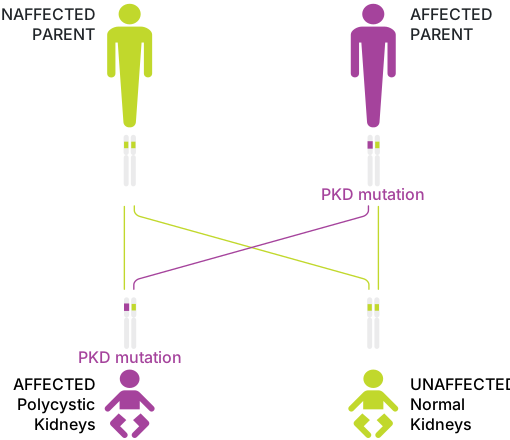
            • If you inherited a gene change causing ADPKD, there’s a 1 in 2 chance (50% chance) of passing it on to each child you have.
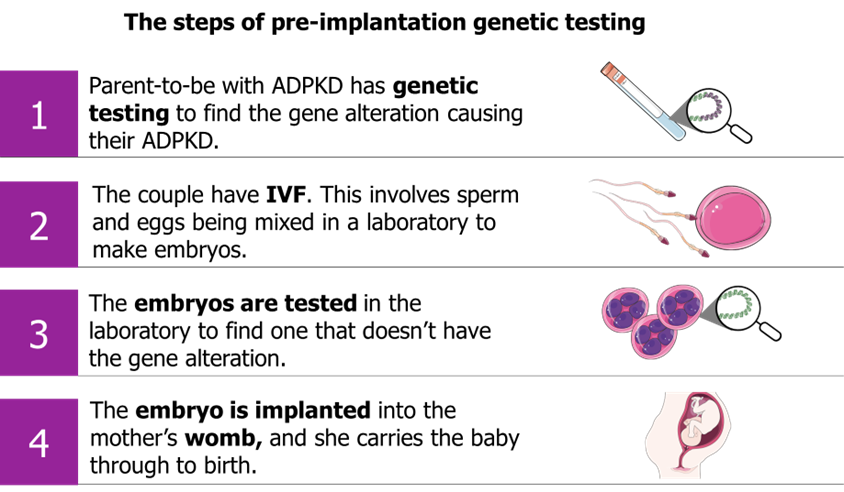
            • If you have ADPKD, you and your partner might be able to have a special type of in vitro fertilization (IVF) to try for a baby without ADPKD. This involves genetic testing of embryos. It’s called preimplantation genetic testing.
            • Less commonly, couples opt to have their developing baby (fetus) tested during pregnancy.

            What is a gene?

            Genes are the instructions the cells in our bodies need to grow, divide and do their jobs. Genes are made of DNA — a long chain of molecules linked together to form a code. These codes act like recipes, telling our cells how to make different proteins. Proteins do most of the work in our bodies.

            Picture: DNA strands, which make up genes. By Geralt, CC0, via Wikimedia Commons.

            Which gene changes cause ADPKD?

            ADPKD is usually inherited. This means it’s passed on from a parent with ADPKD to their child through their genes.

            There are many different gene changes (mutations) that can cause ADPKD.

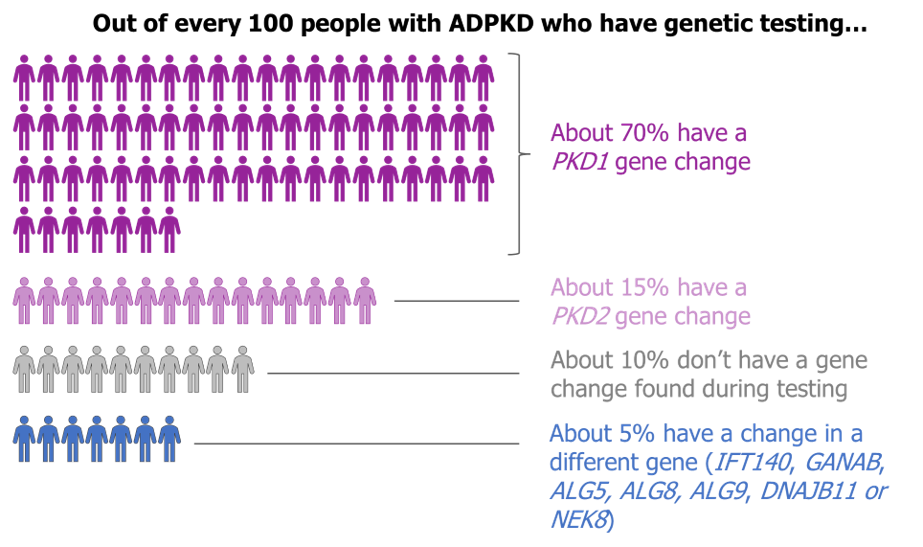
            Usually, ADPKD is caused by a change in either the PKD1 or PKD2 gene. Less often, changes in other genes cause ADPKD (see picture below).

            Diagram: The gene changes causing ADPKD

            Although these gene changes are usually inherited, a new change sometimes happens by chance before a baby is born. This is called a ‘spontaneous mutation’ or ‘de novo mutation’. People with a de novo mutation have ADPKD even though neither of their parents do.

            What is genetic testing?

            A genetic test can look for gene changes that cause health conditions. You usually need to provide a blood or spit (saliva) sample to have a genetic test.

            In a genetics lab, a technician will use a machine called a sequencer to read the DNA code of your genes. They’ll check the code for changes linked to ADPKD and other kidney conditions that cause cysts.

            If they find an ADPKD gene change and you have physical signs (for example, kidney cysts), this means you have ADPKD. If you have an ADPKD gene change but don’t have physical signs yet, you’re predicted to get them in the future.

            Sometimes, the technician reads a person’s entire DNA code rather than individual genes. This is called ‘genomic testing’ (because a whole DNA code is called a genome).

            To keep things simple, we only say ‘genetic testing’ from now on. The information on this page applies to genomic testing too.

            Can I have a genetic test for ADPKD?

            ADPKD is uncommon. Testing for everyone would rarely be useful.

            People can have genetic testing for ADPKD for free on the NHS if they have, or are likely to have, the condition.

            Here are situations when people can have genetic testing for ADPKD on the NHS:

            1. A person has kidney cysts and their kidney doctor is unsure of the cause

            Adults can usually be diagnosed with ADPKD based on signs and symptoms, especially if they have a relative with ADPKD.

            However, if a person has only a few kidney cysts and no other signs of ADPKD, it can be unclear whether they have ADPKD or a different kidney condition. The cause can also be unclear if the person doesn’t have any relatives with ADPKD.

            For these people, doctors use genetic testing to work out if they have ADPKD. This is called a ‘diagnostic genetic test’. The lab will usually check the code of genes linked to ADPKD only.

            2. A child or adolescent has symptoms of ADPKD

            ADPKD doesn’t often cause symptoms in children. If a person under 18 years old has symptoms of ADPKD, their doctor may offer genetic testing to check if they have ADPKD or a different kidney condition.

            3. A person is diagnosed with ADPKD and knowing the causing gene would help plan their care

            The age at which people tend to get problems from ADPKD differs depending on which ADPKD gene change they have. For example, people with a change in the PKD1 or NEK8 gene tend to get kidney failure sooner than people with a PKD2 gene change.

            Kidney doctors can use genetic test results to predict how and when a person’s ADPKD might cause problems. This can help to plan the person’s care.

            4. A person has a close relative with ADPKD and wants to know if they have ADPKD too

            If a person has ADPKD and the gene change causing it has been found, their close relatives can be tested to see if they have the same gene change. The lab will check each relative’s DNA to look for the same gene change. This is called a ‘predictive genetic test’.

            Relatives with the same gene change have (or are predicted to have) ADPKD. There is a chance they can pass ADPKD on to their children.

            Their kidney doctor might check their kidneys too using an ultrasound scan or other test.

            5. A person wants to donate a kidney to a relative with ADPKD

            If someone with ADPKD has kidney failure, they could have the option of a kidney transplant. If a close relative wants to donate a kidney to them, doctors first need to check that this relative doesn’t have ADPKD too. This can be done with a genetic test. People with ADPKD can’t donate a kidney.

            If you would like a genetic test for ADPKD, ask your GP or kidney doctor. They can explain whether you can have a genetic test on the NHS. If you can, they can arrange this for you.

            They might ask you to have genetic counselling first. This is to help you understand the pros and cons of testing before going ahead.

            How long does it take to get the results?

            If you’re having a genetic test for ADPKD and no one in your family has been tested before, the results should come within 12 weeks (about 3 months).

            If the gene change running in your family is already known, your test result might come within 6 weeks. This is because the lab staff already know which gene change they’re looking for.

            Waiting times can vary. Your genetics clinic can confirm how long you may wait.

            What could the results of my genetic test be?

            The 3 main results of a genetic test for ADPKD are:

            • You have a gene change known to cause ADPKD
              • This means you either have ADPKD now (if you have signs and symptoms already) or are predicted to develop it in the future.
              • Your children might inherit ADPKD.
              • Your relatives can have genetic testing too, if they choose.
            • You don’t have a gene change known to cause ADPKD
              • If the gene change causing ADPKD in your family is known and you don’t have it, this means you don’t have ADPKD. Your children can’t inherit ADPKD.
              • If you have strong signs of ADPKD and no one else in your family has ADPKD, you probably do have the condition. The genetic cause is unknown. Your children might inherit ADPKD.
              • If you have unclear signs (for example, one cyst), you probably don’t have ADPKD. Your kidney doctor will recommend more tests in the future to check.
            • You have a gene change but genetic specialists aren’t sure if it causes ADPKD.
              • This can happen if specialists haven’t seen this DNA code change before.
              • About 1 in every 4 people (25%) get an unclear result.
              • Your kidney doctor or genetic specialist will explain what the results mean for you and your family.

            What happens if I’m diagnosed with ADPKD?

            If your kidney doctor diagnoses you with ADPKD, they’ll offer you more tests to check your kidneys and general health. Find out more on our page on diagnosis.

            To help you stay as healthy as possible:

            • You’ll have regular check-ups through life.
            • Your GP, kidney team and other specialists will organize any treatment you need.
            • Your kidney doctor might recommend a treatment called tolvaptan to help slow down the growth of kidney cysts. This depends on how ADPKD is affecting you.
            • Your kidney doctor will recommend a healthy diet and lifestyle to help protect your kidneys.

            Will my DNA code be stored?

            The lab is likely to read your complete DNA code when you have a genetic test for ADPKD. This is called ‘whole genome sequencing’. Although the machine reads your whole DNA code, the lab will only look at the genes linked to ADPKD and other kidney conditions.

            Your doctor may ask if your full DNA code can be stored in the National Genomic Research Library. This is done anonymously (meaning your name is not stored in the database). Researchers can ask to use the anonymous data in studies about the diagnosis and treatment of diseases.

            You can have the test without your DNA going into this library if you prefer.

            Can I have a genetic test for ADPKD at a private clinic?

            If you can’t have genetic testing on the NHS, ask your doctor to explain why. It might be that you’re not at risk of having ADPKD or the results would not alter your care plan.

            Some companies offer private genetic testing (meaning it’s not done by the NHS). You need to pay for this yourself or via health insurance. Before using a private company, ask about the expertise of the lab and the doctor analysing the results.

            Genetic tests are highly technical and the results can be hard to understand. There are over 2,000 different changes in the DNA code that can cause ADPKD. So it’s important the service is familiar with them.

            Make sure the clinic explains beforehand what test results you might get, so you’re prepared. Ask who will be on hand to explain the results to you.

            Can genetic tests tell how fast my ADPKD will progress?

            The gene change you have might give some clues on how your ADPKD might progress. Your kidney doctor won’t be able to predict exactly when your ADPKD will worsen. This is because other factors affect ADPKD too.

            Relatives with the same gene change can get different symptoms or experience problems at different ages.

            People with PKD2 gene changes (versus PKD1), tend to have ADPKD that progresses more slowly. They may not get bad symptoms from ADPKD until quite late in life. For example, people with a PKD2 gene change often get kidney failure in their 70s, while people with PKD1 often get kidney failure in their 50s.

            Experts are still learning about rarer ADPKD genes. ALG5, ALG9, DNAJB11, GANAB and IFT140 changes seem to cause ADPKD that is milder. People with these gene changes might not have symptoms until late in life.

            People with a NEK8 gene change might get kidney failure during childhood.

            Choosing whether to have genetic testing

            What are the pros and cons of genetic testing?

            It can be difficult to decide whether to have genetic testing. It may help to have genetic counselling. Talking to friends and family can also help.

            Below are some of the pros and cons. Your doctor can refer you to a specialist to chat these through.

            • Pros:

              • It can help to have an answer on whether or not you have ADPKD, whatever the result.
              • If you have an ADPKD gene change:
                • You can have further tests and regular check-ups to spot any problems early.
                • You can have any treatment you need and follow the right lifestyle to help protect your kidneys.
                • You may be able to take part in clinical trials of possible new treatments.
                • You’ll know the risk of your children having ADPKD.
                • If you’re planning a family, you can look into a special type of fertility treatment called preimplantation genetic testing. This means you can try for a baby without ADPKD (we explain this later).
                • Other family members can get a test too, if they choose.
              • If you don’t have the ADPKD gene that runs in your family:
                • You can feel reassured that you don’t have ADPKD and your children can’t get it.
            • Cons:

              • Waiting weeks or months for test results can be difficult.
              • There is a 1 in 4 (25%) chance the test won’t give a clear answer on whether you carry a gene change that causes ADPKD. This can be frustrating.
              • Getting a diagnosis of ADPKD cause many emotions (such as shock, anxiety about the future, and anger).
              • If you’re diagnosed with ADPKD, this could affect your own and your family’s insurance (for example life and health insurance). We explain this later.

            What happens in a genetic counselling session?

            Genetic counselling is not the same as counselling for mental health issues. You could see a genetic counsellor, a clinical geneticist or a kidney doctor with expertise in genetics. They’ll give you information to help you decide whether to have a genetic test.

            You’ll talk through:

            • the pros and cons
            • the possible results
            • how the results could affect you and your family
            • your views and what’s most important to you

            After genetic counselling, you’ll choose whether you want to go ahead with the test. You don’t have to decide right away.

            Sometimes, people within families can have different views on genetic testing. This can cause tension. Your genetic counsellor can provide helpful tips on talking to relatives.

            Will having a genetic test affect my insurance?

            Having genetic testing can sometimes affect insurance related to your health (such as travel insurance, life insurance, health insurance, or critical illness cover). It might be harder to find insurance and it might be more expensive.

            This depends on the circumstances of the test:

            • In the UK, you don’t need to tell your insurer about any genetic test you (or your family) have to predict whether you have ADPKD if you have no signs or symptoms now. Your insurer must not ask for or use the results of predictive tests.
            • If asked, you should tell your insurance company about any conditions you have been diagnosed with. If you have symptoms of ADPKD and have a scan or genetic test confirming you have the condition, this is classed as a diagnosis. If you don’t tell your insurance company about your diagnosis when asked, this could invalidate your insurance. This means if you need to make a claim on your insurance in the future, the company might refuse to pay out.

            Being clear on whether you’re having a predictive or diagnostic test is important. Ask your kidney doctor, clinical geneticist or genetic counsellor if you’re unsure.

            Your insurer can ask about your family history. If anyone in your family has been diagnosed with ADPKD, tell your insurer when asked or it could invalidate your insurance.

            If other people in your family have ADPKD, your insurance could be affected whether or not you have a genetic test. In fact, if you have a genetic test and this shows you don’t carry an ADPKD gene, this might help you get a better insurance deal.

            Find out more about genetic tests and insurance on the website for the Association of British Insurers.

            We also cover more on our webpage Insurance.

            More detail on the genetics of ADPKD

            How did I get an ADPKD gene?

            Most people with a gene change causing ADPKD inherited it from a parent with ADPKD. Less often, the gene change can happen by chance early in life (when a person is an embryo).

            How are ADPKD genes inherited?

            You have thousands of genes, and you have 2 copies of each gene.

            One copy came from your mum and one came from your dad. You only need one changed copy of a gene linked to ADPKD to get the condition. So, for example, if you inherited a changed PKD1 gene from your mum, you’ll get the condition.

            If you’ve inherited a gene change causing ADPKD, there is a 1 in 2 chance (50% chance) of passing it on to each child you have.

            We show this in the diagram below using the PKD1 gene as an example.

            Here’s an explanation to go with the diagram:

            • Every person has 2 copies of the PKD1 gene.
            • One copy came from their mum and the other copy came from their dad.
            • If a person has just one changed version of the PKD1 gene, they’ll develop ADPKD.
            • In the diagram, the parent shown on the right (in purple) has one changed copy of the PKD1 gene and one normal copy. They have ADPKD.
            • They could pass either the changed gene or the normal gene on to their child. It’s pure chance which copy their child will get.
            • The parent on the left (in green), has two normal copies of the PKD1 gene. Their child could inherit either one of these normal genes.
            • If this couple’s baby inherits a normal gene from each of them, the baby won’t have ADPKD. This is the baby on the left, in green.
            • However, if their baby inherits a normal gene from the healthy parent and the changed gene from the parent with ADPKD, the baby will have ADPKD. This is the baby on the right, in purple.
            • The chance of their baby inheriting the changed gene is 50%.

            Diagram: How ADPKD is inherited. To keep things simple, we only show the PKD1 gene in this diagram. Changes in the PKD2 gene and rarer genes are inherited the same way.

            A small number of people with a de novo mutation can’t pass it on to their children. Your kidney doctor or genetic specialist should explain if this applies to you.

            What do the genes related to ADPKD do?

            The PKD1 and PKD2 genes are codes for making proteins called polycystin 1 and polycystin 2. These proteins are found on cells lining the kidney tubes that make urine (wee).

            People with a PKD1 or PKD2 gene change have differences in the polycystin 1 or polycystin 2 protein. These changes make it more likely that cysts will grow in the kidney tubes.

            Some other gene changes that cause ADPKD (for example in GANAB or ALG9) might affect the way that polycystin 1 or 2 are made or moved in cells.

            Experts don’t yet know exactly what jobs polycystin 1 and 2 do. But, if cells lining the kidney tubes don’t have enough working polycystin 1 and 2, the cells can multiply too often. When too many cells grow in one area it can make a bulge. This can become a cyst.

            For more information see our webpage, How are cysts formed?

            Researchers are studying polycystin 1 and 2 to find out more about what they do. Their findings might help to design new treatments for ADPKD in the future.

            Information for parents and people planning a family

            Should my child get tested for ADPKD?

            Most children with ADPKD don’t have symptoms that cause problems. The only way to know whether a child has ADPKD (or might develop ADPKD later in life) is a kidney scan or genetic test.

            Children at risk of having ADPKD can have genetic testing at any age. They can have a kidney scan if you prefer.

            If you’re thinking about genetic testing, ask your GP to refer you to a genetic counsellor, clinical geneticist or kidney doctor. They can explain the pros and cons. It’s good to involve your child in the decision if they’re old enough to understand.

            Doctors can check your child’s blood pressure every few years regardless of whether your child has had a genetic test. This is good to do because ADPKD can cause high blood pressure in children and adults. High blood pressure should be treated.

            For more information, see our webpage Symptoms and testing in children.

            Can I have my baby tested for ADPKD during pregnancy?

            If you or your partner have ADPKD, there’s a 1 in 2 (50%) chance your child will inherit ADPKD. This risk applies to each child you have.

            You can have your developing baby (fetus) tested for ADPKD during your pregnancy if you want to. This test can usually confirm whether your baby will develop ADPKD.

            This test can be useful in these situations:

            1. Your pregnancy doctor (obstetrician) has spotted on a pregnancy scan that your fetus has possible signs of a kidney condition.
            2. You want to know whether your baby will develop ADPKD so you can decide whether to continue with the pregnancy.

            We’re sorry if reading this information upsets you. Our helpline details are below, if you would like to chat to someone confidentially.

            To do the test, your pregnancy doctor will take a sample of cells. Usually, they take a sample from the placenta. This is an organ that supplies oxygen and nutrients to your baby in the womb. The procedure is called chorionic villus sampling.

            Find out more on our webpage ADPKD and pregnancy.

            It’s best to discuss options before becoming pregnant. Ask your GP or kidney doctor to refer you to a genetics centre.

            Can I have fertility treatment to select an embryo without ADPKD?

            If you or your partner have ADPKD, a special type of in vitro fertilization (IVF) called pre-implantation genetic testing (PGT) might help you to have a child without ADPKD.

            People can feel differently and strongly about PGT. Some people see it as a good thing. Others find it upsetting, for example because they feel it suggests a baby without ADPKD is ‘better’. A genetic counsellor can help you to explore your views on PGT.

            For PGT, a specialist clinic will do genetic testing on your embryos. They’ll find an embryo without the ADPKD gene and put it in the mother’s womb. This means the baby won’t have ADPKD.

            PGT doesn’t always lead to pregnancy. About a third of couples having PGT have a baby.

            You can only have PGT if the gene change causing your or your partner’s ADPKD is known.

            Figure 3: Steps of pre-implantation genetic testing

            If you want to look into PGT, the first steps are:

            • Ask your GP whether PGT is available on the NHS in your area.
            • Ask your doctor to refer you to a genetic specialist to discuss PGT.
            • If the genetics service agrees you’re eligible for PGT, they’ll refer you to a specialist centre. There are not many in the UK so you may need to travel quite far.

            ADPKD is one of the conditions approved for PGT. However, not everyone is allowed to have it on the NHS. Rules differ by area of the UK.

            In England, for example, you can only have PGT on the NHS to have a baby without ADPKD if:

            • you or your partner have ADPKD
            • the mother-to-be is under 40 and not underweight or obese
            • neither of you smoke

            If you (as a couple living together) already have a child without ADPKD, you won’t usually be allowed to have PGT.

            Find out more about PGT on the Genetic Alliance website.

            You may choose to have PGT privately if you can’t get NHS funding. Learn about choosing a clinic on the Human Fertilisation and Embryology Authority website.

            More information from the PKD Charity

            Information and support from others

            The photos on this webpage are freely available on Pexels.com. The medical history of the persons shown is unknown.

            Authors and contributors

            Written by Hannah Bridges, PhD, independent medical writer, HB Health Comms Limited, UK. Reviewed by Professor Richard Sandford, Academic Department of Medical Genetics, University of Cambridge, UK.

            All of our publications are based on references but these are removed for ease of reading on our webpages. A version of this webpage with references included is available upon request by emailing [email protected]

            With thanks to all those affected by ADPKD who contributed to this publication.

            Ref No: ADPKD.GA.V3.0
            Latest version: © January 2026.
            Due for medical review: January 2029.

            Disclaimer: This information is primarily for people in the UK. We have made every effort to ensure that the information we provide is correct and up to date. However, it is not a substitute for professional medical advice or a medical examination. We do not promote or recommend any treatment. We do not accept liability for any errors or omissions. Medical information, the law and government regulations change rapidly, so always consult your GP, pharmacist or other medical professional if you have any concerns or before starting any new treatment.

            If you don’t have access to a printer and would like a printed version of this information sheet, or any other PKD Charity information, call the PKD Charity Helpline on 0300 111 1234 (weekdays, 9am–5pm) or email [email protected]

            The PKD Charity Helpline offers confidential support and information to anyone affected by PKD, including family, friends, carers, newly diagnosed or those who have lived with the condition for many years.

            Read more …Genetic testing and counselling for ADPKD

            How are cysts formed?

            How are cysts formed?

            This information is for people with autosomal dominant polycystic kidney disease (ADPKD), their family and friends. It explains what cysts are, how they grow, and the damage they can cause to the kidneys.

            Contents

            What is a cyst?

            A cyst is a pouch (or ‘sac’) of cells that contains fluid. It can be as small as a pea to the size of a grapefruit. ‘Polycystic’ means ‘many cysts’, which is where polycystic kidney disease gets its name.

            In people with ADPKD, many cysts grow in the kidneys and increase in size over time (usually over many years). This causes the kidneys to get larger and often stops them working properly. If you have ADPKD, you’re very likely to get cysts in other organs too, such as your liver.

            A picture of a kidney cyst. A circle of cells is shown, with fluid held in the middle.

            Where do kidney cysts form?

            To filter our blood, each kidney contains up to a million filtering units known as nephrons. Each nephron is made of a filter and tiny tube (more technically known as a tubule) and blood vessels. The nephrons filter blood; the water and waste (urine) flow to the bladder.

            In people with ADPKD, cysts grow from the kidney tubules.

            A picture of a nephron. The nephron is a thin, long, winding tube. At the top of the nephron sits a ball of blood vessels called the glomerulus. Water and waste pass through these vessels into the tubule. Waste fluid (urine) flows via a collecting tube to the bladder.

            How do kidney cysts form?

            Kidney cysts begin to form when the cells lining the tubule grow too fast, making a bulge. Over time, this balloons in size and can separate from the tubule, forming a cyst. Fluid collects in the cysts causing them to swell. This is shown in the picture below.

             A picture showing cysts forming in a kidney nephron. Bulges are shown from the tubule. Some of these have ballooned in size and separated from the tubule, becoming cysts.

            Some of the changes to tubule cells that lead to cysts growing are caused by an inherited altered gene (for example, PKD1 or PKD2). As the kidneys get damaged, more changes occur that can worsen cyst growth. For example, the amounts of certain molecules that control how tubule cells behave can change. The gluey substance holding tubule cells together can also weaken.

            What damage do cysts cause to the kidney?

            In people with ADPKD, more and more cysts form and enlarge over time. Scar tissue forms around the cysts (known as fibrosis) squashing nearby blood vessels and nephrons. Immune cells (which usually defend the body against infections) can also collect in the damaged tissue, making things worse.

            These changes mean that both kidneys enlarge as a person ages. The speed at which the kidneys grow differs between people, but they tend to increase in size by about 5% each year. For example, a kidney 15 cm long could increase to almost 16 cm long in a year.

            The kidneys usually continue to work well for many years despite these cysts. However, the damage to the kidneys eventually becomes too great and they stop working properly. The amount of blood they can filter per minute (the estimated glomerular filtration rate, or eGFR) drops. This is known as reduced kidney function or chronic kidney disease (CKD) stage 2, 3, 4 or 5.

            On average, people with ADPKD get kidney failure at about age 60, but this differs a lot from person to person. Some people with ADPKD get kidney failure earlier, while others never get kidney failure. The timing depends on a few factors, including the gene alteration a person has (for example, PKD1 or PKD2).

            Where else can cysts form?

            Most people with ADPKD develop cysts in their liver by middle age. These cysts don’t usually cause any symptoms or stop the liver working. In some people, they increase the size of the liver but they usually don’t cause serious problems. You can learn more about liver cysts on our web page on polycystic liver disease.

            Less commonly, cysts can form in other organs including:

            • the pancreas (an organ that makes enzymes and hormones that aid digestion)
            • the seminal vesicles (glands that release semen in men)
            • the ovaries (where a woman’s eggs are made)

            What symptoms do cysts cause?

            Cysts and kidney damage can cause a range of symptoms including: pain, infections, kidney stones, reduced kidney function, and high blood pressure. You can find lots of information on ADPKD symptoms and treatment on our website.

            Can the growth of cysts be prevented?

            There’s no cure for ADPKD and no treatments can prevent the growth of cysts. However, there are some steps you can take to help slow cyst growth. We explain these below.

            Diet and lifestyle

            Factors that might increase the speed that ADPKD worsens include:

            • being overweight or obese
            • eating more salt than recommended (over 5g a day for adults)
            • having high blood pressure
            • being dehydrated often

            So, it’s a good idea to follow a healthy diet and lifestyle. You should also take any blood pressure medicines your doctor recommends if you have high blood pressure.

            Experts recommend that adults with ADPKD drink at least 2–3 litres of water a day, provided their eGFR is at least 30 ml/min per 1.72 m². If your eGFR is lower than 30 ml/min per 1.72 m² (meaning you have CKD stage 4 or 5), please follow your kidney specialist’s advice about water. If you aren’t sure what your eGFR is, ask your doctor.

            Experts aren’t sure that drinking plenty of water can slow the growth of cysts. However, they think it might help and it’s unlikely to cause you harm.

            Tolvaptan

            A treatment called tolvaptan (Jinarc®) can slow the speed at which the kidneys enlarge and are damaged.

            Researchers think tolvaptan does this by:

            • stopping the growth of cells that line cysts
            • reducing the amount of fluid that collects in cysts

            Tolvaptan is not available to all patients. To find out more about how it works and who may be suitable, see our webpage Medicines to treat ADPKD.

            More from the PKD Charity

            Information and support from others

            Kidney Research UK has information on what the kidneys do.

            TedEd has a video on how your kidneys work.

            Further information

            All of our publications are based on references but these are removed for ease of reading on our webpages. A version of this webpage with references included is available upon request by emailing [email protected]

            Authors and contributors

            Written by Hannah Bridges, PhD, independent medical writer at HB Health Comms Limited. Expert review by Dr Adam Rumjon, Consultant in Renal Medicine, Royal Free London NHS Foundation Trust.

            With thanks to all those affected by ADPKD who contributed to this publication.

            Ref No: ADPKD.HCF.2025.V2.0

            Latest version: © April 2025 (v2.0).

            Due for medical review: April 2028.

            Disclaimer: This information is primarily for people in the UK. We have made every effort to ensure that the information we provide is correct and up to date. However, it is not a substitute for professional medical advice or a medical examination. We do not promote or recommend any treatment. We do not accept liability for any errors or omissions. Medical information, the law and government regulations change rapidly, so always consult your GP, pharmacist or other medical professional if you have any concerns or before starting any new treatment.

            If you don't have access to a printer and would like a printed version of this information sheet, or any other PKD Charity information, call the PKD Charity Helpline on 0300 111 1234 (weekdays, 9am–5pm) or email [email protected]

            The PKD Charity Helpline offers confidential support and information to anyone affected by PKD, including family, friends, carers, newly diagnosed or those who have lived with the condition for many years.

            Read more …How are cysts formed?

            How is ADPKD diagnosed?

            How is ADPKD diagnosed?

            This web page is for people offered tests for autosomal dominant polycystic kidney disease (ADPKD). It’s also for people who are thinking of getting tested because they have a relative with ADPKD. We describe the tests you’re likely to have.

            Contents

            Key facts

            • To check whether you have ADPKD, you might be offered a scan of your abdomen (tummy) or a genetic test.
            • Using a scan, a radiologist can see fluid-filled balls (cysts) in the kidneys caused by ADPKD.
            • A genetics specialist can use a genetic test to look for genes that can cause ADPKD. These include the PKD1 or PKD2 gene.
            • Talk to a specialist about the pros and cons of testing before going ahead.
            • If you’re diagnosed with ADPKD, you may feel a range of emotions. Many people feel shocked or overwhelmed at first.
            • Specialists will chat you through what the diagnosis means. They’ll explain any tests or treatments you can have now or in the future.

            Call our helpline on 0300 111 1234 for support, practical advice and information. You can also contact us via Facebook messenger or email [email protected].

            How do doctors diagnose ADPKD?

            To check for ADPKD your doctor might offer you a scan of your abdomen (tummy) or a genetic test.

            You should talk to a specialist before having either test. They could, for example, be a specialist in the kidneys (a nephrologist) or in genetics (a genetics counsellor). They can explain the pros and cons of tests for ADPKD. They’ll also ask about your preferences for testing.

            A specialist will also talk you through your test results.

            Here is an overview of the two main ways to check for ADPKD:

            Images by Laymik and Vectors Point under CC BY 3.0 License.

            Scan of the kidneys

            Kidney specialists (nephrologists) most often diagnose ADPKD using imaging scans of the kidney, such as an ultrasound scan. On these kidney scans, fluid-filled balls (cysts) caused by ADPKD can be seen. You might have a scan to check for ADPKD, or the cysts might be spotted on a scan you have for other reasons.

            Images by Laymik and Vectors Point under CC BY 3.0 License.

            Genetic test

            A genetic test looks for the gene changes that can cause ADPKD. Doctors can use these tests to check for ADPKD in people with signs of the condition. They can also be useful when a person has kidney cysts but the cause isn’t known. Sometimes, genetic tests are used in people already diagnosed with ADPKD to help plan their care.

            The pros and cons of ADPKD tests

            Pros (benefits) of tests for ADPKD include:

            • You may get a clear answer on whether you have ADPKD.
            • If you don’t have ADPKD, this can be reassuring.
            • If you do have ADPKD:
              • You can get any further tests and treatment you need.
              • You can get advice on diet and lifestyle to manage the condition well.
              • You might be able to take part in clinical trials of new ADPKD treatments.
              • You can learn how ADPKD might affect your children and get help with planning a family.
              • Other family members can be tested too.

            Cons (downsides) of tests for ADPKD include:

            • The tests might not give a clear answer on whether you have ADPKD. This happens for about 1 in 4 people having the test.
            • Finding out you have ADPKD can cause strong emotions. For example, you might feel anxious, angry or guilty.
            • If you’re diagnosed with ADPKD, this may affect insurance related to your health (such as life insurance, health insurance, or critical illness cover).

            To learn more about insurance and tests to diagnose ADPKD, see our web page on Genetic testing and counselling.

            Having a scan of your kidneys

            Picture: a radiologist looking at an ultrasound image.

            A specialist in taking images of the inside of the body (a radiologist) will do your scan. The most common type of imaging to look for kidney cysts is ultrasound.Ultrasound uses soundwaves to see inside the body.The radiologist will hold a probe against the skin of your abdomen (tummy). This is almost always painless.

            [Alt text: An ultrasound image of a PKD kidney. Much of the screen is black. Where the ultrasound waves hit body tissue, the scan appears grey or white. The cysts appear as black circles].

            Less often, radiologists use computed tomography (CT) or magnetic resonance imaging (MRI) to see the kidneys.

            A CT scan uses X-rays. An MRI uses a powerful magnet and radio waves.

            To have an MRI you’ll need to lie inside a machine. It doesn’t hurt but people who don’t like small spaces may feel anxious. During a CT scan, a large ring passes along your body but you’re less enclosed than with MRI.

            A doctor may offer you an MRI or CT scan if an ultrasound scan doesn’t give a clear answer on whether you have ADPKD.

            A doctor can usually diagnose ADPKD if they see kidney cysts on the scan and you have a relative with ADPKD. If you have cysts but no relatives with the disease, your doctor may suggest a genetic test to confirm the results.

            If the scan doesn’t show any cysts, you might not have ADPKD. However, if you’re under 40 years old, there’s a chance you have ADPKD but it hasn’t caused cysts yet. Your doctor will offer you further scans in the future to check for cysts.

            If you need a definite answer now (for example, because you’re thinking about donating a kidney), a genetic test can often confirm whether you have ADPKD.

            Having a genetic test

            ADPKD is caused by a change in a gene (usually in the PKD1 or PKD2 gene).

            If a relative has ADPKD and the genetic cause is found, you may be offered a genetic test to see if you have the same gene change.

            To do a genetic test a doctor or nurse will take a sample of your blood (or body fluid or tissue). They’ll send this to a laboratory to test. If the gene change that runs in your family is found in your sample this confirms you have ADPKD. If the gene change isn’t found you don’t have ADPKD.

            If a gene change hasn’t been found in your family before, the laboratory will check your sample against a list of possible ADPKD genes. If they find a match this confirms you have ADPKD. If they don’t find a gene change known to cause ADPKD, it’s unlikely you have the condition. However, there’s a small chance that you have ADPKD but your gene change is rare or previously unseen. This means it’s not on the laboratory’s list.

            Your kidney specialist may be able to estimate how ADPKD is likely to affect you based on your genetic test results. However, the way the condition affects people with the same gene can vary.

            You can learn more on our web page Genetic testing and counselling.

            You can also watch a video of a talk that expert Professor Sayer gave about genetics and genetic testing in ADPKD.

            Coming to terms with a diagnosis

            If you’re diagnosed with ADPKD, you may feel strong emotions. Many people feel shocked or overwhelmed at first.

            As you think through the news, you and your family are likely to have questions and concerns. It’s a good idea to ask for a follow-up appointment with your kidney specialist to chat these through. If you have not been referred to a kidney specialist yet, ask your doctor (GP) to refer you.

            Your kidney specialist can explain how they’ll monitor your health. They can also explain how ADPKD might affect you now and in the future.

            Your GP might be able to arrange for you to chat with other specialists too.

            Getting a diagnosis of ADPKD usually doesn’t mean making big changes to your life.

            Many people with ADPKD have decades of good health before ADPKD affects their body.

            People with ADPKD are usually still able to work, have children, go on holiday, keep active and drink alcohol if they want to.

            Our website has information about life with ADPKD including how to live well with the condition and appointment tips.

            Our helpline is open Monday to Friday 9.30 am to 5.00 pm, except bank holidays. Call us on 0300 111 1234 for emotional support, practical advice and information. You can also contact us on Facebook messenger or by emailing [email protected].

            Further health checks

            If you’re diagnosed with ADPKD, your kidney specialist will offer you a blood test and urine test to see how well your kidneys are working. They’ll also check your blood pressure and general health.

            If you haven’t been referred to a kidney specialist yet, ask your GP to refer you.

            You’ll have check-ups with your kidney specialist and doctor throughout your life. This is so they can monitor your health and recommend treatments when needed. Depending on your symptoms, you may see other specialists or a counsellor too.

            Tests for ADPKD in children

            If your child has kidney symptoms, your doctor might offer them a kidney scan or genetic test for ADPKD.

            Usually, children without symptoms can only have a test if they have a parent with ADPKD. This is because ADPKD is very rare unless a parent has it.

            Your child can have ADPKD tests at any age (if they’re eligible).

            [Alt text: picture of a young boy in the countryside.]

            If your child is offered an ADPKD test, think about the pros and cons before going ahead. For example:

            • A diagnosis means your child can get the right check-ups and care.
            • If tests show that your child doesn’t have ADPKD, this can be a relief.
            • Having tests might worry your child.
            • If your child is diagnosed with ADPKD, this might affect their insurance in the future.

            ADPKD tests sometimes don’t give a definite answer on whether a child has ADPKD. Ask your doctor to explain whether the results are likely to give a clear answer for your child and why.

            Experts recommend that children with ADPKD (or who might have ADPKD) have a blood pressure check every year. This is because ADPKD can cause high blood pressure.

            See Symptoms of ADPKD and tests in children for more information.

            More from the PKD Charity

            Information and support from others

            The NHS website has information on ultrasound scans, CT scans, MRI, and genetic testing.

            Further information

            All of our publications are based on references but these are removed for ease of reading on our webpages. A version of this webpage with references included is available upon request by emailing [email protected]

            Authors and contributors

            Written by Hannah Bridges, PhD, independent medical writer, HB Health Comms Limited. Expert review by Dr Grahame Wood, Consultant Renal Physician, Salford Royal Hospital, Northern Care Alliance NHS Foundation Trust, UK.

            With thanks to all those affected by ADPKD who contributed to this publication.

            Ref No: ADPKD.HIAD.V3.0
            © PKD Charity 2025
            First published: June 2025
            Due to be medically reviewed: June 2028

            Disclaimer: This information is primarily for people in the UK. We have made every effort to ensure that the information we provide is correct and up to date. However, it is not a substitute for professional medical advice or a medical examination. We do not promote or recommend any treatment. We do not accept liability for any errors or omissions. Medical information, the law and government regulations change rapidly, so always consult your GP, pharmacist or other medical professional if you have any concerns or before starting any new treatment.

            If you don't have access to a printer and would like a printed version of this information sheet, or any other PKD Charity information, call the PKD Charity Helpline on 0300 111 1234 (weekdays, 9am–5pm) or email [email protected].

            The PKD Charity Helpline offers confidential support and information to anyone affected by PKD, including family, friends, carers, newly diagnosed or those who have lived with the condition for many years.

            Read more …How is ADPKD diagnosed?

            ADPKD basics

            ADPKD basics

            This information is for people who have recently found out they have autosomal dominant polycystic kidney disease (ADPKD). It’s also for their friends, families and carers. It answers many of the initial questions you may have about ADPKD.

            Finding out you have ADPKD can be a difficult time. If you’d like emotional support, practical advice and information, contact our confidential helpline. Call 0300 111 1234 (9.30 am to 5.00 pm Monday to Friday, except bank holidays), email [email protected] or use Facebook messenger.

            Contents

            Key facts

            • Autosomal dominant polycystic kidney disease (ADPKD) is a rare health condition that some people are born with.
            • It causes fluid-filled pouches (cysts) to grow in your kidneys.
            • These cause damage to your kidneys over time, stopping them working properly.
            • However, most people stay in good health for decades after their diagnosis.
            • A kidney doctor (nephrologist) can check whether you have ADPKD using a kidney scan or genetic test.
            • ADPKD can lead to: high blood pressure, urinary tract infections, cyst infections, blood in your wee, kidney stones, pain and discomfort, and low kidney function.
            • People with ADPKD have regular check-ups with their kidney doctor and GP throughout life.
            • There is no cure for ADPKD.
            • Treatments can help with many of its symptoms.
            • Some people can take a medicine called tolvaptan to slow down kidney damage.
            • Many people eventually need dialysis or a kidney transplant.

            What is ADPKD?

            ADPKD is a rare health condition that some people are born with. It’s caused by a gene that’s usually inherited from a parent.

            ADPKD is not a disease you can catch. It’s also not cancer.

            It causes fluid-filled pouches (cysts) to grow in your kidneys. Some people with ADPKD get cysts in other organs too.

            With the right care, people with ADPKD can stay healthy for much of their lives.

            Kidney cysts grow over time, causing kidney damage. Your kidneys may eventually stop working properly, causing symptoms. This often happens at middle age.

            Hearing that your kidneys might fail in the future can be scary. However, there are good treatments available. Most people live for many years after reaching kidney failure.

            How common is ADPKD?

            In the UK, about 1 person in every 1,000 to 2,500 are born with ADPKD. There could be between 30,000 and 70,000 people with ADPKD in the UK.

            ADPKD can affect men and women and people of different ethnicities.
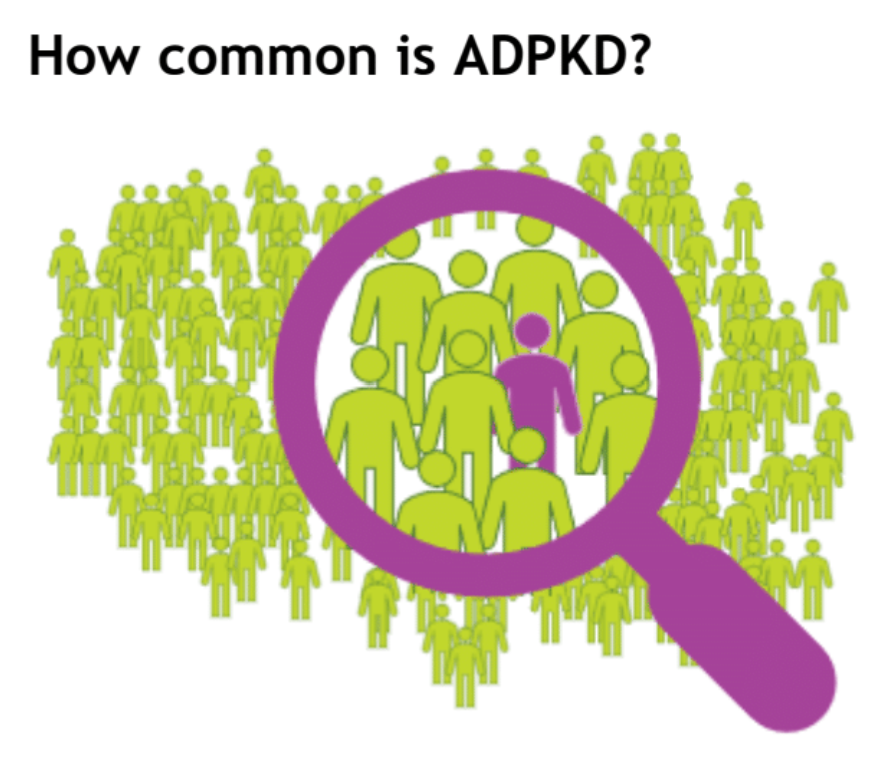
            Illustration of a crowd of people, zooming in on a person with ADPKD.

            Kidney cysts

            Your kidneys contain fine tubes that filter your blood to make urine (wee). ADPKD causes fluid-filled pouches called cysts to form in these tubes.

            Kidney cysts caused by ADPKD grow bigger over time. The largest ones can be the size of a grapefruit. Many are smaller, such as the size of a pea.

            Over time, these cysts could make your kidneys very large. We show this in the picture below.
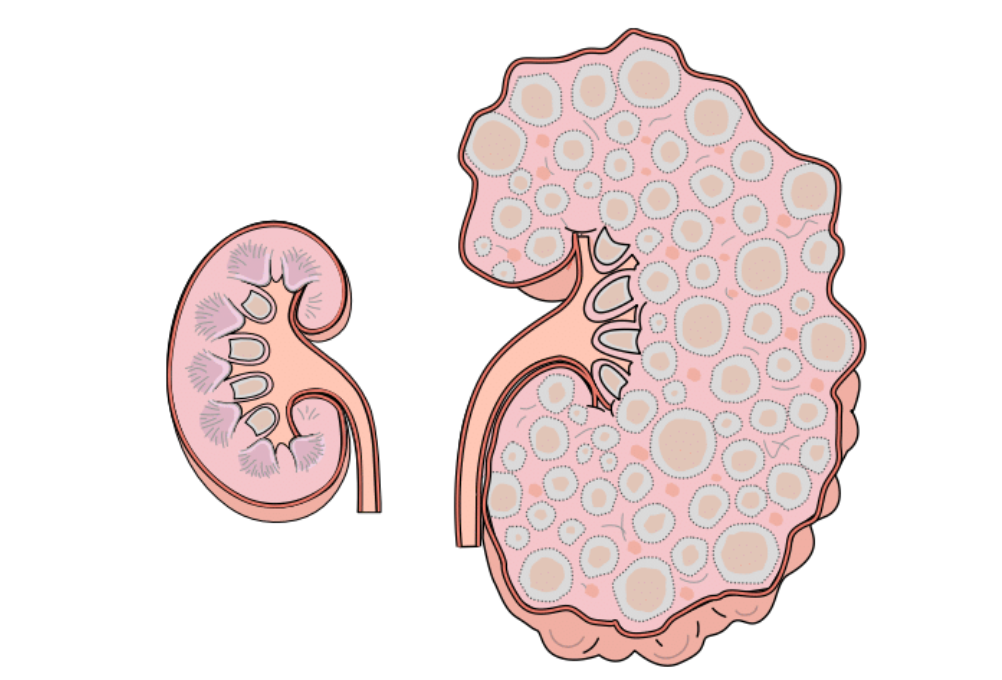
            A picture of a normal kidney compared with an ADPKD kidney. The ADPKD kidney is much larger and has many cysts of varying size.

            Diagram: A normal kidney versus ADPKD kidney. The inside of a normal kidney is shown on the left, and a kidney of a person with ADPKD is shown on the right. The ADPKD kidney is much larger and has many cysts of varying size.

            Kidney cysts can stop your kidneys working well. Eventually, your kidneys may stop working altogether. This is called kidney failure. It can be treated with dialysis, a kidney transplant, or with medicines to help with symptoms.

            On average, people with ADPKD get kidney failure at about age 55 or 60 years. The timing differs a lot from person to person.

            Some people with ADPKD never get kidney failure.

            Cysts in other organs

            Most people with ADPKD (8 out of 10) have liver cysts by their mid-thirties. Your liver will probably still work well. However, liver cysts can make your liver very large, causing symptoms.

            Around 1 in 10 people get cysts in their pancreas. These almost never cause problems.

            Some men with ADPKD get cysts in the tubes that carry semen and sperm. These cysts probably don’t affect fertility.

            We explain further symptoms and problems caused by ADPKD later on this page.

            How did I get ADPKD?

            ADPKD is usually inherited. This means it’s caused by a gene that’s passed from a parent to their child. This happens at conception (when an egg and sperm meet to make an embryo).

            Photo of two parents with their children.

            Genes are codes for the proteins our cells need to grow and function. You can think of each gene as a recipe. We all have two copies of each gene, one from each parent.

            If a gene code changes, this can alter the protein it makes. The protein may work less well or differently to normal. You might hear this gene change called a ‘mutation’ or ‘variant’. These changes can be inherited.

            Most people with ADPKD inherited a gene change from a parent.

            Less often, a new gene change causing ADPKD happens by chance when a baby is forming. This is called a spontaneous or de novo mutation.

            Which genes cause ADPKD?

            ADPKD is most often caused by a change in the PKD1 or PKD2 gene.

            About 67 out of every 100 people with ADPKD (67%) have a PKD1 gene change.

            About 15 out of every 100 (15%) have a PKD2 gene change.

            Less often, ADPKD is caused by a different gene. For a few people with ADPKD, genetic tests don’t find the cause.

            An illustration showing strands of DNA twisted together in a helix shape.

            Picture: an illustration showing DNA strands, which make up genes.
            Image by geralt, CC0, via Wikimedia Commons.

            How is ADPKD diagnosed?

            A kidney doctor (nephrologist) can check whether you have ADPKD using a kidney scan or genetic test.

            Kidney scans

            Kidney doctors often diagnose ADPKD using imaging scans of the kidneys.

            Most often they use an ultrasound scan, which uses soundwaves to see inside your body. Less often, they use computed tomography (CT) or magnetic resonance imaging (MRI). A CT scan uses X-rays, while an MRI uses a powerful magnet and radio waves.

            If you have cysts caused by ADPKD, your kidney doctor will see them on the scan.
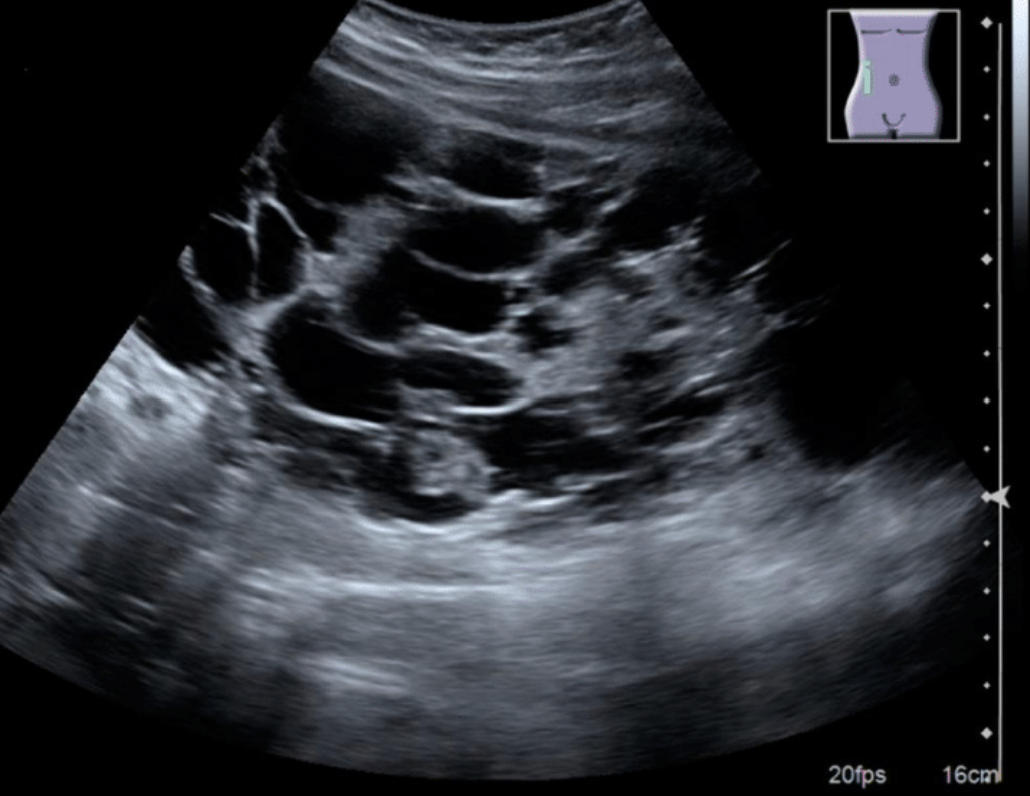
            An ultrasound image of a PKD kidney. The cysts appear as circles in a different colour.

            Picture: Ultrasound image of a kidney in a person with ADPKD. The darker circles are cysts in the kidney. Image by Kristoffer Lindskov Hansen, Michael Bachmann Nielsen and Caroline Ewertsen, CC BY 4.0, via Wikimedia Commons.

            Genetic tests

            A genetic test looks for gene changes that can cause ADPKD. To do the test, a doctor or nurse will take a sample of your blood (or body fluid or tissue). They’ll send this to a laboratory to test.

            These tests can be useful if:

            • your relative has ADPKD and the causing gene has been found — you can be tested to see if you have the gene change too
            • you have signs of ADPKD but a kidney scan doesn’t clearly show whether you have the condition
            • you have ADPKD and knowing which gene change you have would help your kidney doctor to plan your care
            • you have (or are approaching) kidney failure and a relative has offered to donate a kidney to you — the genetic test can check your relative doesn’t have ADPKD too, which would make them an unsuitable donor

            Further health checks

            If your kidney doctor diagnoses you with ADPKD, they’ll offer you more tests.

            These may include:

            • blood and urine tests to see how well your kidneys are working
            • a check of your blood pressure
            • a review of your overall health
            • a liver scan to check for liver cysts
            • a brain scan to check for a swollen blood vessel in your brain (called a brain aneurysm), if you’re at higher risk

            Brain aneurysms are more likely in people with ADPKD than the general population. If you’re at high risk of a brain aneurysm (for example, because a family member has had one), your treatment team will offer you a screening test.

            Based on the results of these tests, your kidney doctor will explain how ADPKD is affecting you and any treatments you need. They can also explain how ADPKD might affect you in the future.

            If you haven’t seen a kidney doctor yet, ask your GP to refer you.

            Learn more on our webpage How is ADPKD diagnosed?

            What problems does ADPKD cause?

            ADPKD causes changes to your kidneys which can lead to symptoms and health problems. Some people also get problems in other areas of their body, including their liver and bowel (guts).

            We cover the more common symptoms and problems caused by ADPKD below.

            Not everyone with ADPKD gets these problems. They become more likely as you get older.
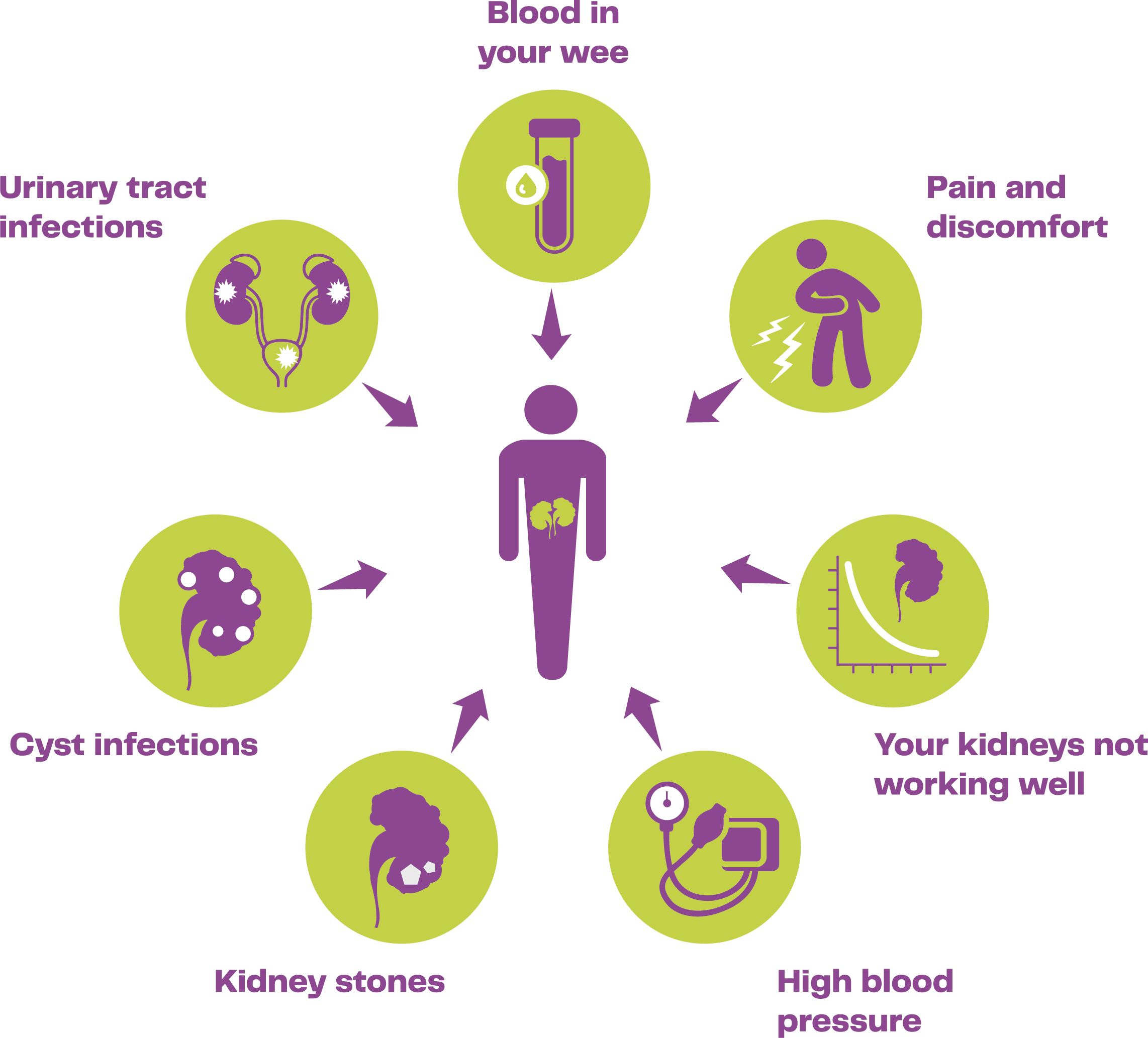
            Diagram showing the more common symptoms of ADPKD: high blood pressure, urinary tract infections, cyst infections, blood in your wee, kidney stones, pain and discomfort, and your kidneys not working well.

            Diagram: Symptoms and health problems caused by ADPKD.

            High blood pressure

            About 5 in every 10 people with ADPKD have high blood pressure. The medical term for this is hypertension.

            On average, people with ADPKD get high blood pressure at about 30 years old. Some people get it earlier or later than this. Risk increases with age.

            It’s important to treat high blood pressure because it can damage your kidneys. It can also increase your risk of having a stroke and heart problems.

            Find out more on our webpage High blood pressure.

            Urinary tract infections

            Your urinary tract includes your kidneys, bladder and the tube you wee through (urethra).

            Urinary tract infections are common in people with ADPKD. Women are more likely to get them than men.

            Symptoms of urinary tract infections include:

            • pain or burning when you wee
            • needing to wee more often and suddenly
            • a high or low temperature (fever or chills)

            If you get these symptoms, see your GP. They can run tests to check the cause and give you antibiotics.

            Find out more on our webpage Urinary tract infections.

            Cyst infections

            Kidney and liver cysts can get infected with bacteria.

            Symptoms of a cyst infection include:

            • pain in your back, side or abdomen (tummy)
            • blood in your wee
            • a high or low temperature (fever or chills)

            If you get these symptoms, see your GP or kidney doctor right away. They can do tests to find the cause.

            If you have an infection, you’ll need antibiotics.

            Picture of a woman looking at a thermometer.

            Kidney stones

            Kidney stones are made of salts and minerals that have stuck together. They can be the size of a piece of gravel or a pebble.

            People with ADPKD are more likely than the general population to get kidney stones. By middle age, at least 1 in every 10 people with ADPKD has been diagnosed with a kidney stone.

            Symptoms of kidney stones include:

            • strong pain in your back or side
            • blood in your wee
            • a high or low temperature (fever or chills)

            These symptoms are similar to those of cyst infections.

            See your GP or kidney doctor if you have these symptoms. They can run tests to find the cause and get you the right treatment.

            Find out more on our webpage Kidney stones.

            Blood in your wee

            About 6 in every 10 people with ADPKD get visible blood in their wee at times. The medical term for this is haematuria.

            Blood in your wee can make it pink, red or brown. You might also see small lumps of solid blood.

            This bleeding could be from:

            • a burst kidney cyst
            • kidney damage from a hard knock (during sport, for example)
            • a urinary tract infection
            • a cyst infection
            • a kidney stone

            Usually, the bleeding stops in a few days with simple steps such as drinking plenty of fluid and rest.

            See your GP or kidney doctor if:

            • the bleeding continues
            • you have other symptoms
            • you’re losing a lot of blood in your wee

            They can do a urine test and refer you for further tests if needed.

            Find out more on our webpage Blood in your wee.

            Pain and discomfort

            Cysts in the kidneys and liver can make these organs large. The larger they get, the more space they’ll take up.

            This can cause:

            • a swollen abdomen (tummy)
            • pain in your abdomen, side or back pain
            • indigestion (heart burn)
            • feeling full early on in a meal
            A photo of a person holding the side of their back.

            Six out of every 10 people with ADPKD have long-term pain (chronic pain).

            See your GP or kidney doctor if you’re in pain or discomfort. They’ll organize tests to find the cause, so you can have the right treatment.

            Long-term pain is sometimes hard to treat. A team of specialists may be involved in your care.

            Find out more on our webpage Pain.

            Reduced kidney function

            Our kidneys have several jobs:

            • They balance levels of chemicals and fluid in our blood, getting rid of what’s not needed.
            • They remove waste and toxins from our blood.
            • They help to control blood pressure.
            • They tell our bodies when to make more red blood cells (which carry oxygen).

            Having ADPKD can make it harder for your kidneys to do these jobs. This is known as reduced kidney function.

            Although ADPKD causes damage to the kidneys, the remaining healthy tissue can work well for decades.

            Until your kidney function gets very low, you probably won’t have symptoms.

            Your kidney doctor will keep track of your kidney function using blood tests and scans. Together, you’ll plan the care you need.

            Find out more on our webpage Progression.

            Kidney failure

            Kidney failure means your kidneys are doing less than a sixth of the work of healthy kidneys. It’s also known as end-stage kidney disease or stage 5 chronic kidney disease.

            On average, people with ADPKD reach kidney failure at about age 55 or 60 years. The timing differs a lot from person to person. Some people with ADPKD never get kidney failure.

            Kidney failure causes a lot of problems but good treatments are available to help. These include dialysis, a kidney transplant and medicines to treat symptoms.

            Your kidney team can usually predict a year or two before you get kidney failure. This means you can consider your treatment options and make plans ahead of time.

            Find out more on our webpage Kidney failure.

            Further health problems caused by ADPKD

            ADPKD can cause:

            Monitoring and treatments are available for these problems.
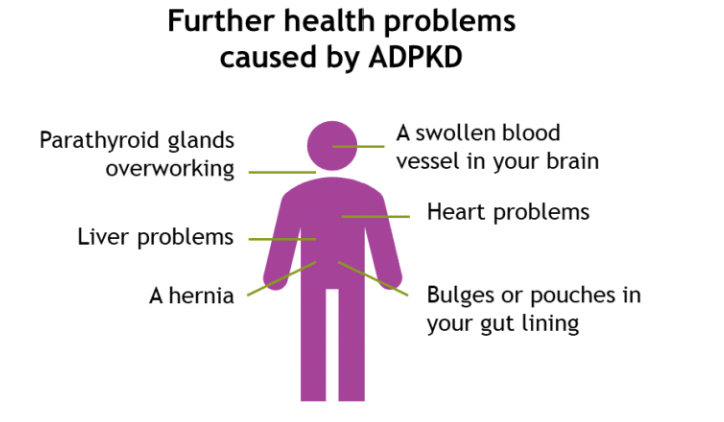
            Diagram showing further health problems caused by ADPKD, as listed below.

            Check-ups throughout life

            You’ll have regular check-ups with your kidney doctor and GP throughout your life. This is so they can monitor your health and get you the right treatments when needed.

            Depending on your symptoms, you may see other specialists. Examples are a liver doctor (hepatologist), surgeon, pharmacist, dietitian and mental health counsellor.

            Most people with kidney disease have check-ups 1 to 4 times a year. How often you’ll have check-ups will depend on your kidney health, general health, and which treatments you’re having.

            Photo of a patient and doctor discussing test results.

            Tests at check-ups can include:

            • blood and urine tests to check your kidney function
            • blood pressure checks
            • scans of your kidneys

            Measuring kidney function

            Kidney doctors usually use a measure called estimated glomerular filtration rate (eGFR) to check your kidney function. Your eGFR is an estimate of how much blood your kidneys can filter in 1 minute. It’s based on a blood test. We explain it more in the next section.

            Other tests to check kidney function include:

            • a blood test for creatinine
            • a urine test for albumin
            • a urine test for blood in your wee

            Your kidney doctor will explain the results.

            Understanding your eGFR values

            Kidneys that are working perfectly can filter about 100 ml of blood per minute.

            The lower your eGFR, the worse your kidney function. We show this in the table.
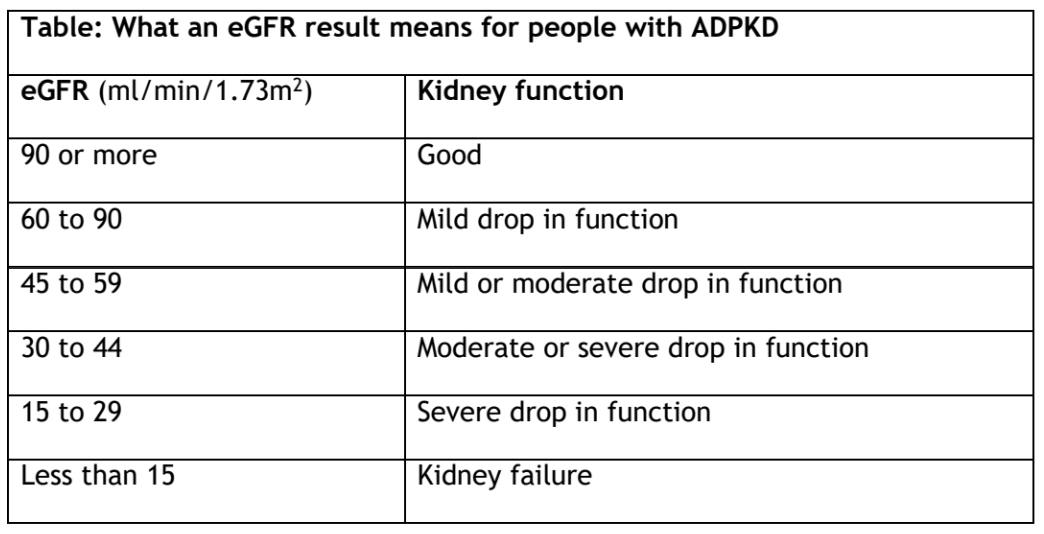
            It can help to think of eGFR as a percentage. For example, an eGFR of 40 means your kidneys are doing about 40% of the work they should be.

            eGFR is a good estimate but the results sometimes come out a little high or low. The way your eGFR changes over months or years shows how fast your kidney function is falling.

            Blood pressure tests

            Blood pressure is a measure of how strongly your blood pushes against your artery walls as your heart beats.

            ADPKD can cause high blood pressure, which may need treatment. So people with ADPKD usually have their blood pressure checked at least once a year.

            You may have these checks at the kidney clinic, your GP surgery or a pharmacy. Your kidney doctor may suggest you monitor your blood pressure at home too.

            Photo of a person having a blood pressure test. The person has an inflatable cuff on their arm which is linked to a pressure gauge and air pump.

            Learn more about blood pressure monitoring on our webpage High blood pressure.

            Getting the most out of check-ups

            To get the most out of your health appointments:

            • Prepare well. For example, note down your recent symptoms and the questions you have.
            • Mention the most important points first (even if they’re tricky to talk about).
            • Ask the doctor or nurse to explain anything that isn’t clear.
            • Check your notes before you leave to make sure you’ve covered everything.
            • Ask who you can contact later if you have any questions.

            For more advice, see our webpage Appointment tips.

            How is ADPKD treated?

            There is no cure for ADPKD but treatments can help with many of its symptoms. In addition, some people can take a medicine called tolvaptan to slow down kidney damage.

            Treating symptoms

            Medicines can help with many ADPKD symptoms. Different medicines can lower your blood pressure, treat infections or help to manage pain, for example.

            Some people need to have surgery or smaller procedures, for example to drain and treat a cyst.

            A person holding a pill and a water glass.

            Tolvaptan to slow progression

            A drug called tolvaptan can slow down cyst growth and kidney damage in some adults.

            Tolvaptan might be suitable for you if:

            • you have reduced kidney function
            • your ADPKD is progressing rapidly

            Find out more on our page on Medications to treat ADPKD.

            Treating kidney failure

            If your kidneys fail, treatment can help to filter your blood. This is known as kidney replacement therapy.

            The best option is usually a kidney transplant, where you receive a donated kidney from a living or deceased donor.

            If this isn’t possible, or if you would prefer, you can have dialysis.

            There are two main types of dialysis:

            • For haemodialysis, a machine filters your blood to remove waste and extra fluid.
            • For peritoneal dialysis, you add fluid into a space in your abdomen (tummy). The fluid absorbs waste and fluid from your blood.

            A third option is called conservative care. This means you receive treatments to help with the symptoms of kidney failure only.

            A kidney transplant will do about half (50%) the work of a healthy kidney. Dialysis will do about one tenth (10%). This removes enough waste and fluid from your blood to reduce your symptoms and extend your life.

            Find out more on our pages on Kidney transplants and ADPKD, and An introduction to dialysis.

            How will ADPKD affect my life?

            Finding out you have ADPKD can be a shock but it doesn’t mean you need to change your life greatly. Most people stay in good health for decades after their diagnosis.

            A photo of an older woman enjoying a lunch outside with a group of people.

            Daily life

            Most people with ADPKD can still work, have children, go on holiday (including abroad) and keep active.

            Of people with good or moderate kidney function, over 8 in every 10 say ADPKD doesn’t affect their daily life. Many report as good or better quality of life than the average person.

            These people may still have symptoms occasionally. These are often due to a particular problem (such as an infection) and clear up with treatment. When symptoms occur, they can make it harder to work and keep active.

            ADPKD might affect your life more as you get older and your kidney health worsens.

            Of people with low kidney function or kidney failure, over 6 in every 10 say ADPKD affects their daily life. They may have ongoing symptoms such as daily pain and tiredness.

            Living with long-term symptoms can be hard. Adjusting your routine and getting practical and emotional support can help.

            We list some places to get support (including our helpline) later on this webpage.

            Emotions and mental health

            Finding out you have ADPKD may cause a range of emotions.

            It’s common to:

            • be fearful of how ADPKD will affect your health, life and family
            • feel stressed, anxious or frustrated because doctors can’t say for sure how and when ADPKD will affect you
            • feel sad about how your life may change
            • resent that you inherited ADPKD or feel guilty about passing it to children

            Photo of two people holding hands.

            At least 3 in 10 people with ADPKD have anxiety or depression at some point in their life. Signs of depression can include loss of sex drive, difficulty sleeping and tiredness.

            Your GP and kidney team are there to support your mental health as well as your physical health. If anxiety, depression or other issues are affecting your day-to-day life, let them know. They can help you get the right mental health support.

            You can also get emotional support from:

            Find out how others with ADPKD feel and how they manage their ADPKD on our webpage Living well.

            Work

            Most people with ADPKD can work, including those with low kidney function.

            You might sometimes need time off work if your ADPKD causes symptoms. This is more likely as your kidney function falls.

            You don’t have to tell your employer that you have ADPKD. However, if you explain how ADPKD affects you, your employer must make changes to help you do your job, if they can. These are called ‘reasonable adjustments’.

            Find out more on our page Employment: PKD and work.

            Insurance

            Having a family history of ADPKD or a diagnosis of ADPKD could affect the cost of some insurance. This includes travel, life, private medical and critical illness insurance.

            If you or other family members have been diagnosed with ADPKD, share this information if asked. If you don’t say, you might not be covered by your insurance if you need to make a claim.

            If you’ve had a genetic test to predict whether you could develop ADPKD in the future but you don’t have symptoms and all other test results are normal, you don’t need to tell your insurance company.

            Find out more on our page Insurance.

            Driving

            You must tell the DVLA if you have certain health problems.

            A photo of a person driving a car.

            We cover the rules for ADPKD and some related health problems in the table below.
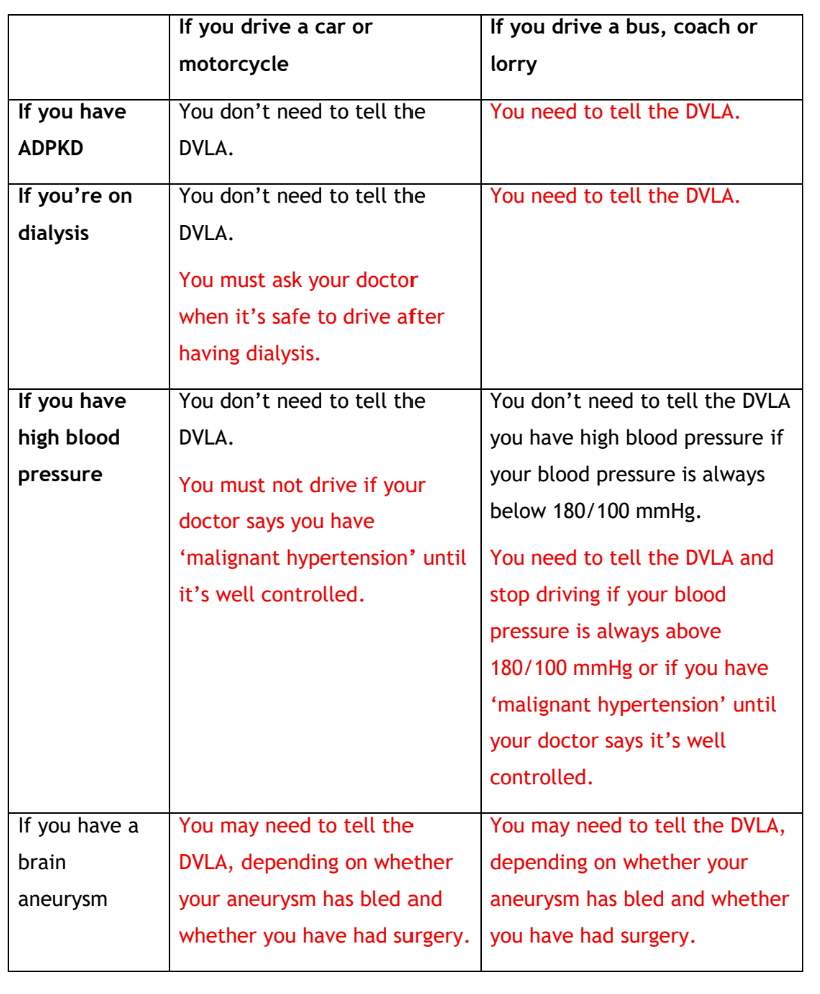
            Ask your doctor for advice and always check with the DVLA for full advice.

            What can I do to protect my kidneys?

            Follow our tips below to stay as healthy as possible and protect your kidneys.

            • Don't smoke

              Smoking can speed up kidney damage in people with kidney diseases. There have not been studies in ADPKD in particular. Smoking can increase your risk of a brain aneurysm and is bad for your general health.

            • Take blood pressure seriously

              High blood pressure can damage your kidneys. It can also increase your risk of having a stroke and heart problems. If you have high blood pressure, control it as well as possible by taking your blood pressure medicine and following your doctor’s advice on diet and lifestyle.

            • Eat healthily

              Dietitians don’t recommend a special diet for people with ADPKD unless they have low kidney function. A balanced diet can help you stay a healthy weight. This helps to slow down kidney damage and control your blood pressure.

              Eat less than 5 grams of salt a day. This helps to slow down kidney damage and control your blood pressure.

              You can drink alcohol but follow general NHS advice on safe amounts.

            • Exercise

              Dietitians don’t recommend a special diet for people with ADPKD unless they have low kidney function. A balanced diet can help you stay a healthy weight. This helps to slow down kidney damage and control your blood pressure.

              Eat less than 5 grams of salt a day. This helps to slow down kidney damage and control your blood pressure.

              You can drink alcohol but follow general NHS advice on safe amounts.

            • Drink plenty of fluid

              Experts think that drinking plenty of water (and other fluids) might slow down cyst growth and help to control blood pressure. While this isn’t proven, experts think it’s worth trying and unlikely to cause harm. Drink enough to stay well hydrated (meaning your wee is light in colour). Avoid having lots of drinks containing sugar or caffeine.

            • Use pain medications other than NSAIDs

              Don’t take non-steroidal anti-inflammatory drugs (NSAIDs) to treat pain and swelling. Examples of NSAIDs are aspirin, ibuprofen, Nurofen® and diclofenac. These medicines can damage your kidneys. Only use them if your doctor says it’s okay. Your doctor or pharmacist can suggest other pain medicines, such as paracetamol.

            What’s the chance of my child having ADPKD?

            If you have ADPKD, there’s usually a one in two (50%) chance you’ll pass it on to each child you have.

            Our cells contain thousands of genes. We have two copies of each gene — one inherited from our mother and one from our father.

            If you have ADPKD, you’ll have one altered gene that is causing your condition. The other gene copy is probably normal.

            When you have a baby, it’s down to chance whether your baby will inherit the normal gene or the changed gene. If they get the changed gene, they’ll have ADPKD.

            We show this in the diagram below using the PKD1 gene as an example.
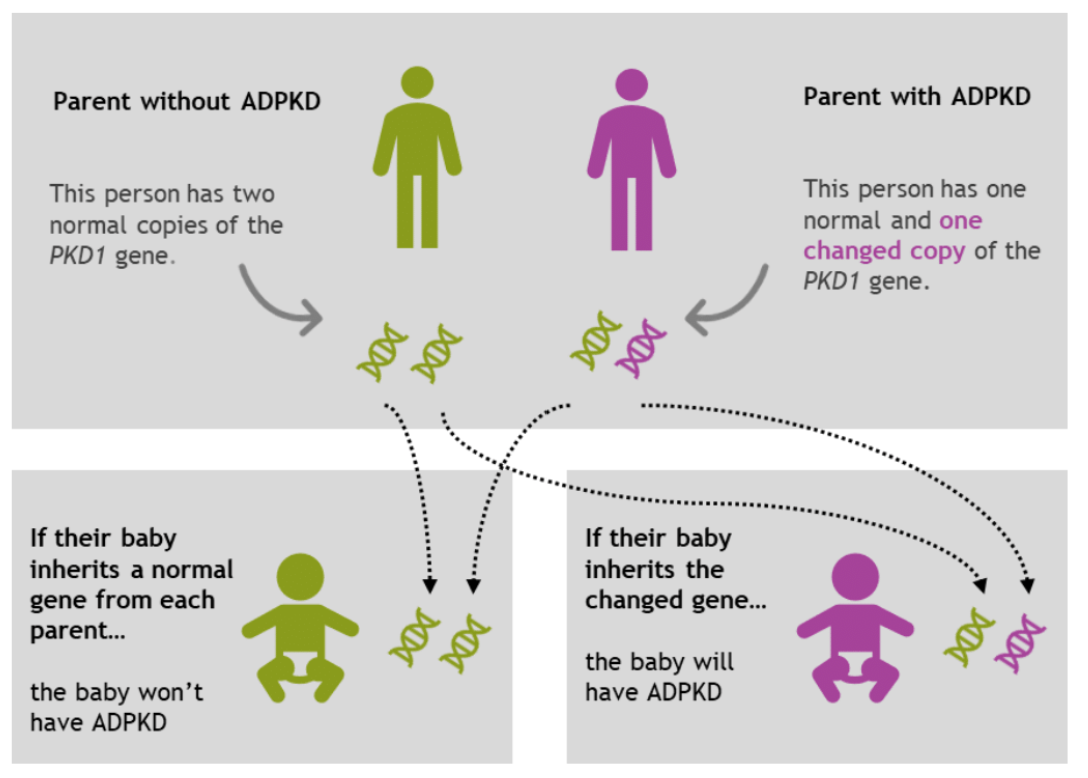
            Diagram showing how ADPKD is inherited, as explained in the text.

            Diagram: How ADPKD is inherited. To keep things simple, we only show the PKD1 gene in this diagram. If you have an altered PKD2 gene or a rarer gene causing your ADPKD, the chance of you passing the gene on to your child is usually the same.

            Nearly all people with ADPKD have a 50% chance of each baby having ADPKD. However, some people with de novo mutations can pass the gene on to their children and others can’t. Your kidney doctor or genetics specialist can explain this to you.

            Find out more on our webpage Genetic testing and counselling.

            Is there a way to have a baby without ADPKD?

            If you want to be sure you have a baby without ADPKD, ask your doctor about preimplantation genetic testing. This is a special type of in vitro fertilization (IVF) where the clinic tests a couple’s embryos for ADPKD. They then put an embryo without ADPKD into the mother’s womb.

            Find out more on our webpage ADPKD and pregnancy.

            Nearly all people with ADPKD have a 50% chance of each baby having ADPKD. However, some people with de novo mutations can pass the gene on to their children and others can’t. Your kidney doctor or genetics specialist can explain this to you.

            Find out more on our webpage Genetic testing and counselling.

            What research is being done on ADPKD?

            Researchers are studying ADPKD to better understand how it develops and how it can be treated. The PKD Charity helps to fund some of this research, sometimes in partnership with Kidney Research UK.

            We also help to fund:

            • A library of thousands of cell, tissue, and fluid samples from people with and without ADPKD (The PKD Bioresource Bank). Researchers can ask to use the samples for their studies.
            • A registry of people with ADPKD, which collects data on their health and how their ADPKD progresses over time. This ADPKD Patient Registry is helping us to better understand ADPKD.

            If you’re interested in joining the ADPKD Patient Registry, please email us at [email protected].

            You can find out more about ADPKD research in our Research web area.

            More from the PKD Charity

            • Our website has a wealth of information on ADPKD, including symptoms, treatments, and living well.
            • You’ll also find videos from educational events, including ‘Newly Diagnosed with PKD – a Q&A’ with kidney specialist Dr Matthew Gittus.
            • Find out about upcoming educational events on our website.
            • For printed information, emotional support and practical advice, contact our confidential Helpline. Call 0300 111 1234 (weekdays, 9.30 am to 5.00 pm, except bank holidays), email [email protected] or use Facebook messenger.

            Information and support from others

            • Kidney Care UK provides emotional, practical, and financial support to people with kidney disease.
            • The National Kidney Federation supports people with kidney disease in the UK. They can connect you with another person with experience of kidney disease for support.
            • Kidney Research UK has information on kidney disease and research.
            • InfoKID provides information to parents and carers of babies, children, and young people with kidney disease.
            • The NHS website has information on a wide range of health topics.

            The photos on this webpage are freely available on Pexels.com. The medical history of the persons shown is unknown.

            Authors and contributors

            Written by Hannah Bridges, independent medical writer, HB Health Comms Limited. Reviewed by Osasuyi Iyasere, Consultant Nephrologist, University Hospitals of Leicester NHS Trust, and Honorary Senior Lecturer, University of Leicester.

            With thanks to all those affected by ADPKD who contributed to this publication.

            Ref No: ADPKD.IWTKM.V3.0

            Last updated: September 2025

            Next scheduled review: September 2028

            Disclaimer: This information is primarily for people in the UK. We have made every effort to ensure that the information we provide is correct and up to date. However, it is not a substitute for professional medical advice or a medical examination. We do not promote or recommend any treatment. We do not accept liability for any errors or omissions. Medical information, the law, and government regulations change rapidly, so always consult your GP, pharmacist, or other medical professional if you have any concerns or before starting any new treatment.

            If you don't have access to a printer and would like a printed version of this information sheet, or any other PKD Charity information, call the PKD Charity Helpline on 0300 111 1234 (weekdays, 9am–5pm) or email [email protected].

            The PKD Charity Helpline offers confidential support and information to anyone affected by PKD, including family, friends, carers, newly diagnosed individuals, or those who have lived with the condition for many years.

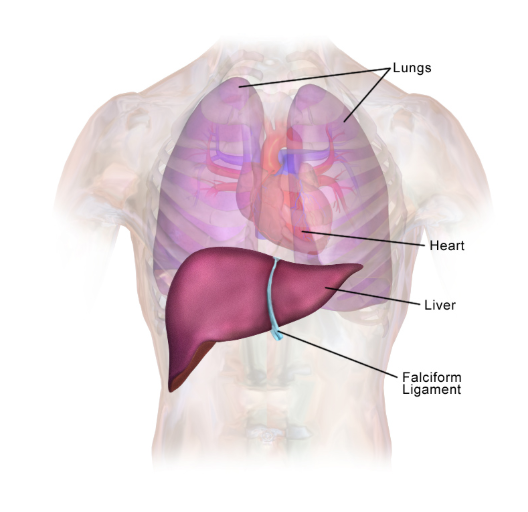
            Read more …ADPKD basics

            ADPKD

            ADPKD

            Autosomal dominant polycystic kidney disease

            ADPKD

            Autosomal dominant polycystic kidney disease

            Autosomal dominant polycystic kidney disease (ADPKD) is the most common inherited kidney disease affecting over 12 million people worldwide and up to 70,000 in the UK. It's estimated that between 1 in every 400 to 2,500 people has the disease. It can affect women and men equally, across all ethnic groups.

            Read more …ADPKD

            Feedback

            We welcome feedback on the information provided on this webpage. If you have any feedback regarding the information provided on this webpage, please complete the Feedback Form